
Light and small SUVs are booming. While they’re often based on hatchback passenger car architectures, SUVs are always more expensive than their derivatives. So, which city-sized models have the least ‘SUV tax’ charge?
It is inevitable that you will buy – or at least consider – a sports utility vehicle (SUV) in your life. SUVs make up nearly 40 per cent of the car market in Australia as at the first half of 2021.
Particularly, strong demand has been accelerated by the advent of light and small urban crossover SUV models from nearly every carmaker in the world. They feature a slightly higher driving position for a better sense of security on the road among a sea of other SUVs, utes and trucks.
These city-sized SUVs take the form of conventional passenger car hatchbacks – but slightly lift the ground clearance, jack up seating positions, add plastic cladding trims all-round the exterior, bolster some body panels for a tougher look, and maybe even add part-time all-wheel-drive.
However, they are often more expensive than their donor hatchbacks – coined the ‘SUV tax’.
Here, I compare the cost of the latest light and city SUVs with the most equivalent hatch from each brand. Not all carmakers have a comparable hatch equivalent; therefore, they are listed at the bottom of this article.
EDITOR’S NOTE: All models analysed are entry-level trims, with an automatic transmission, and prices listed are before on-road costs without options (unless otherwise stated). Pricing will differ for drive-away costs and are subject to change depending on running model years.
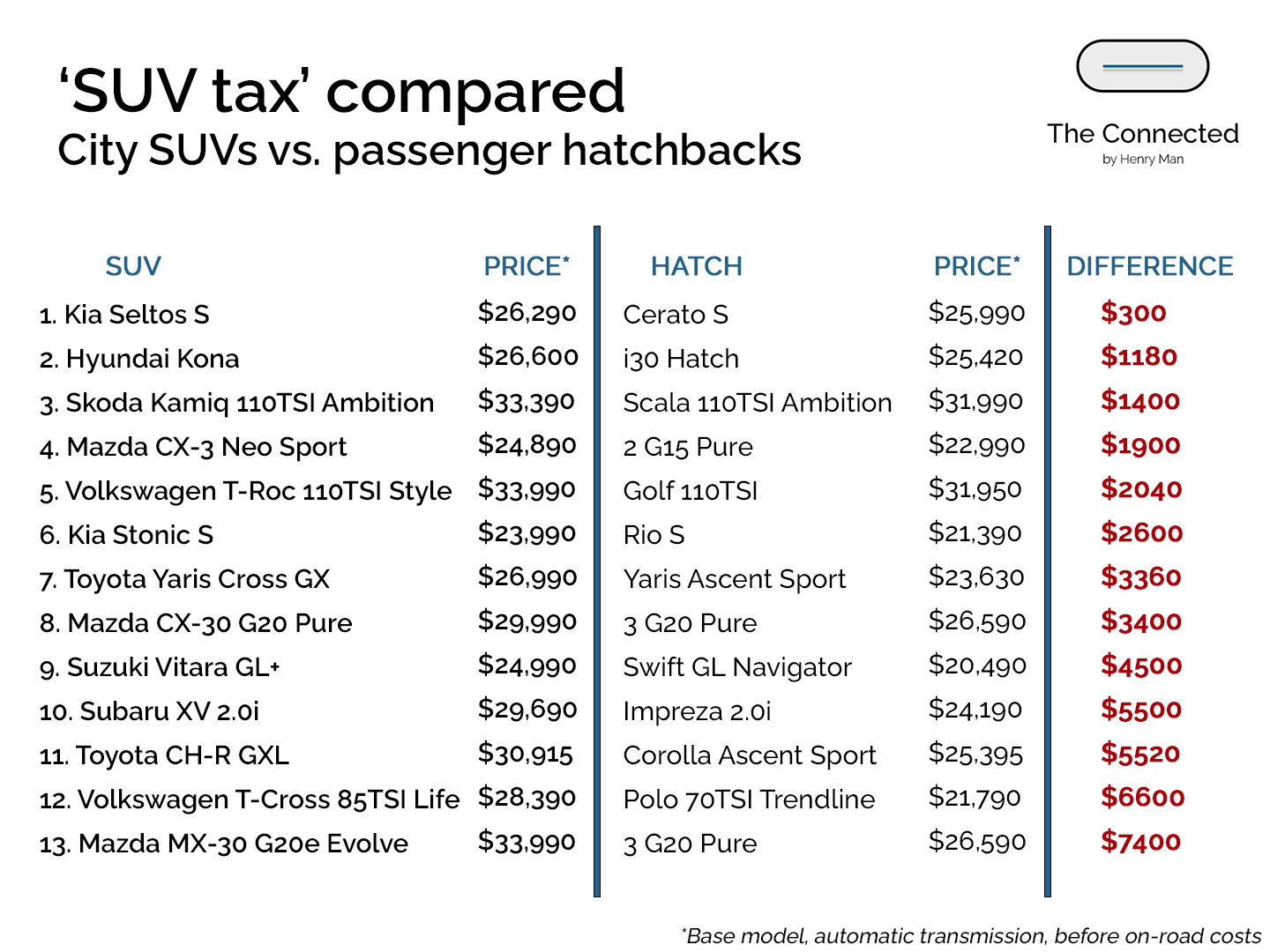
1. Kia Seltos: +$300
Kia is on a roll with the Seltos small SUV. It is the Korean firm’s second-best selling model in Australia, just ousted by the Kia Cerato hatch and sedan on which it’s based. The base 2021 Seltos S with an automatic transmission is just $300 more than the equivalent 2022 Cerato S, placing it at the top of the podium when it comes to the least SUV tax.
It’s worth noting, though, that Kia often has national drive-away offers. As at publication, a more sizeable $2300 separates the two siblings in terms of drive-away pricing, the definitive cost buyers will pay.
At 177mm, the Seltos’ ground clearance is 37mm higher than the Cerato. The Seltos is also 170mm higher, but 140mm shorter in length and a 70mm shorter wheelbase versus the Cerato hatch. It’s width is identical, ditto the turning circle. The Seltos features a 468-litre boot with all seats in place, which is up 40-litres from the Cerato hatch thanks in part to a boxier rear.
A mid-life facelift for the Seltos is expected in 2022, bringing more advanced safety features, some tweaked styling, and the illusive new Kia logo to match the just-updated Cerato. Unsurprisingly, it should cost more, so don’t expect the Seltos to retain its top SUV tax position soon.
2. Hyundai Kona: +$1180
The Hyundai Kona just received a mid-life nip and tuck for the 2022 model-year. While its platform is not explicitly linked to the Hyundai i30 Hatch, it is the most comparable in the line-up. Only $1180 separates both entry-level models.
The Kona features a 170mm ground clearance – up 30mm from the i30 – is 110mm higher and 5mm wider, albeit with a 135mm shorter length and 50mm shorter wheelbase.
Both models have the same turning circle, though.
Hyundai’s crossover SUV has a 374-litre boot capacity, which is 21-litres smaller than the i30 Hatch.
3. Skoda Kamiq: +1400
Skoda’s late entrant into the small SUV market, the Kamiq, lobbed in Australia alongside with its Scala hatch derivative at the start of 2021 after lengthy delays caused by an electrical fault preventing it from being sold. The Volkswagen Group’s MQB A0 platform sits beneath both cars. Currently, the Kamiq 110TSI Ambition is $1400 more than the base Scala 110TSI Ambition.
Skoda’s small SUV crossover is 39mm higher off the ground than the Scala at 188mm of ground clearance. Its overall height is 60mm taller, though it has the same width, is 121mm smaller in length, but only has a 2mm longer wheelbase. However, the Kamiq’s boot space is 67-litres tighter than the Scala’s rear.
The Kamiq launched with a hit, to the extent that it has sold out of its base 85TSI Ambition model this year due to high demand and the semiconductor shortage. As a stopgap, the Czech brand has introduced a more powerful and pricier 110TSI base model, which is described here.
Expect the price gap to further narrow when it re-launches the Kamiq 85TSI motor next year.
4. Mazda CX-3: +$1900
Despite launching in 2016, the Mazda CX-3 remains a strong seller in the light SUV segment in Australia thanks to light facelift in 2019 and running model changes over the years. It is based on the Mazda 2, which is available as hatch and sedan body styles. Only $1900 separates the two Mazda’s.
The CX-3 only has a 3mm higher ground clearance at 155mm, with a 70mm wider body, 40mm taller overall height, and 210mm longer length than the 2 hatchback. Both the CX-3 and 2 have the same wheelbase length. Despite this, the crossover SUV has a 14-litre larger boot capacity.
Surprisingly, the Mazda 2 is more maneuverable with a 9.4-metre turning circle as opposed to the CX-3’s 10.6-metre turning circle.
Despite its age, a new-generation CX-3 is up in the air, but there were rumours of an all-new Mazda 2 to debut this year. The Japanese automaker plans to launch five hybrid, five plug-in hybrid, and three battery-electric models between 2022 and 2025 using a new SkyActiv Multi-Solution Scalable Architecture.
5. Volkswagen T-Roc: +$2040
The iconic Volkswagen Golf gained a belated (at least in Australia) SUV sibling earlier this year with the T-Roc small crossover SUV. Unlike the newest Golf Mk8 hatch and wagon, the T-Roc still shares its underpinnings with the old Golf Mk7.5’s MQB A1 platform. Nevertheless, it is $2040 dearer.
With a 161mm ground clearance, the T-Roc is 27mm higher off the bitumen than the Golf hatch. The overall height of the crossover SUV is 117mm higher, 30mm wider, but 50mm shorter in length. That corresponds to the wheelbase, measuring in at 33mm shorter. The T-Roc, though, has the upper-hand for boot volume, with a whopping 71-litres more than the Golf.
Turning circle is also different, with the Golf at 10.9-metres as opposed to the T-Roc at 11.1-metres.
A subtle facelift for the T-Roc has been spied overseas and is expected to lob Down Under in the second half of 2022, alongside a new hi-po T-Roc R variant.
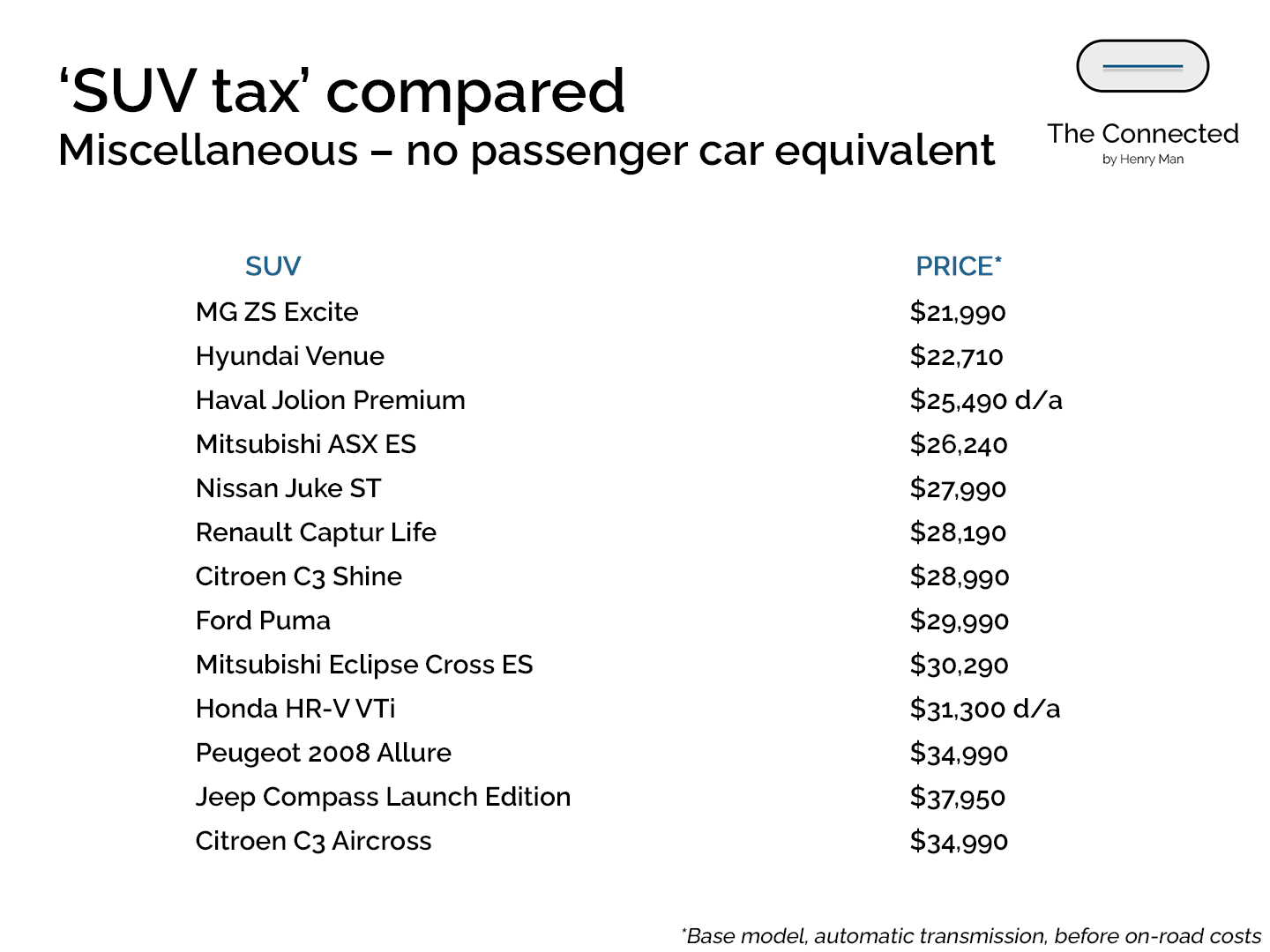
Honourable Mentions
While these models may represent the least SUV tax, countless other crossovers couldn’t be compared.
Due to the boom of SUVs globally, many carmakers have ditched conventional passenger car hatchbacks and sedans in favour of having an SUV-only range. As such, these are listed below.
Notable models include the Chinese-born MG ZS, newcomer Haval Jolion, and evergreen Mitsubishi ASX which represent good value propositions in the city SUV segment.

 The Connected by Henry Man