
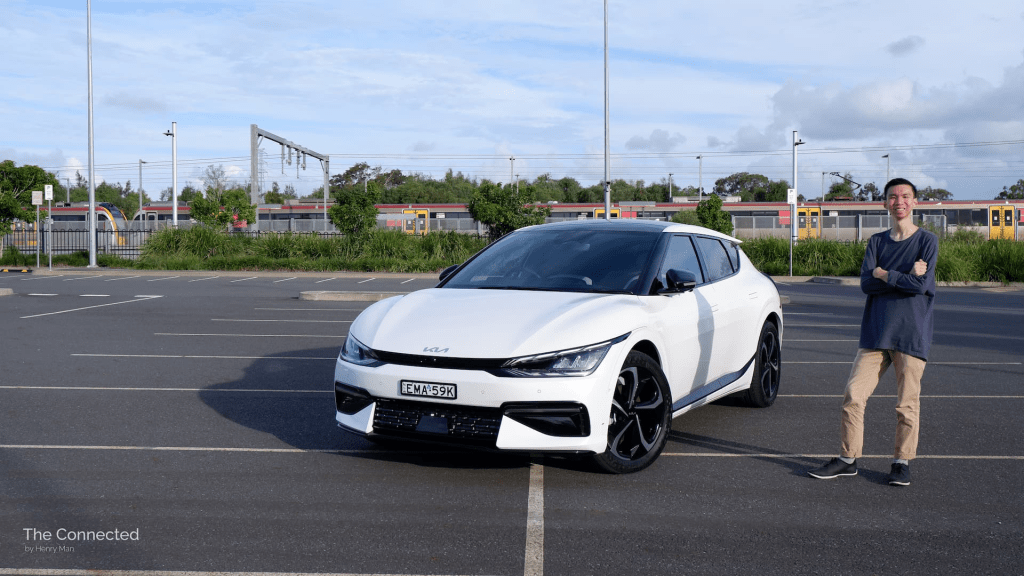
I’ve been writing about electric vehicles for years – and now I’ve finally driven one.
Through my work at zecar, I’ve been fortunate enough to be offered a loan by Kia Australia in April of their new ground-up EV6 crossover in the top-spec GT-Line all-wheel drive (AWD) guise for one-week for an independent review.
It was a great first experience, especially with a relatively expensive and attractive EV that’s virtually sold out for two years. But here, I reflect on my week living with an EV – the good and bad – and what it means for the future of mobility.
It’s just a car.
Electric cars have been seen as a binary, alien eco-warrior threat that will destroy the local economy, jobs, the electricity grid and the sole passion of driving heads and tradies alike – especially in the political agenda.
But EVs are just another car.
It still gets people from A to B, just powered by another form of ‘fuel’ that’s cleaner, cheaper and more efficient than what we’ve been driving around in for more than a century. What gives?
Knowing that I was driving a vehicle that didn’t emit any harmful tailpipe pollutants is self-satisfying and made me feel superior on the road. However, as an EV driver, I became more acutely aware of the old diesel-guzzling SUVs and utes that still dominate Australian roads and continue to idle their engines in car parks.
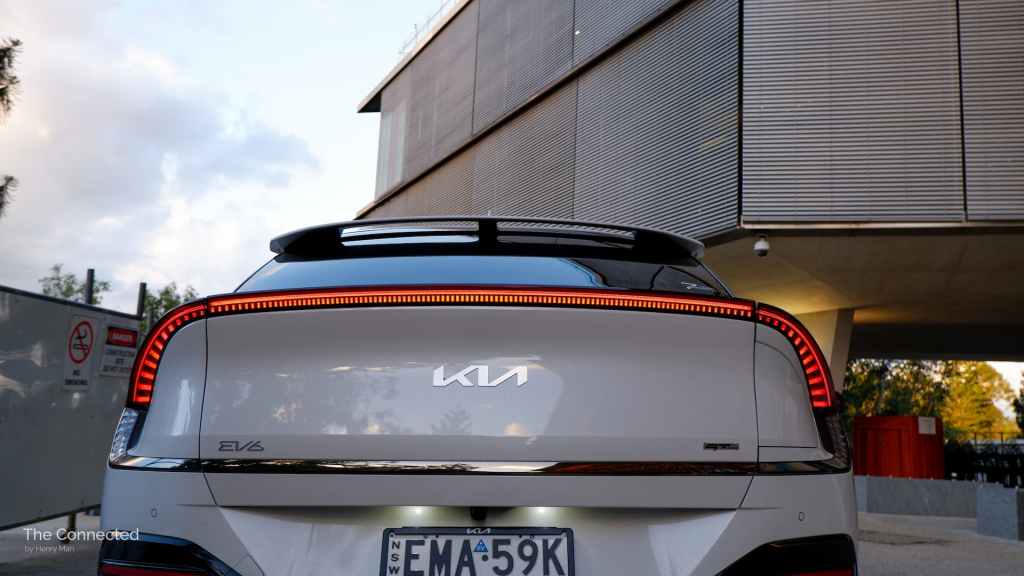
Over my week of driving the Kia EV6, it’s really encouraging to see people turning their heads, taking photos, and even stopping by to have a quick chat with me (someone who can’t remotely afford it by the way).
It might be because of its rarity of 600 examples earmarked this year or photogenic full-width rear light bar spoiler, but it’s clear that many Australians are interested in pure-electric cars. I’m not sure about the Tesla Model 3 driver who poked his tongue at me while driving alongside in the tunnel, though…
Thanks to the added front electric motor on the EV6 GT-Line AWD, there were some scintillating futuristic whirring sounds piping through into the cabin. It’s like driving a spaceship.
What else can I say? It drives just like any other car – but with a few differences and some additional benefits…

Confidence-inspiring.
Admittedly, environmental sustainability wasn’t top-of-mind in my week of driving the EV6.
Without the need to wait for an engine, pistons and gears to kick in, the rapid acceleration of electric motors are confidence-inspiring.
The instant response to my right foot allowed me to easily seize opportunities – quickly enter a gap in the roundabout, change lanes before the fork, and leave everyone in the rear-view mirror from the lights.
That’s benefited by the GT-Line AWD’s healthy 239kW of power and 605Nm of torque that can accelerate from 0-100km/h in a claimed 5.2 seconds. Even affordable models like the MG ZS EV can nip from 0-100km/h in a respectable 8.6 seconds.
It’s like going from an Apple iPhone 6 to the 13 or jumping from the National Broadband Network (NBN) failure to cellular 4G/5G.
Having 100 per cent of power and torque on tap anytime is not only a performance-head selling point; I’d argue a critical safety feature.
EV’s heavy battery packs have been proven to improve structural safety by enabling a lower centre of gravity. The conventional petrol-powered MG ZS small SUV achieved a four-star ANCAP safety rating under the 2017 testing criteria, whereas its pure-electric guide obtained the full five-stars under the stricter 2019 criteria.
We know sustainability is difficult to communicate because it isn’t always tangible. Not everyone cares about high performance numbers if you’re stuck in traffic chaos all the time. People also look at how vehicle purchases impact their bank accounts imminently now, rather than five to 15 years later in total cost of ownership to ‘break even’ in price parity.
It’s time to reframe electric cars as safer vehicles.
Charging gripes.
If you don’t have access to a three-pin power point at home (or if your mum persists to keep her old Hyundai i20 in the one-car garage), then relying on public EV charging infrastructure is your only choice.
With the EV6 GT-Line AWD’s 424km tested real-world range (484km WLTP claimed), I didn’t get much so-called ‘range anxiety’ – just a lot of glancing at the battery percentage.
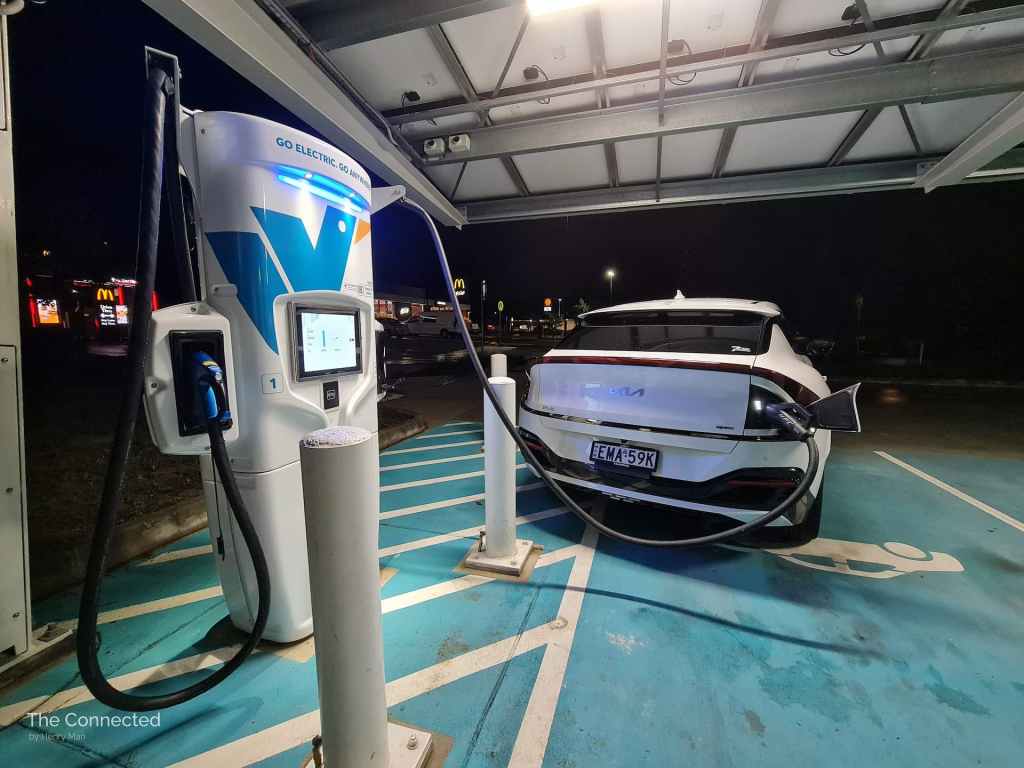
First, I headed to my nearest 350kW ultra rapid DC charger – two Evie Networks stations at Cochin Creek, just south of the Sunshine Coast – to truly test out the EV6’s 800-volt 240kW DC capabilities. After driving for one-and-a-half hours from the city and into the highway, I was boldly pushing the crossover to 10 per cent on arrival – with no hesitation of using eco mode.
Since the charge port is uniquely at the rear-right of the tailgate, it was logical to choose the stall located at the back of the parking spot. Plug in, pull out the phone and activate the session via the app… The EV6 voices “charging failed”.
After multiple attempts, I assumed it was another classic case of another faulty Brisbane-made Tritium charger, so I changed to the stall next to me. However, getting the cable to reach the EV6 was difficult as it’s positioned at the side of the parking bay seemingly designed to be trailer-friendly. Reversing in, front in, back half in – all couldn’t reach the awkwardly placed EV6 charge port. Thankfully, in the end I disobeyed convention, parked at an angle, stepping on the painted zebra lines and plugged in. Yet, it still would refuse to activate the charging session. Deja vu.
Then, an epiphany happened. The endless hours of watching YouTube creator Bjorn Nyland videos paid off. Since Tritium’s PK350 charger has thick and heavy water-cooled cables, it tends to sag its weight down once plugged-in. So, similar to keeping a firm grip at the fuel bowser, I had to push up and in to ensure the top portion of the CCS2 connector, the Type 2 port which is responsible for ‘handshaking’ with the EV, had a connection. Success.
While it took 30 minutes to start the charger, it only took 18 minutes for the EV6 to reach 80 per cent – exactly matching Kia’s claim. Check out the full charging curve in my review for zecar.
Second, I took a final top-up before handing the keys back at the four 50kW Evie Networks hub at Skygate within the Brisbane Airport Corporation precinct.
Again, I couldn’t start the charging session and quickly moved to another stall, but to no avail. It was also next to a noisy high pitched sprinkler system making the experience unpleasant. Amid the glaring sun, I noticed flashing lights from the Tritium unit’s start/stop button when I initiated charging via the mobile app, pressed it and succeeded! There weren’t any instructions displayed with the Evie Networks app and no one mentioned it in the Plugshare community.
As an EV charging newbie, it was an interesting experience to explore the challenges public charging infrastructure faces. Should we have a standard vehicle charge port and station stall placement? Do we really need traditional parking spot lines? Should there be clearer instructions from charging providers to start and troubleshoot a session? And how can we ensure public safety and accessibility for all at EV charging locations?
After exploring Skygate and giving in to Woolworths for food (ultimate cheapskate here), 50kW was already fast enough to juice the EV6 from around 30 to 80 per cent in an hour.
Final thoughts.
Walking back to the rather isolated Evie Networks hub, it was really encouraging to see all four stalls in use by different, unique electric car models – I was joined by the Hyundai Ioniq Electric, Mini Electric and, of course, the Tesla Model 3. An MG ZS EV also came in later and I was obliged to give way.
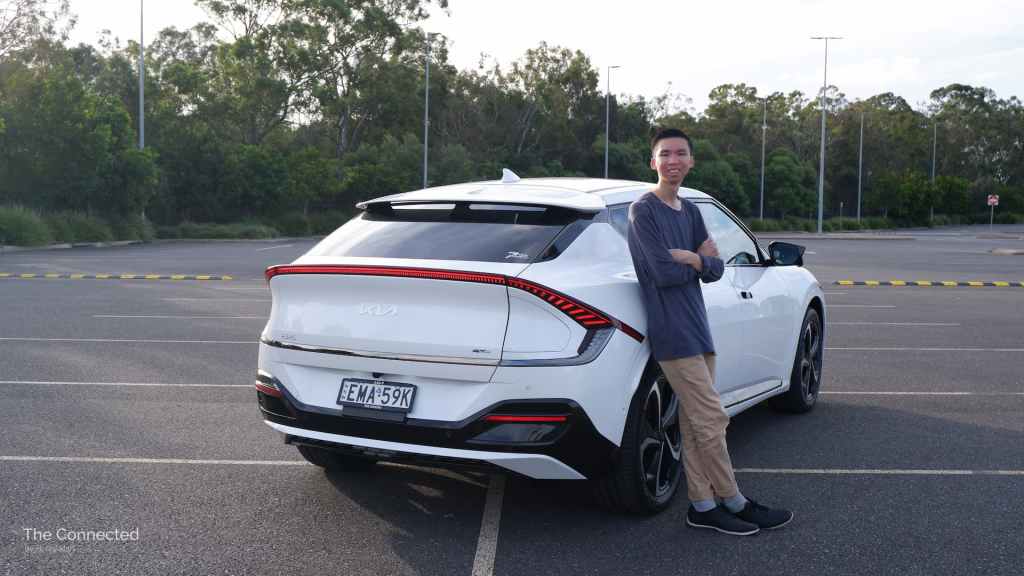
It was a fitting end to the week – and a sign of what’s coming in the e-mobility industry – with the Kia EV6 GT-Line AWD loan (which was also my first press vehicle).
Yet, we also know the solution to this current ‘wicked problem’ doesn’t lie in private vehicles, with Australians only travelling around 34km per day on average.
It is about encouraging a more sustainable multi-modal transport system (public, shared and active) and transitioning always-moving commercial vehicles, including the aviation industry, to an emissions-free solution for a healthier environment and improved public health. That is where the true critical impact (or lack thereof) is in this mobility revolution.
Read my full review of the 2022 Kia EV6 GT-Line AWD at zecar. Thank you to Kia Australia for the seven-day press vehicle loan.
Follow Henry Man on LinkedIn, Instagram and Twitter.
For further information about Henry Man, click here.

 The Connected by Henry Man