
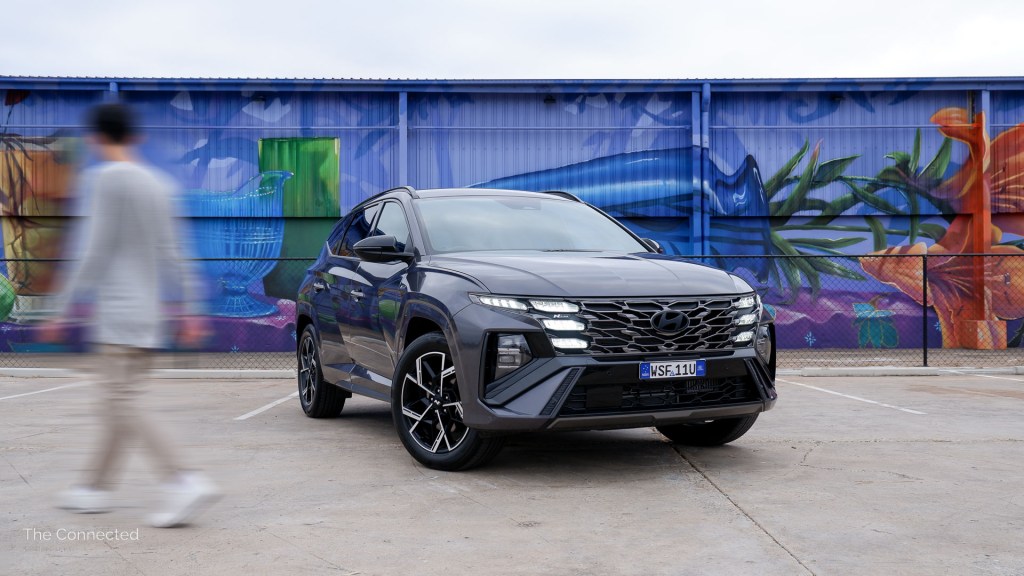
The popular Hyundai Tucson has been refreshed. But with prices now topping out at more than $60K drive-away, is this popular medium SUV still worth shortlisting?
Introduced in 2021, the fourth-generation Tucson has now gained a midlife facelift for 2025 with the same super edgy design, an overhauled interior, and more advanced connected technology.
Crucially, a frugal petrol-electric hybrid option is now available across the range with a $4000 to $6000 premium.
The choice of medium family SUVs are almost endless, from the Toyota RAV4, to the MG HS and Mazda CX-5, so what makes the Tucson stand out to so many Australians?
I tested the mid-spec Tucson Elite Hybrid with optional all-wheel drive (AWD) to see why it’s Hyundai’s most popular model.
NOTE: The press vehicle was provided by Hyundai Australia for a seven-day independent evaluation. We have no commercial arrangements with the company and it had no editorial control.


Pros.
+ Family-friendly interior
+ Frugal hybrid powertrain
+ Less intrusive safety tech
+ Adaptive LED headlights
+ Much improved interior
Cons.
– High specs are expensive
– Too-low rear indicators
– Interior quality could feel better
– Touchy regen braking
– Shorter servicing intervals
Vehicle tested:
| Model | 2025 Hyundai Tucson |
| Variant | Hybrid Elite N Line AWD |
| Starting price | $51,100 before on-road costs |
| Exterior colour | Titan Grey (+$595) |
| Interior colour | N Line black leather and suede with red highlights |
| Country made | South Korea |
Design and quality.
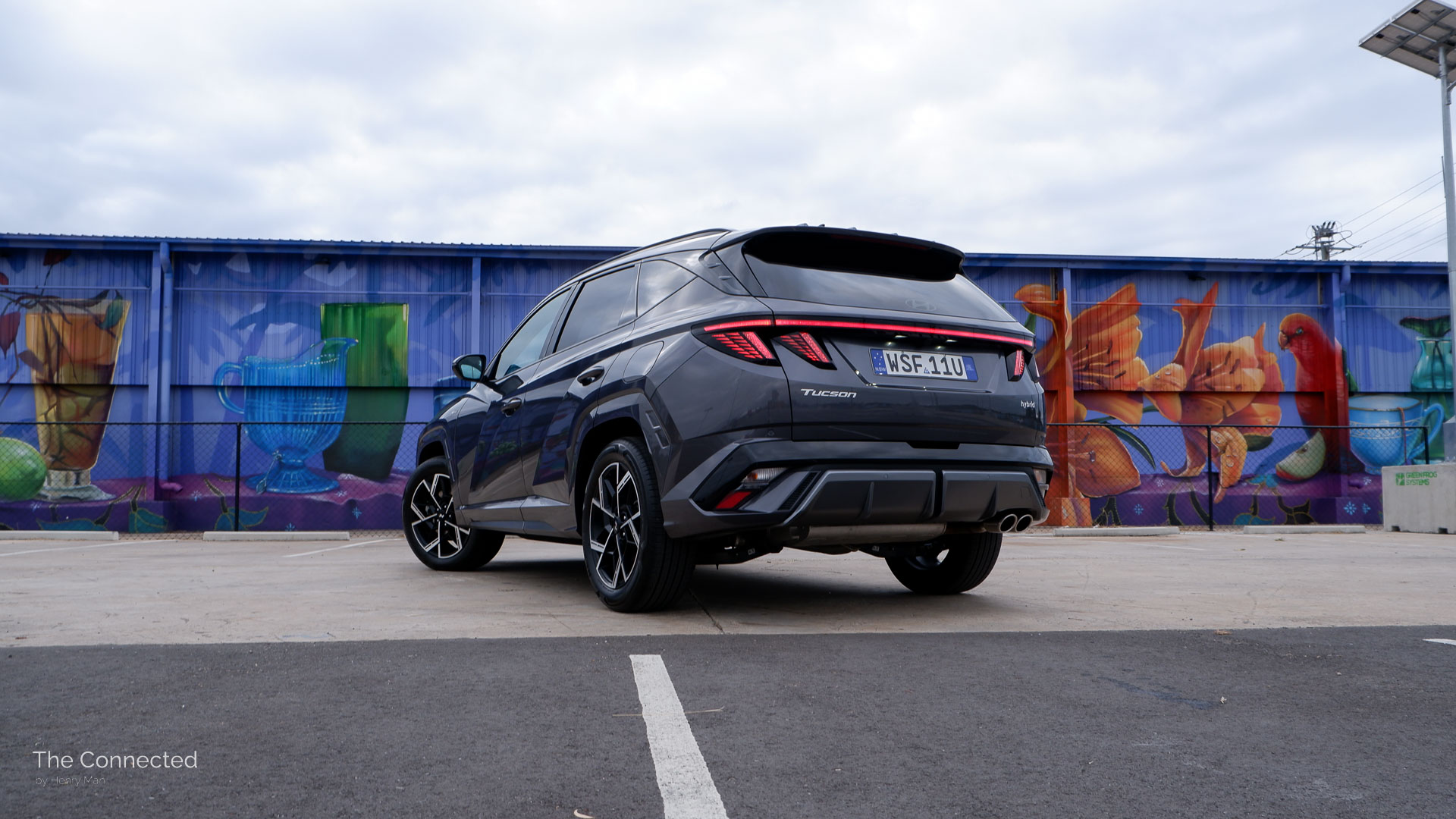
The facelifted 2025 Hyundai Tucson doesn’t look as different from the outside, but the interior has been redesigned for the better.
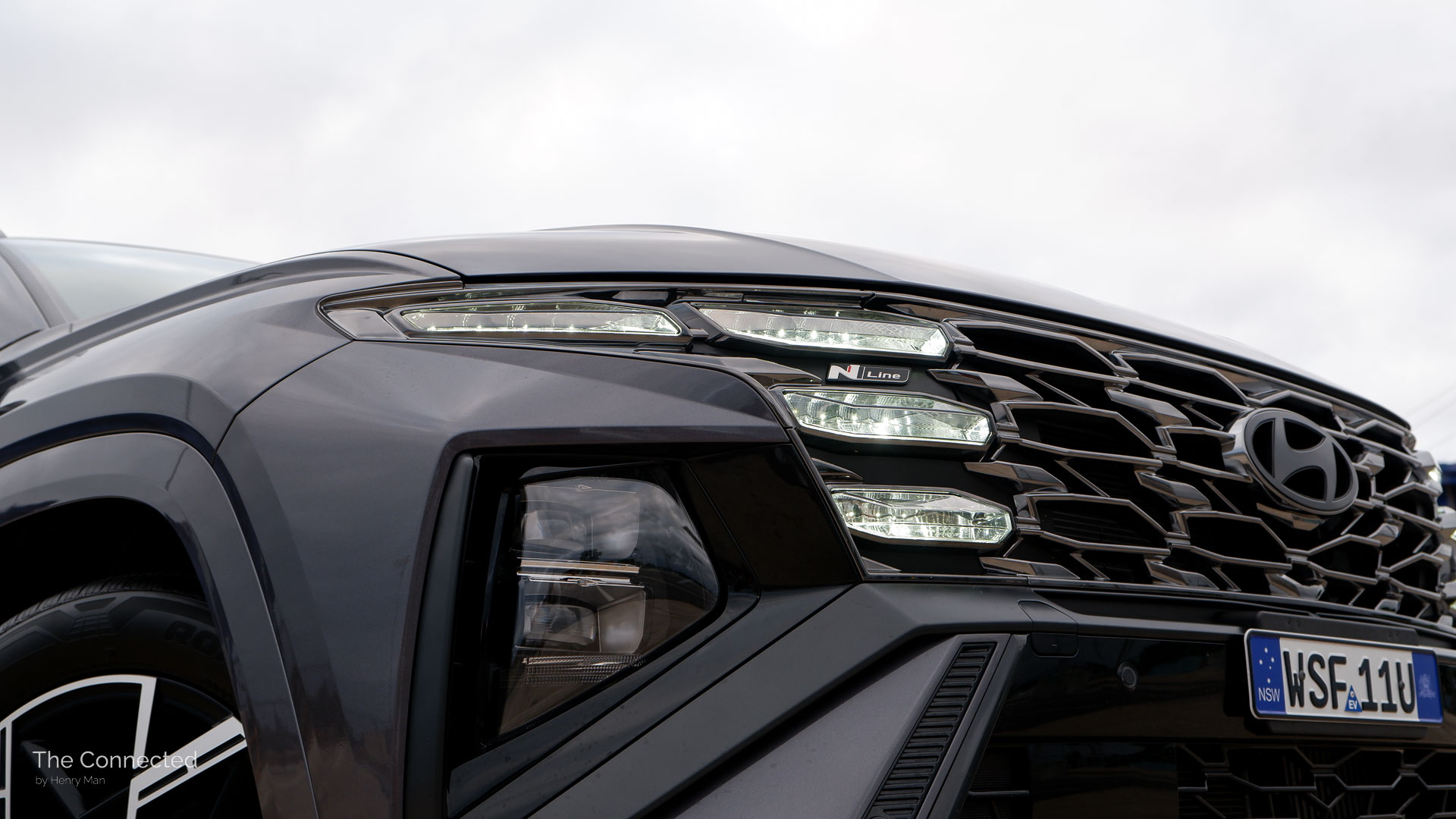
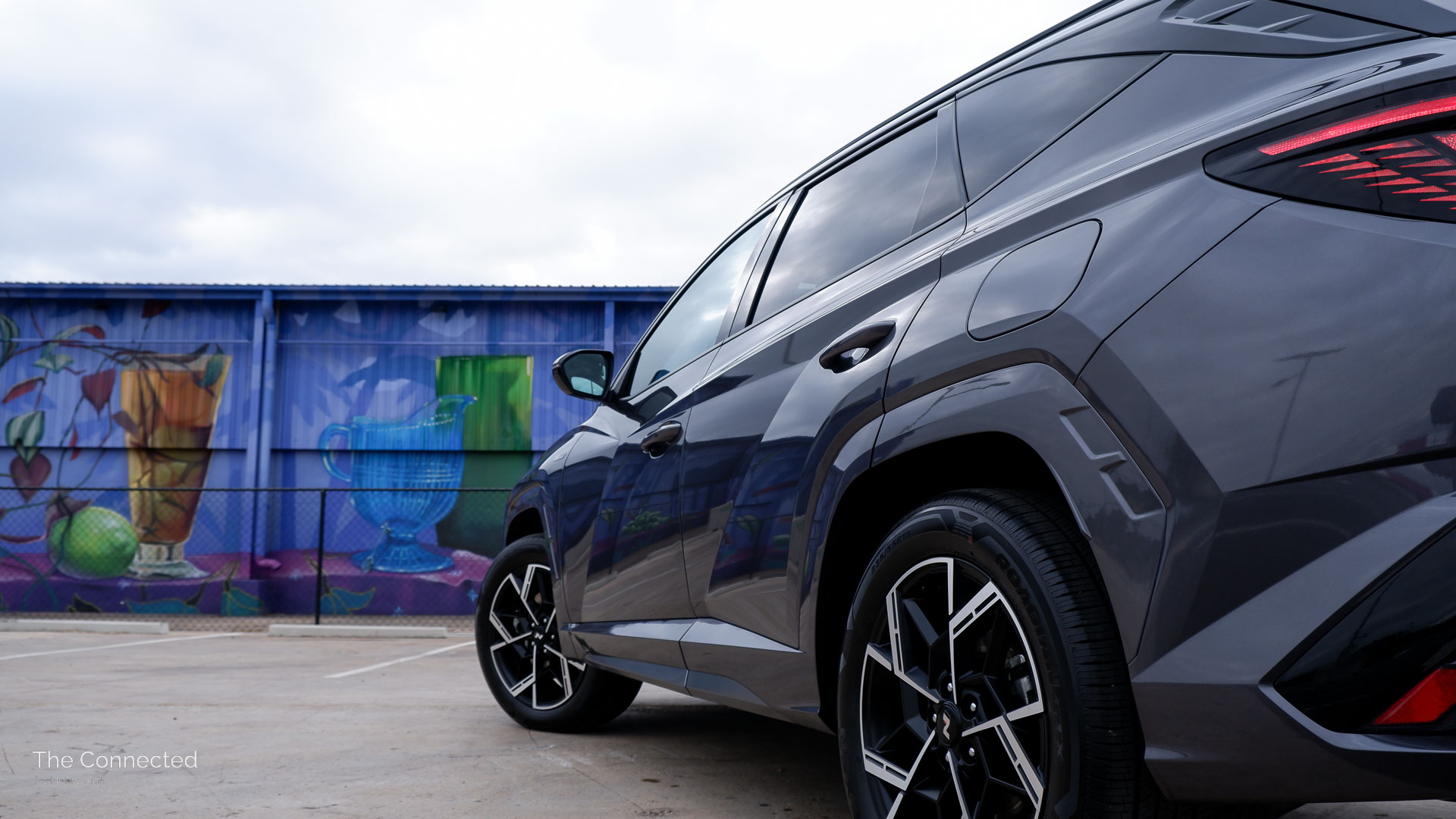
The South Korean carmaker hasn’t fettled with the Tucson’s exterior as much with updates limited to larger and fewer daytime running light blocks, slightly fettled front and rear bumpers, new wheel designs, and flat badges.
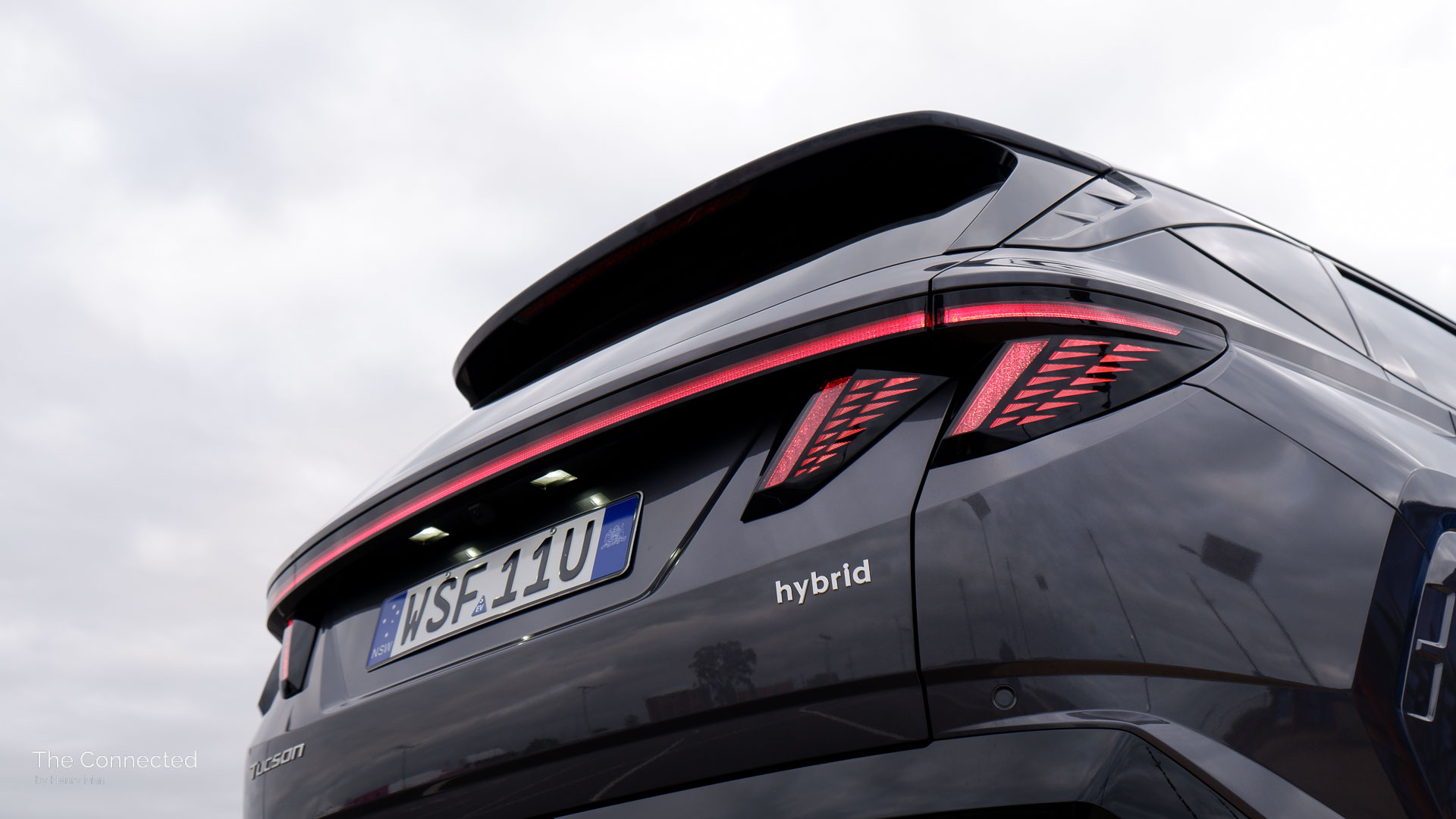
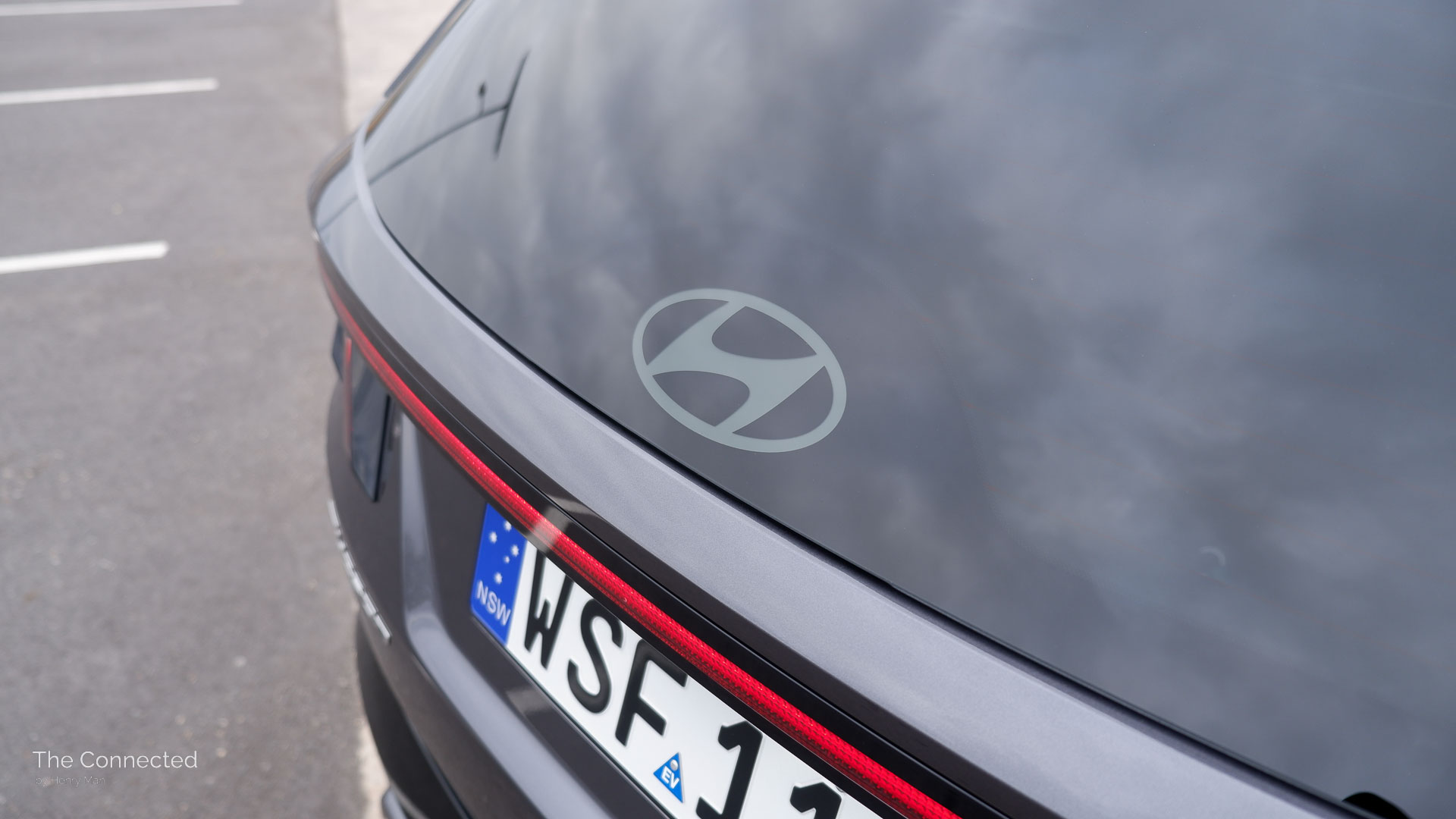
Its edgy exterior design isn’t as controversial as it once was with the same sharp side body creases, Peugeot-esque tail-light bar claws with the Hyundai logo hidden underneath the tailgate glass, and front grille scales. The Tucson midsize SUV doesn’t look boring and generic.
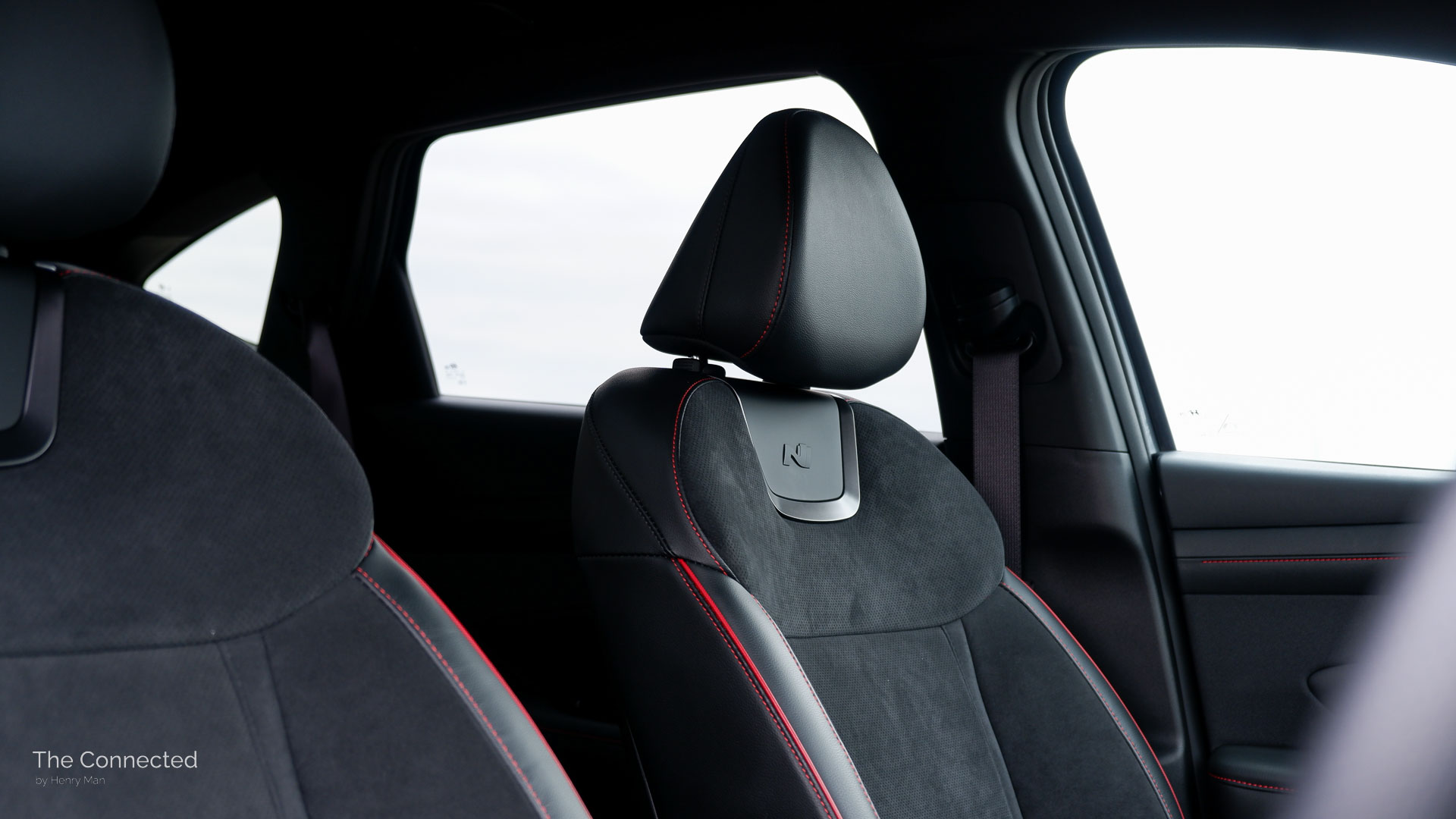
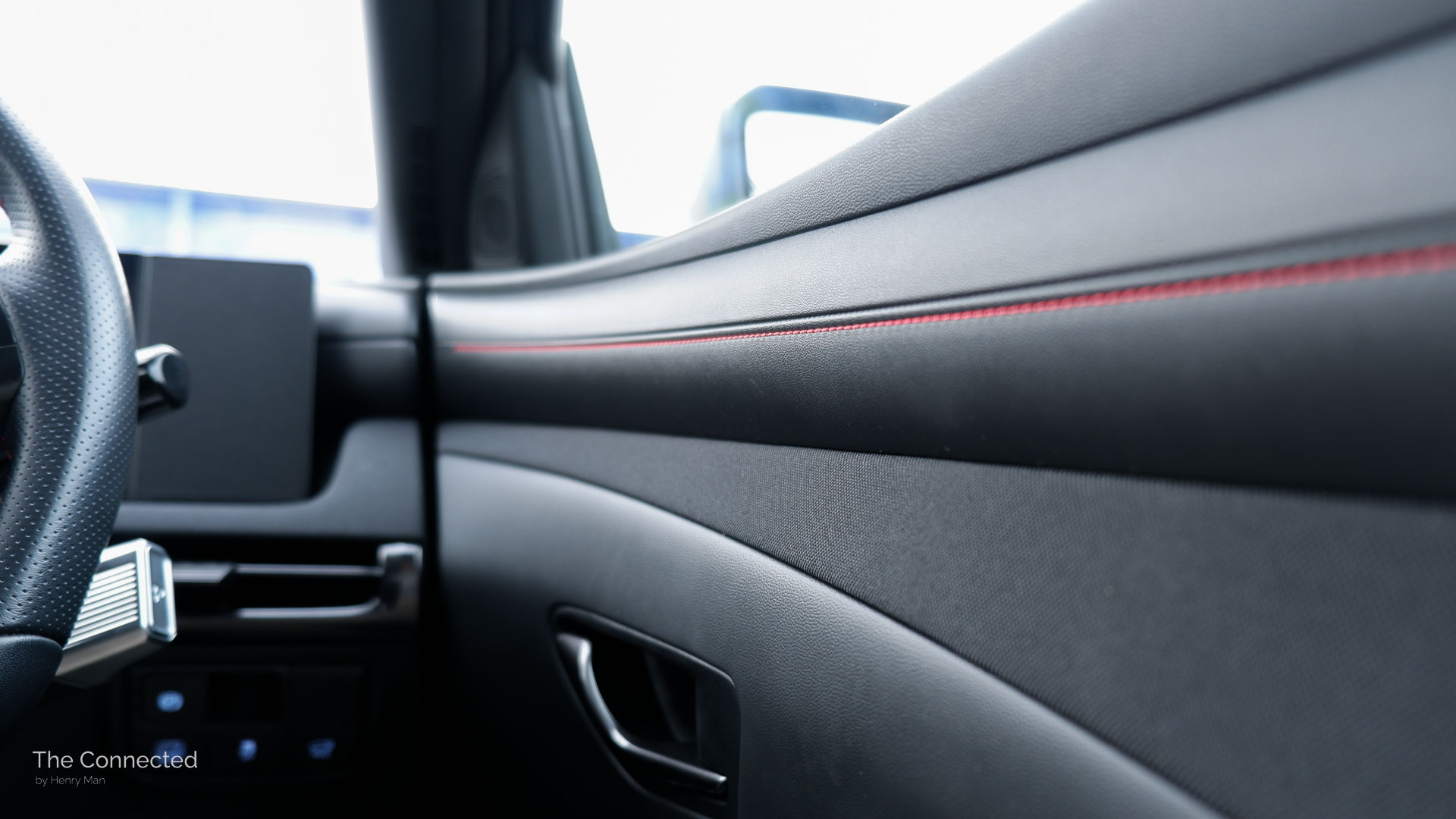
The optional N Line package adds an even sportier touch with different gloss black bumpers, complex-looking 19-inch alloys, matte black badges, and black leather and suede seats with red stitching and piping.
The key benefit for paying between $1500 to $4000 more (depending on the variant) is the fact that adding the N Line option on the base Tucson looks and feels identical to adding it on the top-spec Premium, even though it costs more on the former.

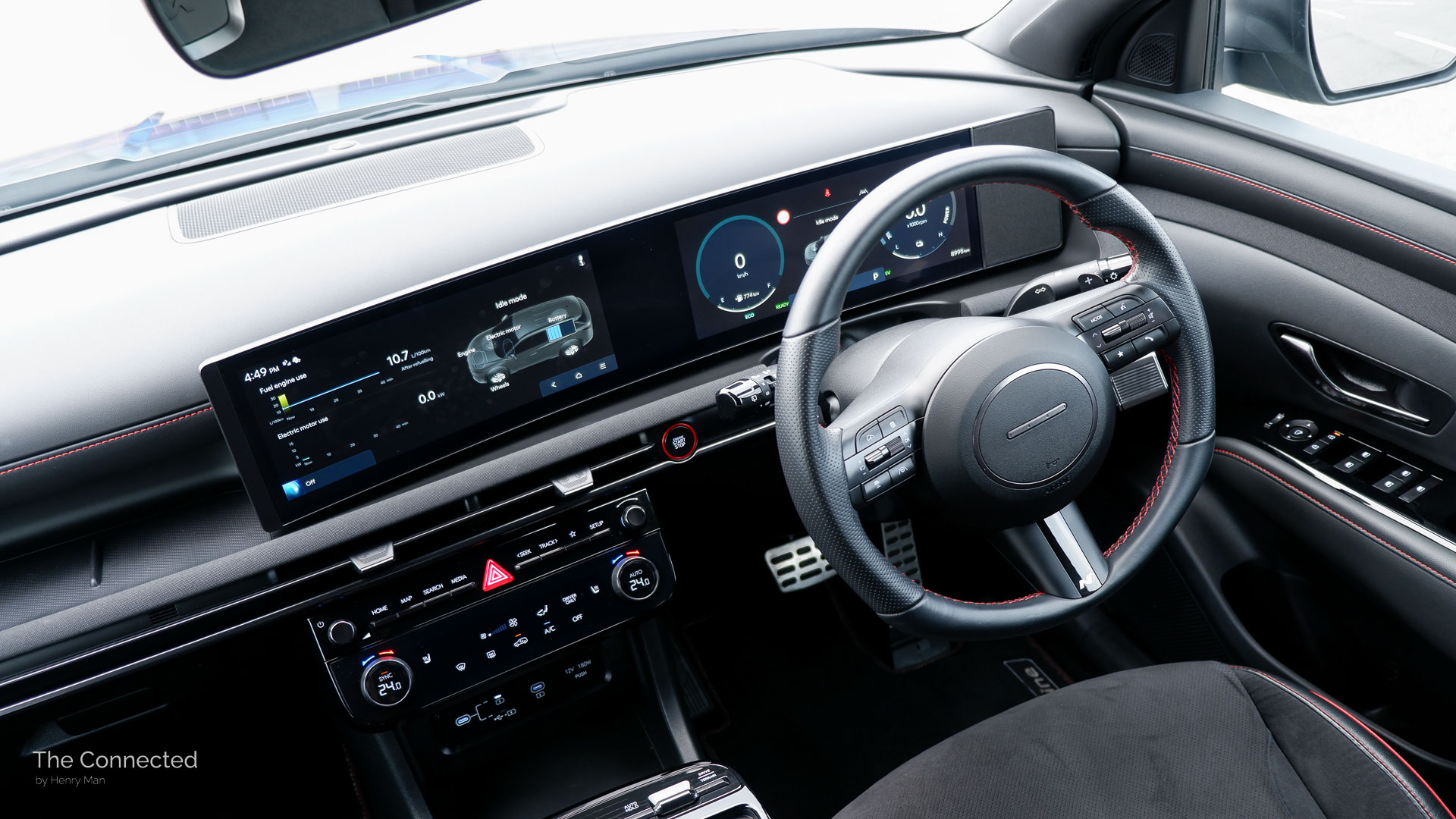
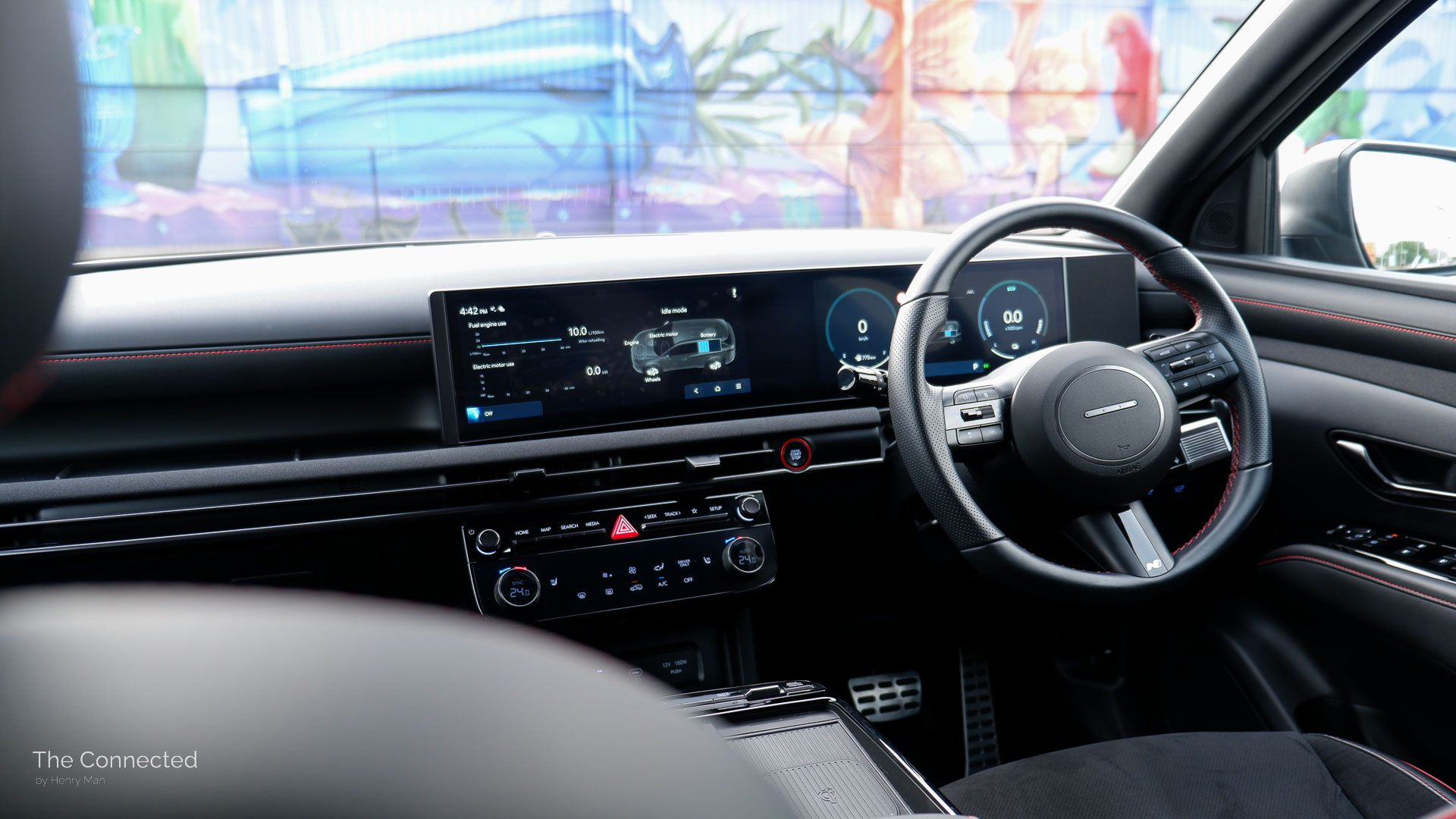
Importantly, the updated Hyundai Tucson’s interior has been overhauled and feels much more modern, in line with the latest-generation Hyundai Santa Fe.
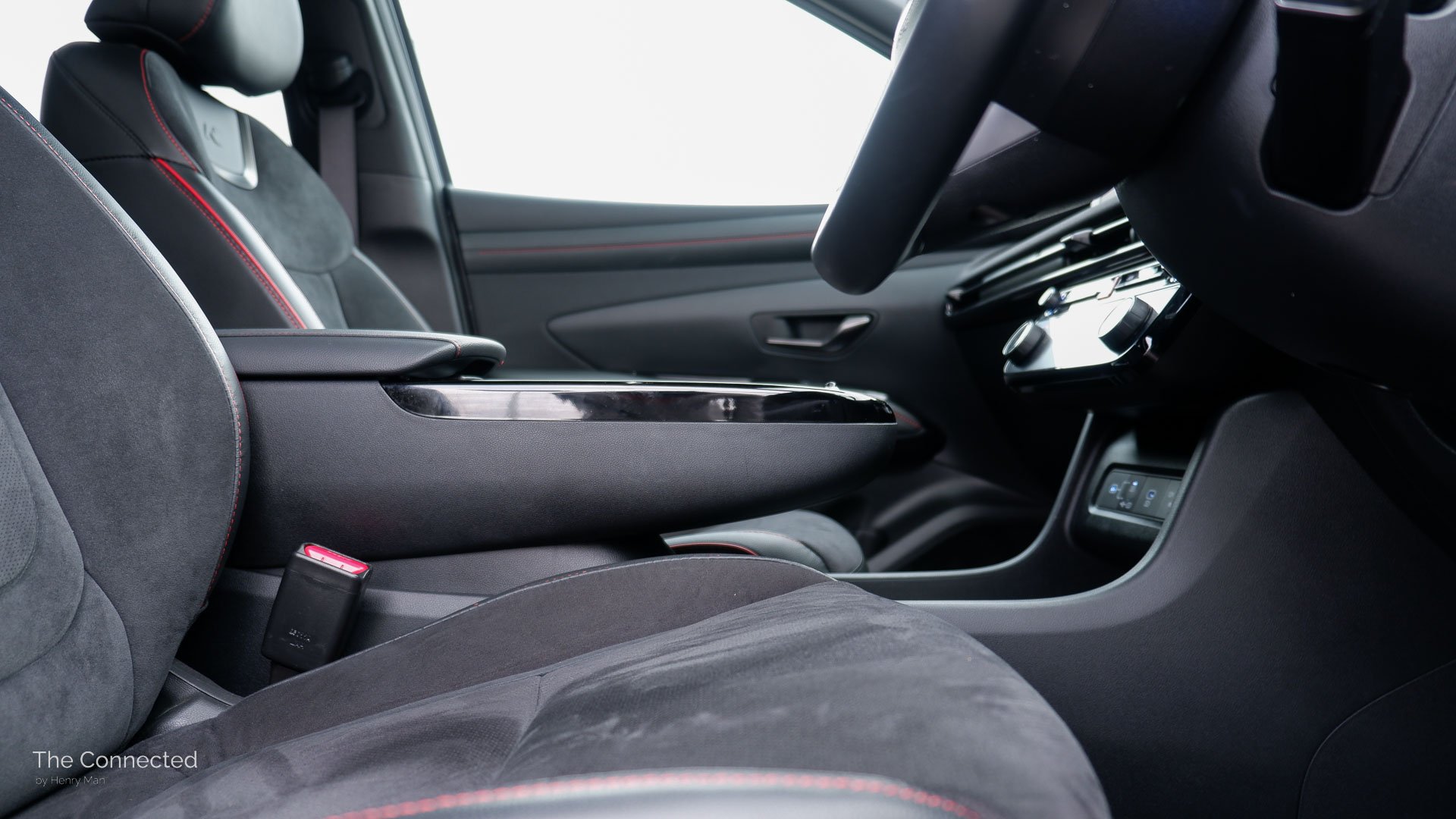
The touchscreen and driver instruments are now adjoined on one curved panel, with a redesigned open-type centre console, and a shelf ahead of the front passenger.
Material quality is adequate and solid, but it doesn’t feel premium.
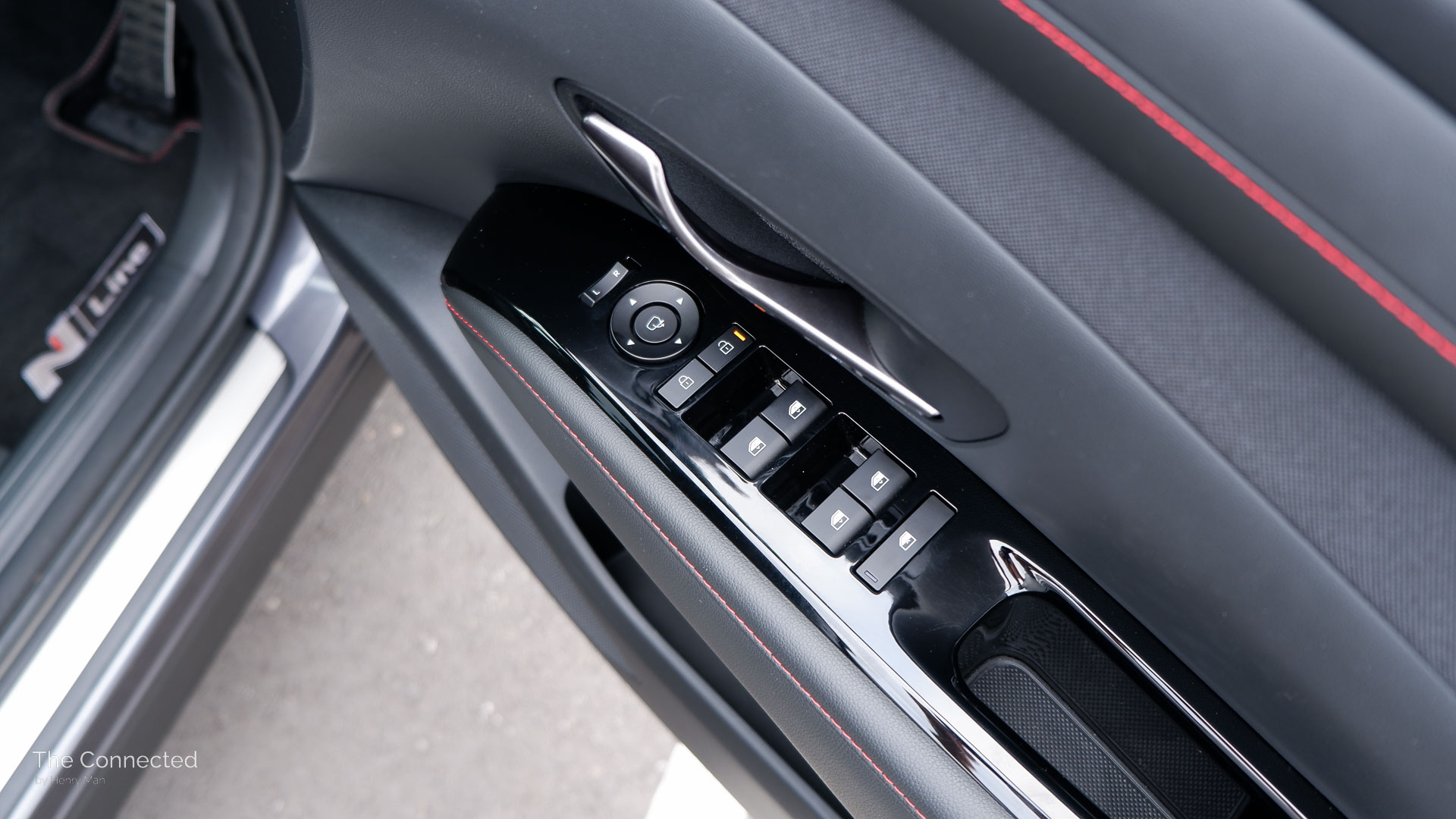
Plastics are a bit firm, fabric trims help break up the interior but look a bit cheap, and the shiny gloss black window switch surrounds and centre console offer good fingerprint resistance – but are still prone to micro scratches.
It ought to be better when the asking price is now more than $60K for a high-spec Tucson.

Practicality.
2025 Hyundai Tucson Hybrid Elite N Line dimensions:
| Length x width x height | 4690 x 1860 x 1650mm |
| Wheelbase | 2755mm |
| Ground clearance | 181mm |
| Boot space (min / rear seats folded) | 582 / 1903 litres |
| Rear seat split fold | 60:40 |
| Child seat anchors | 2x ISOFIX and 3x top tethers |
| Air-conditioning system | Two-zone climate control with rear air vents |
The Hyundai Tucson provides a family-friendly interior, with the refresh bringing even better storage practicality.
The 582-litre boot is spacious with a flat loading lip, LED light, and now features levers on each side to remotely fold down the rear seats as per its Kia Sportage sibling.
An electric tailgate is offered from the mid-spec Elite grade and above, which opens hands-free by standing behind the vehicle for a few seconds.
Unfortunately, there’s no kick sensor so it can’t open hands-free when the doors are unlocked, no hands-free closing, and no button to lock all doors when closing as well. The boot lacks proper bag hooks, too.


The rear row is also spacious with good legroom and plentiful headroom, albeit with a small centre floor hump.
Amenities include a fold-down middle armrest with two cup holders, two USB-C charging ports, LED lights across both rows, and tinted rear windows on the Elite variant and higher.
Yet, no Tucson offers built-in rear window sunshades and all door bottle pockets are fairly narrow.
On the brighter side, the redesigned interior substantially improves practicality at the front row.
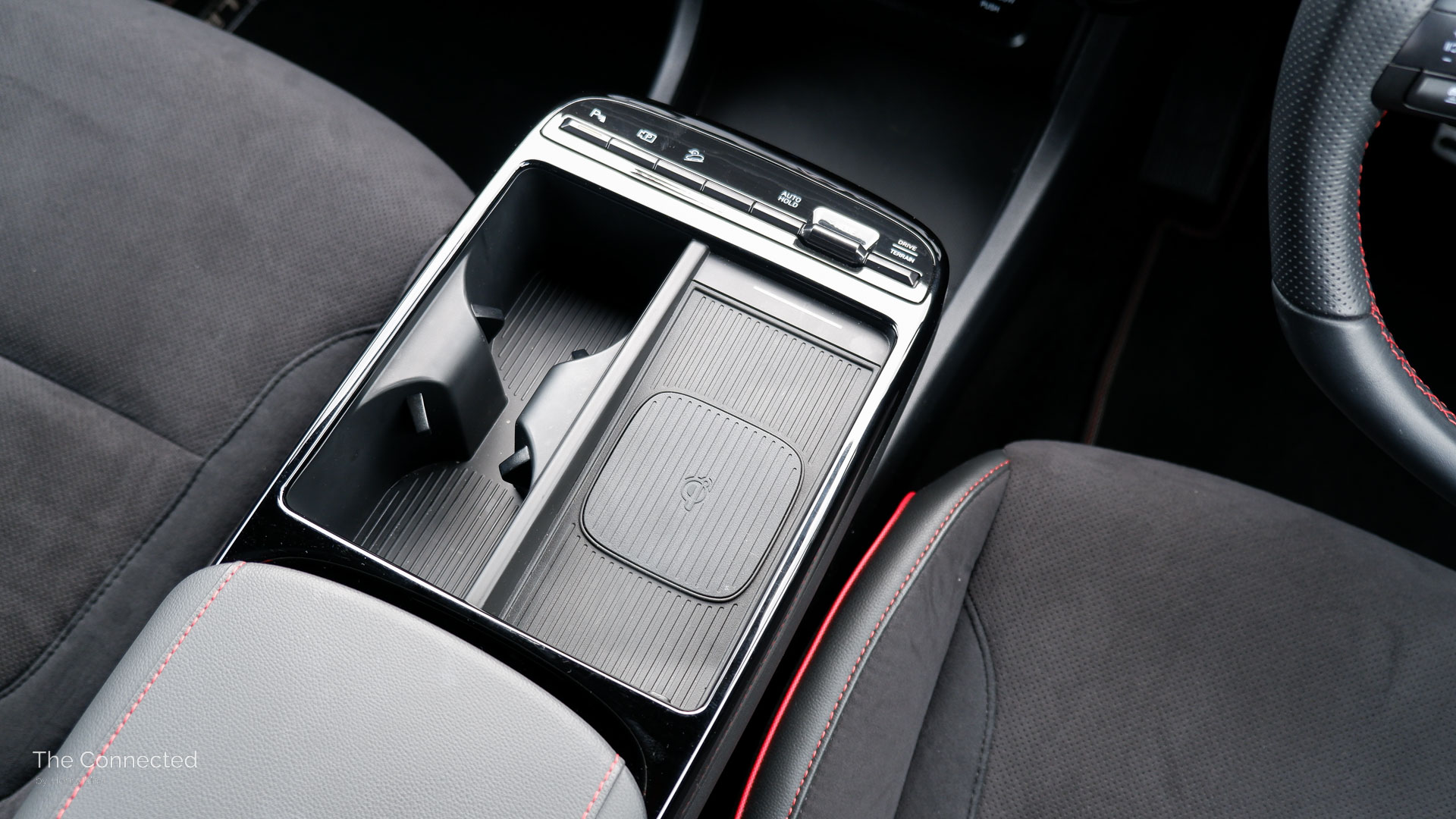
The new centre console is very ergonomic to place your phone on the Qi wireless charging pad and use the cup holders.
Ahead, there’s a large open tray underneath, divided into two sections, with a rubberised and textured surface that was sorely lacking with the smaller Hyundai Kona SUV.

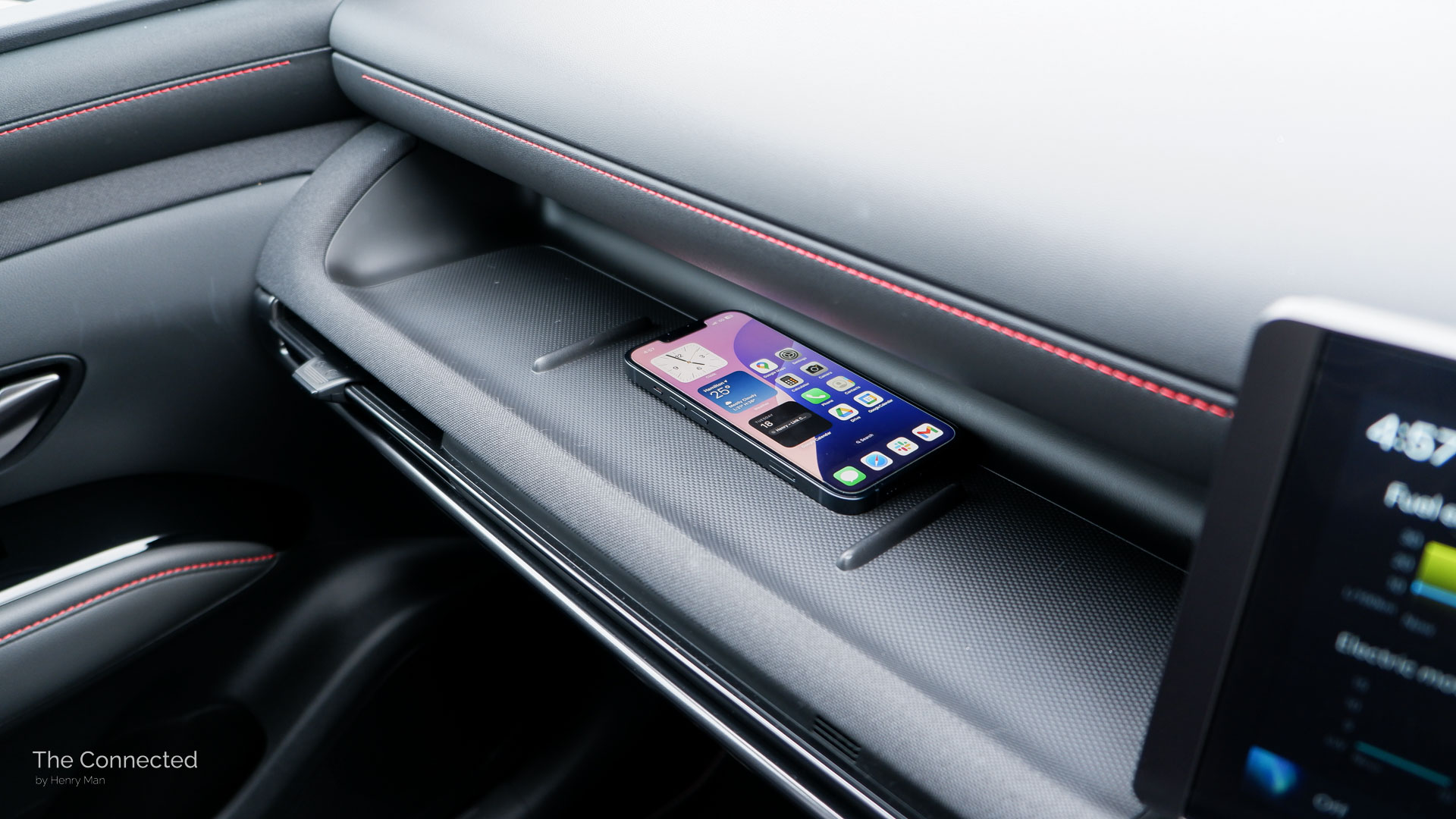
Additionally, the dashboard now offers an open shelf in front of the front passenger with two bumps to perfectly hold a phone in place on the rubberised surface.
Uniquely for a Hyundai, there are plastic slidable elements on both sun visors to help block the sun.
The glovebox is still well-sized and illuminated, the centre armrest storage is large and deep, there are now USB-C charging ports, and the unchanged optional N Line suede and leather seats are supportive but a little firm and absorbs heat.
Seat ventilation and a heated steering wheel are reserved for the flagship Premium, with our Elite grade tester only including three-level heated seats.
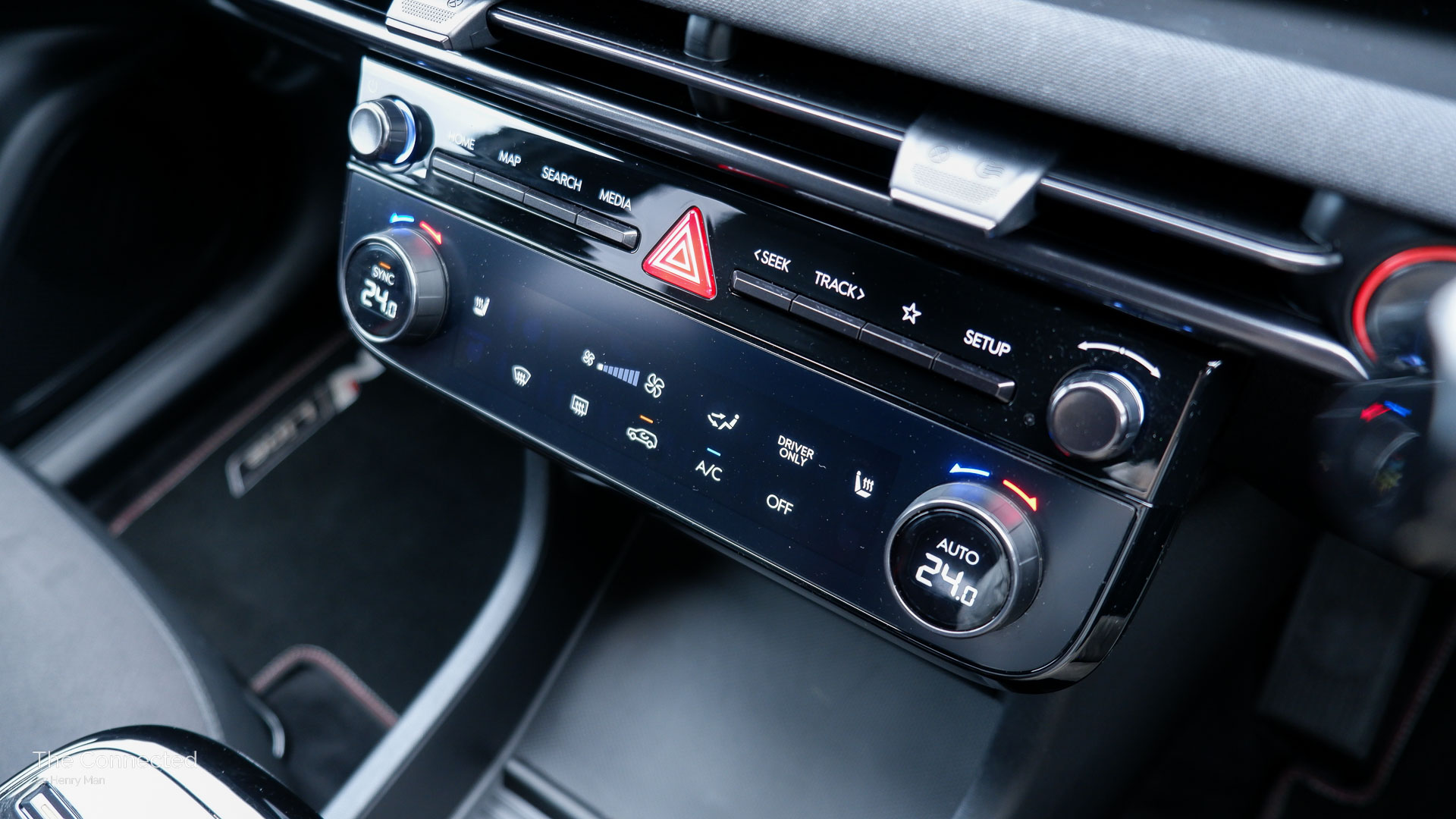
The two-zone climate controls have been redesigned with a dedicated 6.6-inch touchscreen incorporating two physical temperature control dials. It’s very easy to use, largely thanks to the latter.
Technology.
2025 Hyundai Tucson Hybrid Elite tech features:
| 12.3-inch touchscreen running ccNC | 12.3-inch driver instrument display |
| Wireless Apple CarPlay and Android Auto | 6.6-inch climate control touchscreen |
| Built-in maps | 4x USB-C charging ports and 2x 12-volt charging ports |
| OTA software update capability | Qi wireless charging pad |
| Hyundai Bluelink connected services and mobile app | Proximity key with auto-folding mirrors and front door handle lights |
The facelifted 2025 Tucson gains a big tech upgrade with Hyundai’s latest refined and easy-to-use software offering.
Now larger, curved and positioned higher up, the 12.3-inch touchscreen runs on Hyundai’s newest Connected Car Navigation Cockpit (ccNC) software with Bluelink connected services, over-the-air (OTA) software update capability, and wireless Apple CarPlay and Android Auto.
A more powerful processor brings faster boot-up times and feels much more snappy when using the built-in software, which has a fairly easy to learn and modern user interface.
Importantly, Apple CarPlay and Android Auto can now be used without a cable – with both systems connecting quickly and reliably every time. No issues whatsoever.

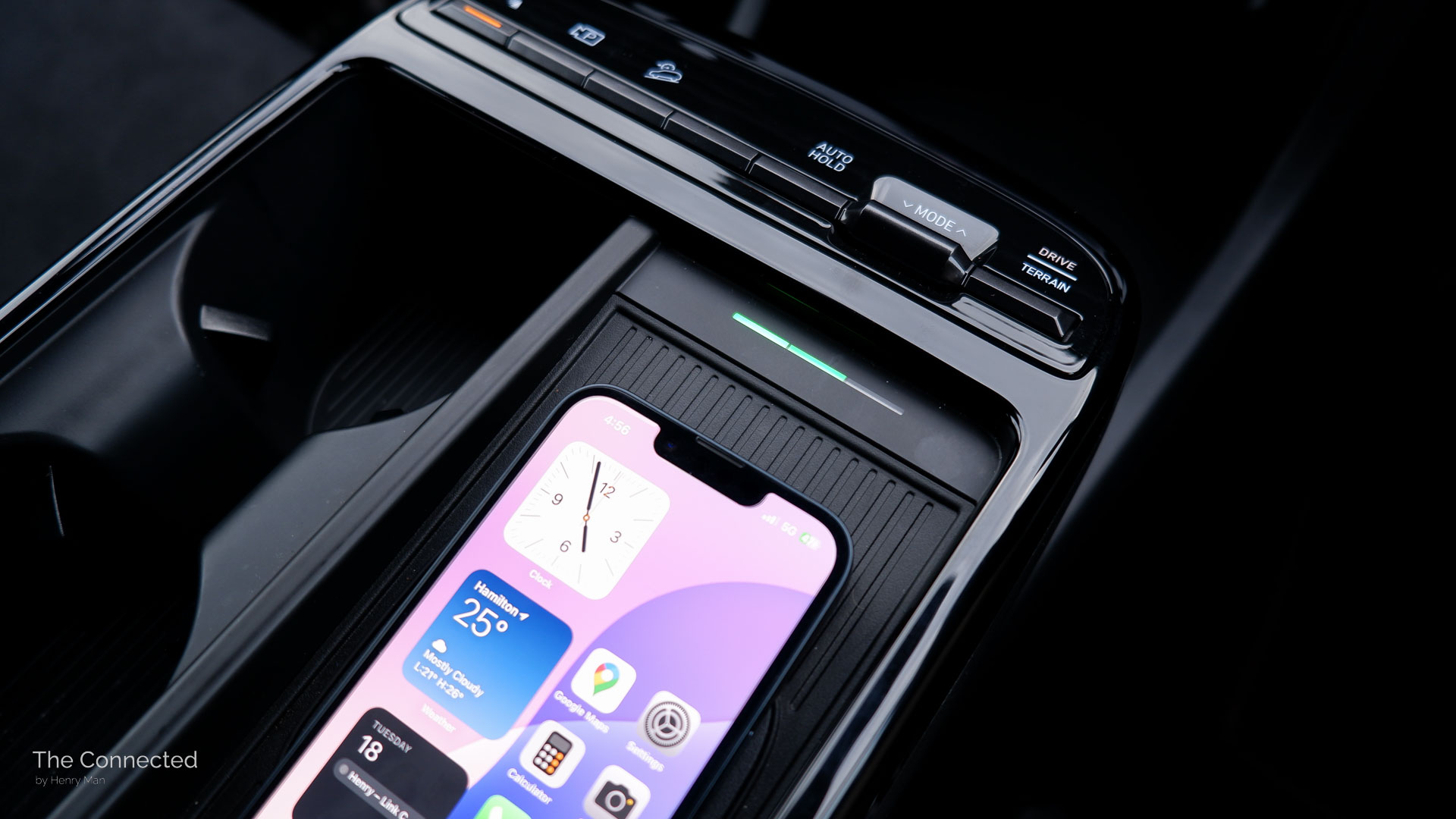

The Qi wireless charging pad on the redesigned centre console is very ergonomic to quickly place your phone, although it is exposed and could be distracting to drivers.
Wireless charging is fast, but lacks a ventilation fan so phones can overheat and stop charging over time. At least there are USB-C charging ports now (rather than USB-A).
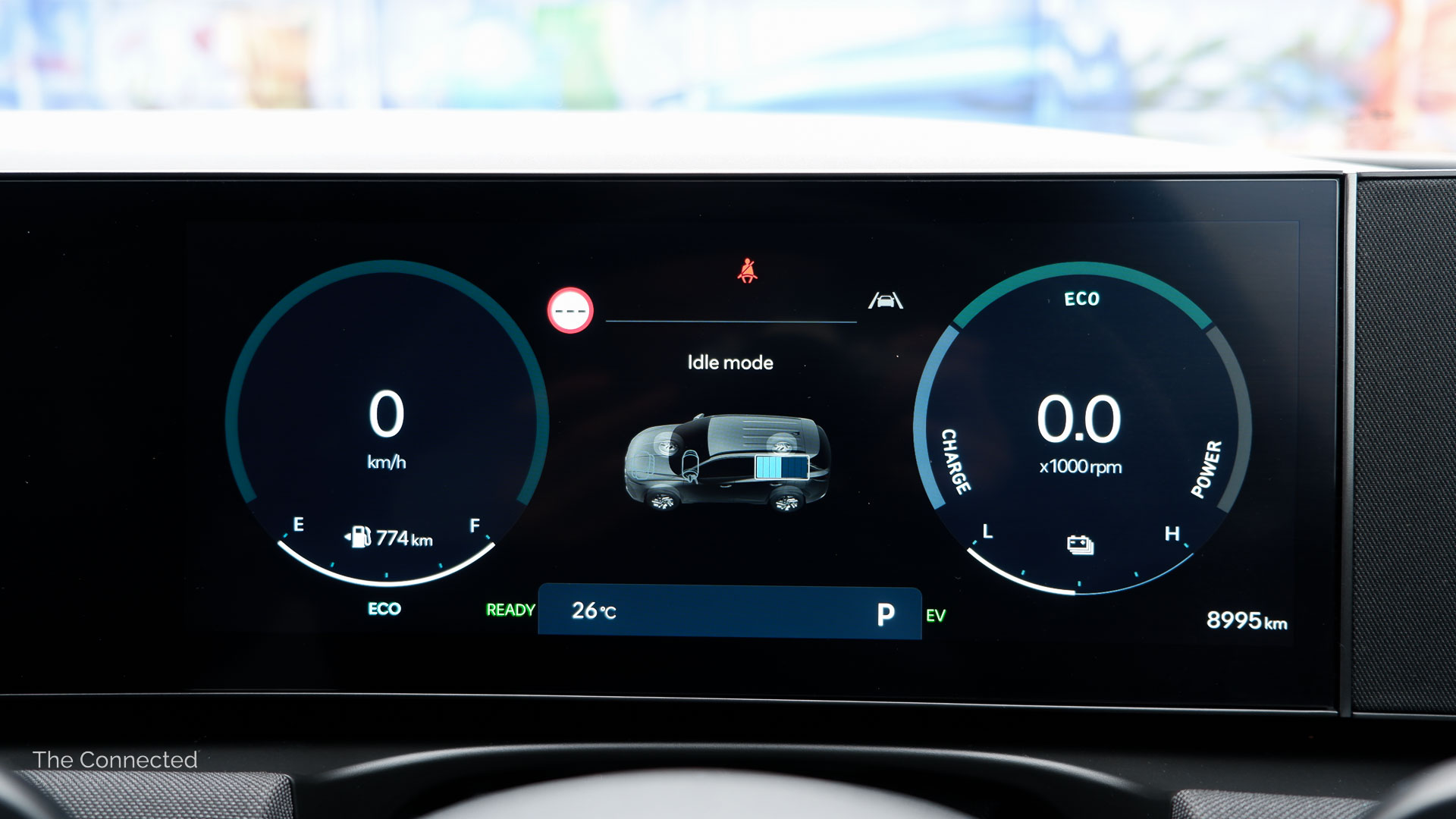
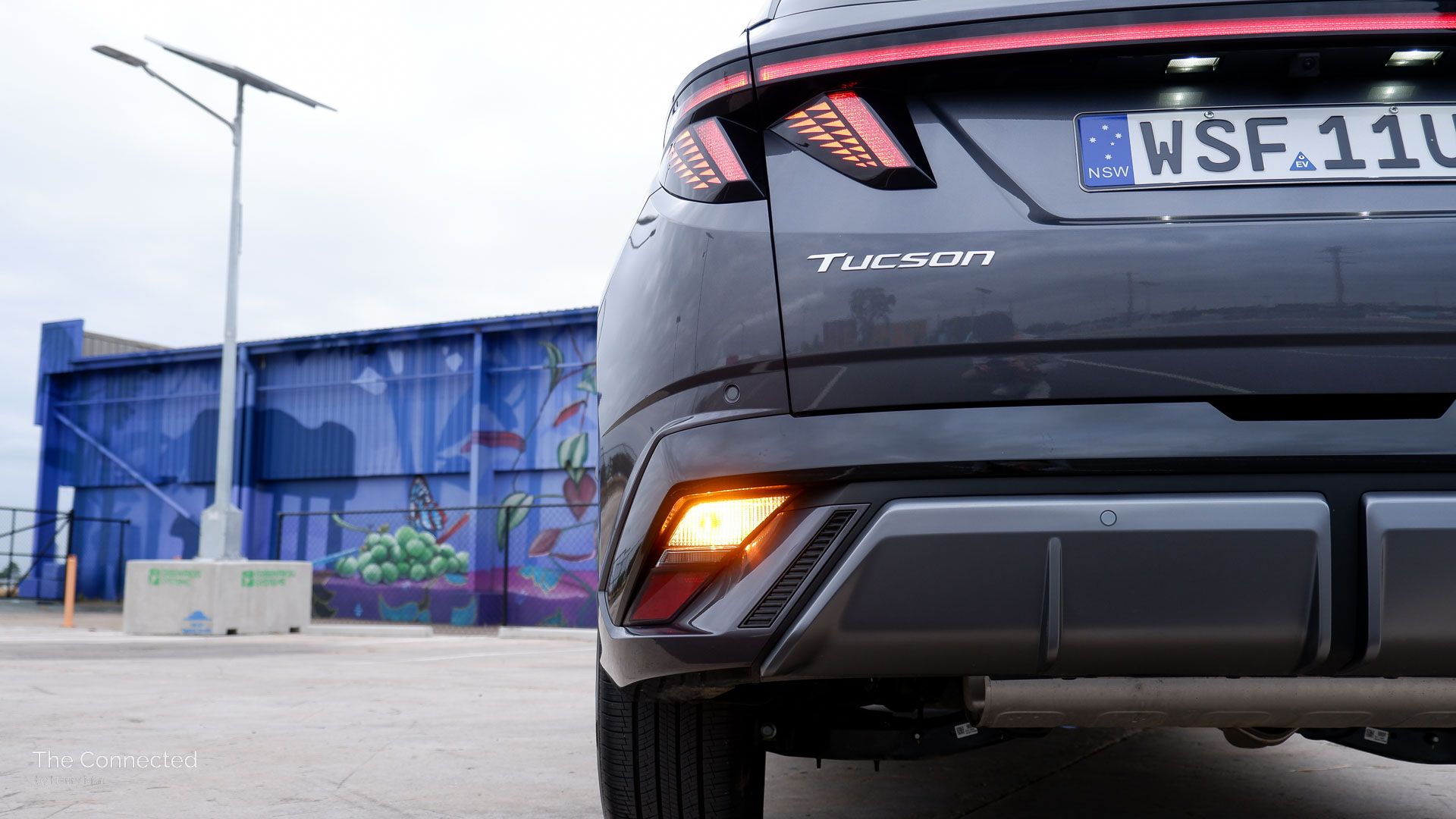
Moreover, the Elite variant and higher or optioning the N Line pack on the base Tucson introduces a full 12.3-inch driver instrument display, too.
It’s fairly simple without much customizability, but shows information including safety assists, the hybrid drivetrain status, and map direction arrows – but not a complete map integration with Apple CarPlay and Android Auto as per its fancier Genesis GV70 counterpart.
Same with the pre-facelift, the Hyundai Bluelink mobile app is designed well and handy to remotely pre-condition the interior, unlock/lock the doors, and check the remaining fuel. It is included for the first five years.
Safety.
2025 Hyundai Tucson Hybrid Elite safety features:
| Front AEB with vehicle/pedestrian/cyclist/junction turning detection | Reversing camera |
| AEB with direct oncoming/side detection | Front and rear parking sensors |
| Blind-spot assist | Rear occupant alert (logic type) |
| Rear cross-traffic assist | Road sign detection and speed limit assist |
| Lane-centring and lane-keep assist | Bluelink emergency calling and remote location tracking |
| HDA1.5 adaptive cruise control | Full LED headlights |
| Door open warning and assist | LED tail-light bar and reversing light with halogen turn indicators |
While Hyundai’s infamously annoying safety assist systems have been introduced, it’s a bit more palatable on the new Tucson.
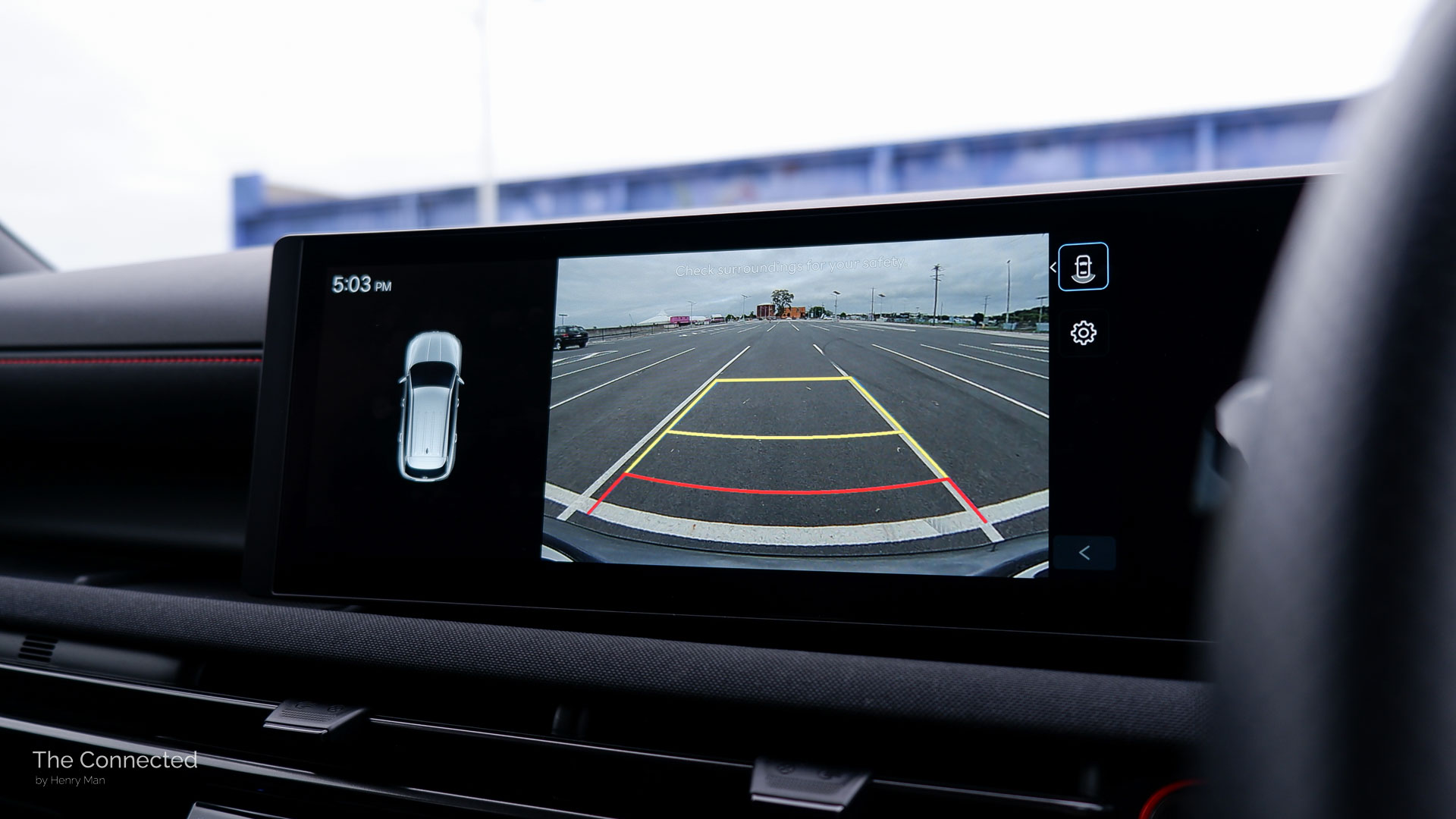
The South Korean carmaker’s safety tech systems are all well-calibrated and refined with reliable adaptive cruise control, smooth lane-centring assist, and a clear reversing camera which can be enabled at any speed.
Yet, the lane-keep assist system now activates from 45km/h speeds (rather than from 60km/h), which means it constantly makes subtle tugs on the wheel against the driver when the medium SUV is barely touching the road lines. A quick press and hold of a button on the wheel disables it temporarily, though.
Additionally, the facelifted 2025 Tucson brings the European-mandated Intelligent Speed Limit Assist (ISLA) feature, which generally detects signs accurately and understands school zone times.
However, it chimes incessantly each time you pass a new sign and sounds multiple warnings as soon as you drive over the detected speed limit. While useful, it is annoying – particularly in those unnecessarily strict 5km/h car parks and it can get the speed wrong or not detect one at all sometimes.
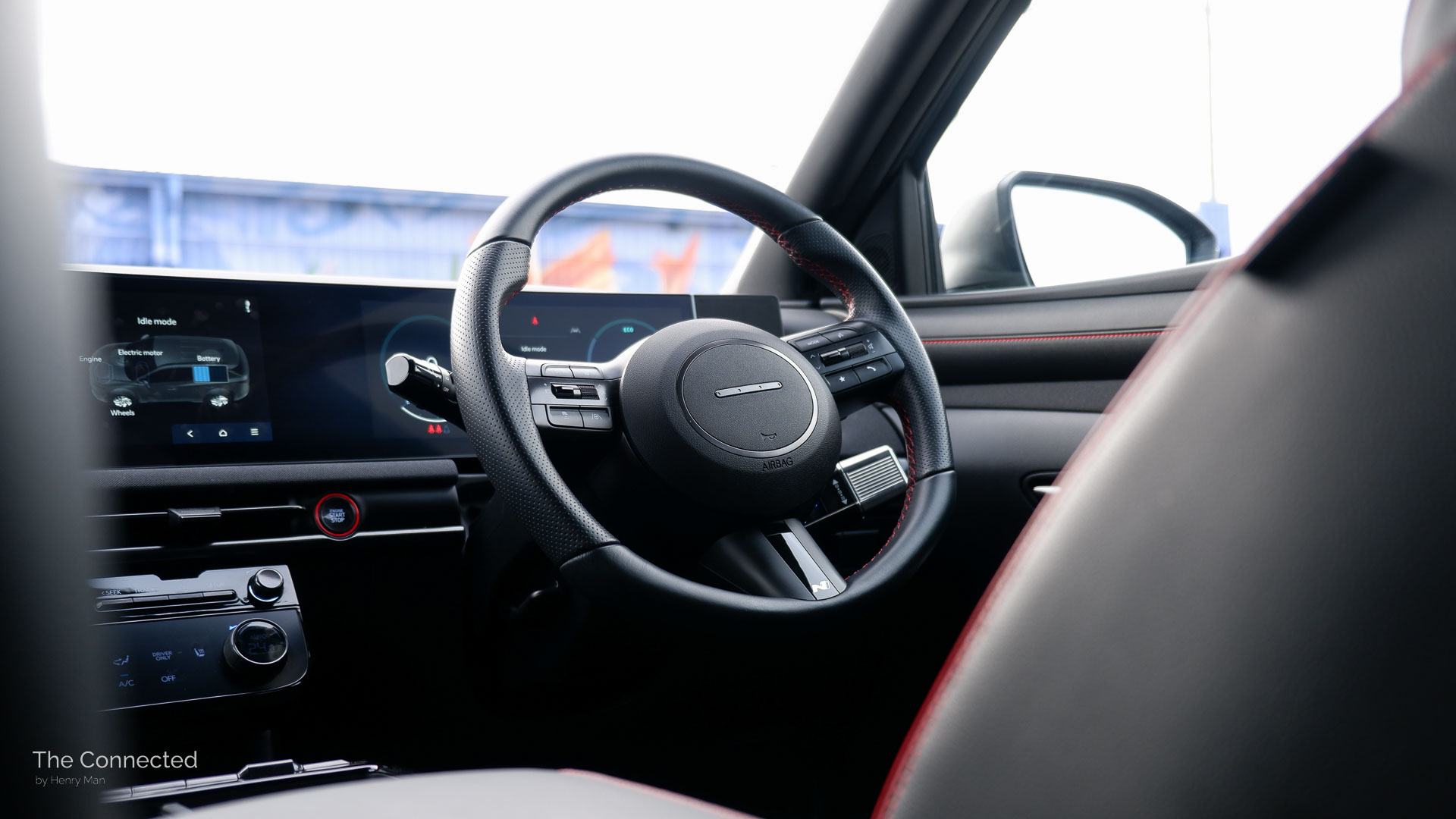
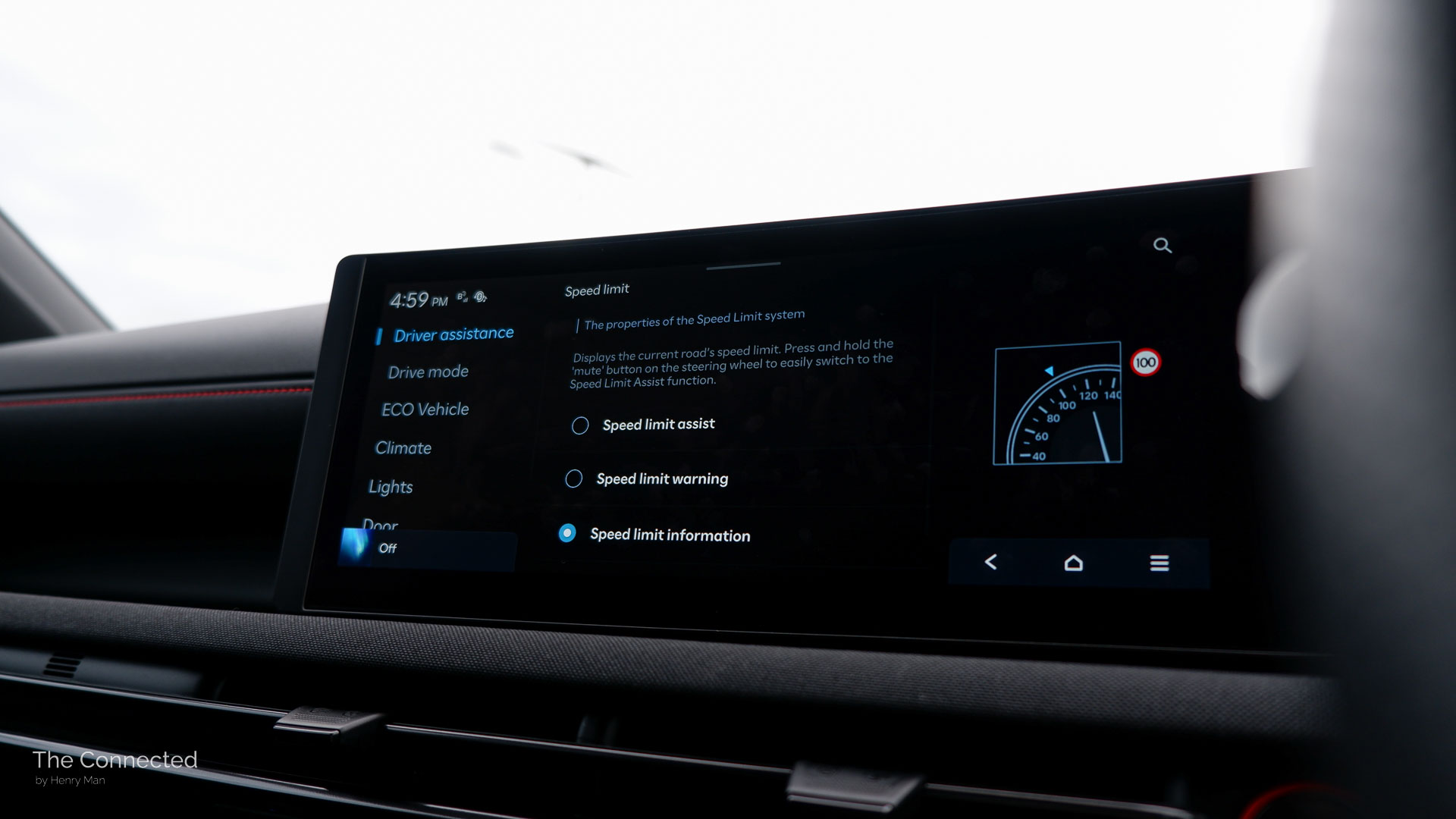

Fortunately, drivers can easily press and hold the mute button on the steering wheel to turn off the speed limit assist warnings, while still having the icon in the instrument display.
You’ll need to do it every time you start the Tucson, but at least it’s completely silenced – unlike other new models from the South Korean car brand.
Another win for the Hyundai Tucson is the lack of a driver attention monitoring camera, which while useful for often distracted parents, can be unnecessary and frustrating like Big Brother is watching.
All variants include full LED headlights as standard, but optioning the N Line on the base Tucson and Elite or choosing the Premium brings stronger projector-type LED headlights with an adaptive matrix function.
Usually a luxury car feature, it can turn on the high beams at night and block individual bulbs to avoid dazzling other road users. Uniquely, the Tucson’s system turns on even when it isn’t pitch black without street lights at night, although it sometimes doesn’t turn off the pixels fast enough.
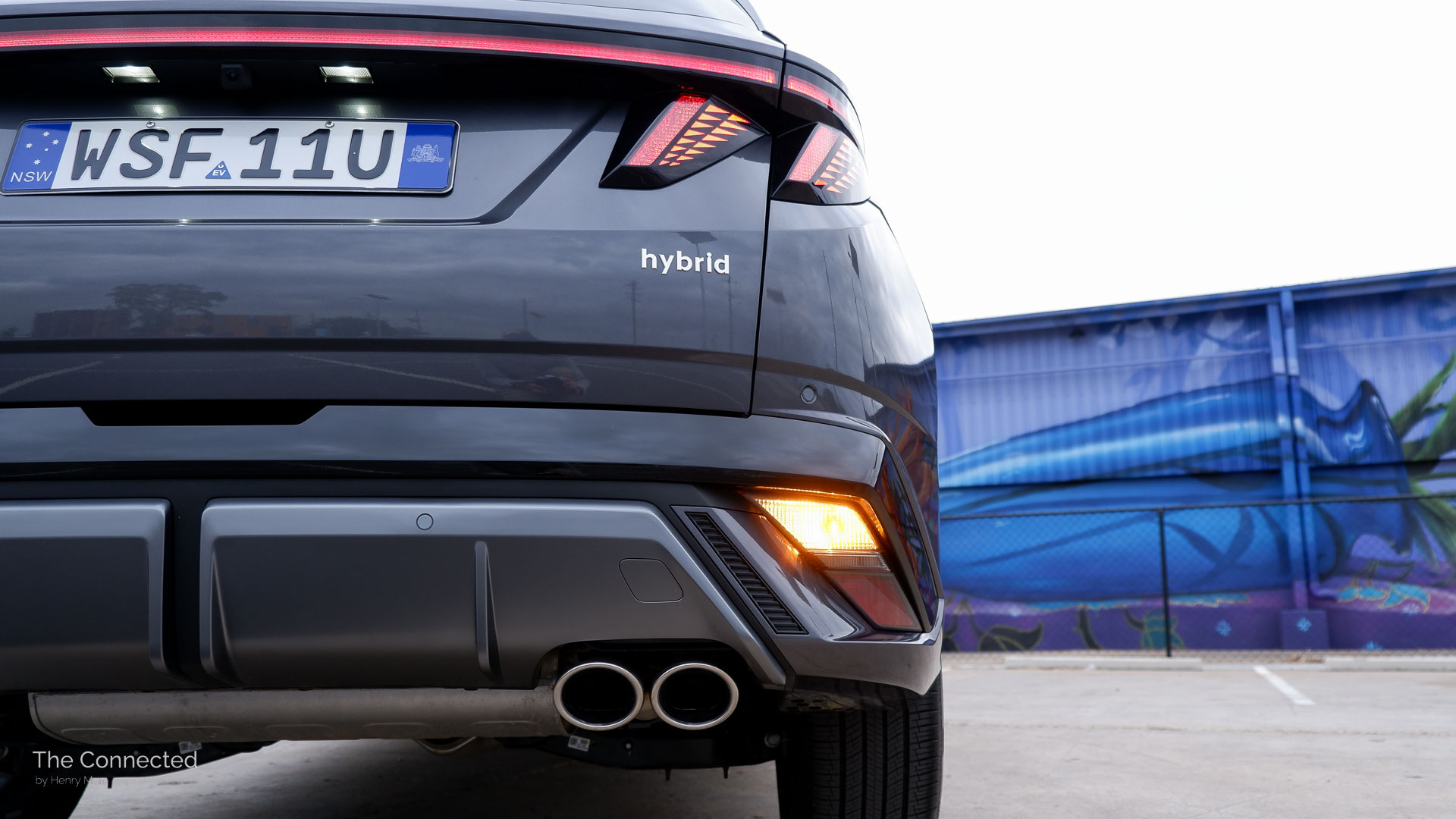


Critically, the rear turn indicators are placed even lower down the bumper than its predecessor – which makes it less visible to other road users, who may block the bumper when stopped behind.
Exacerbating this, the new N Line bumper design has a gloss black panel protruding from the top, which slightly covers the indicators. Again, if a cyclist behind is the Tucson at the lights, it’s more difficult to see that the turn signals are activated.
It’s still a halogen-type bulb, too, despite using LEDs for the reverse bulb below.
The 2025 Hyundai Tucson carries the same full five-star Australasian New Car Assessment Program (ANCAP) rating under the 2021 testing criteria from the pre-facelift model. This rating is due to expire by the end of 2027, as per ANCAP rules.
Range and fuel consumption.
2025 Hyundai Tucson Hybrid Elite AWD fuel and efficiency specs:
| Claimed driving range (combined cycle) | 981km |
| Claimed fuel efficiency (combined cycle) | 5.3L/100km |
| Fuel tank size | 52 litres |
| Minimum fuel quality requirement | 91 RON unleaded petrol |
| Claimed CO2 exhaust emissions (combined) | 121g/km |
| European emissions compliance | Euro 5 |
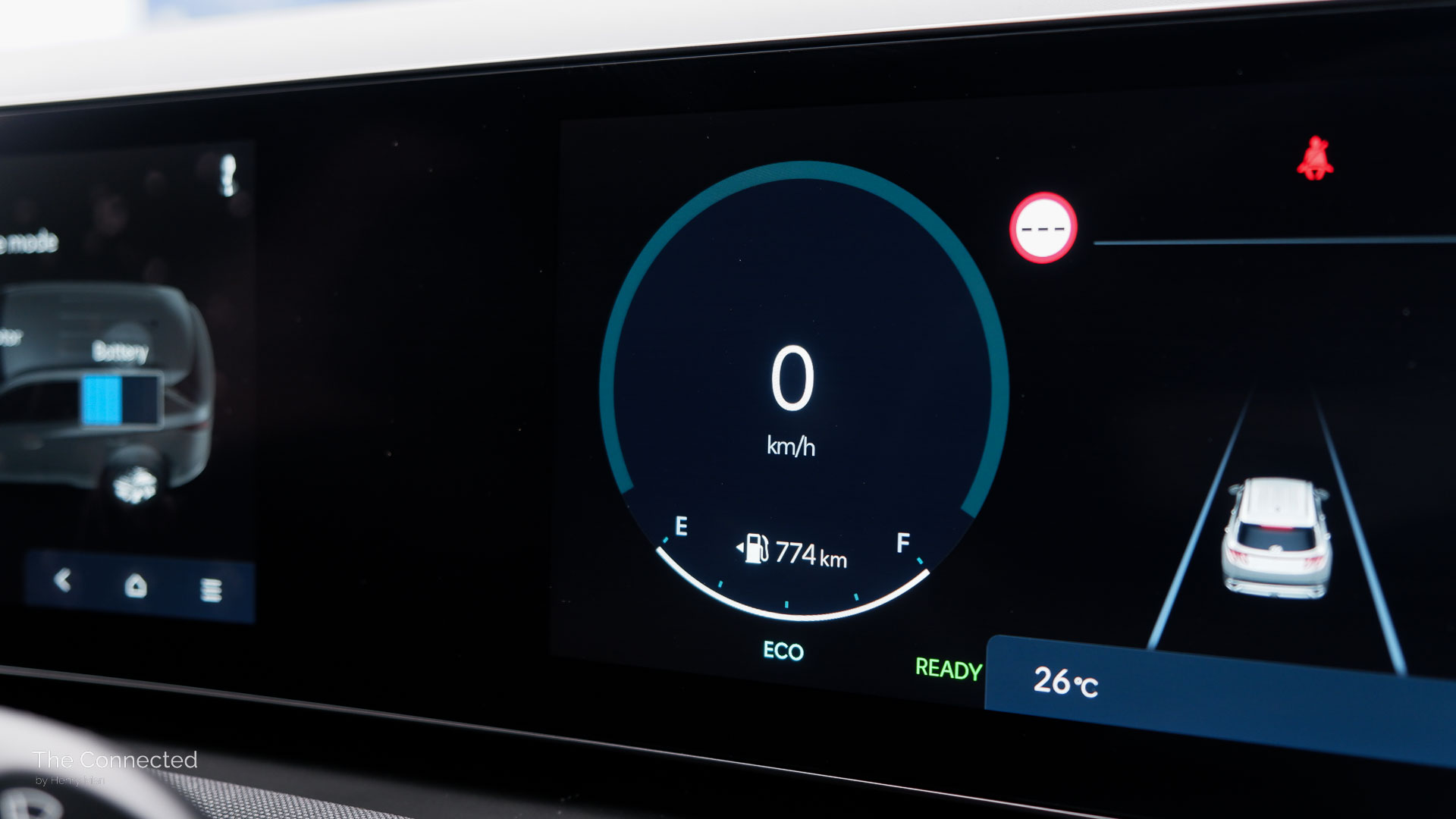
The Hyundai Tucson Hybrid AWD returned an average fuel efficiency of 5.6L/100km after a week of mixed city and highway driving.
The series-parallel petrol-electric powertrain proves to be efficient in the real-world with around 928km of driving range achievable from its 52-litre fuel tank.
Cheaper 91 RON unleaded petrol can be used and it is E10 compatible, too.
The all-wheel drive has the same claimed fuel consumption as the standard front-wheel drive.
The hybrid system is self-contained and recharges the small 1.49kWh lithium-ion battery via the engine and regenerative braking. No external plug-in charging is required.
The fuel lid is accessible via the left-rear quarter of the Tucson, which unlocks along with the doors and has an easy to twist cap.

Driving.
2025 Hyundai Tucson Hybrid Elite AWD powertrain specs:
| Engine and electric motor | 1.6-litre turbocharged petrol engine and single permanent magnet electric motor |
| Battery size and type | 1.49kWh (gross) lithium-ion battery |
| Power | 172kW @5600rpm |
| Torque | 367Nm @1000-4100rpm |
| Transmission | Six-speed torque converter auto |
| Drive type | AWD |
| Tare weight | 1686-1806kg |
| Turning circle | 11.8 metres |
| Payload | 494-614kg (excluding max 100kg towball download) |
| Towing (unbraked / braked) | 750 / 1900kg |
The facelifted Tucson Hybrid is efficient, yet easy to drive with more than enough power thanks to a small electric motor boost.
The hybrid medium SUV pairs a turbocharged 1.6-litre petrol engine and a front-mounted electric motor to produce up to 172kW of power and 367Nm of torque. The EV motor is mounted to a six-speed automatic transmission.
It provides plenty of push and instant torque response from the small 37.4kW EV motor, with the optional all-wheel drive adding some extra confidence – although it likely isn’t worth the extra $2500 for most.
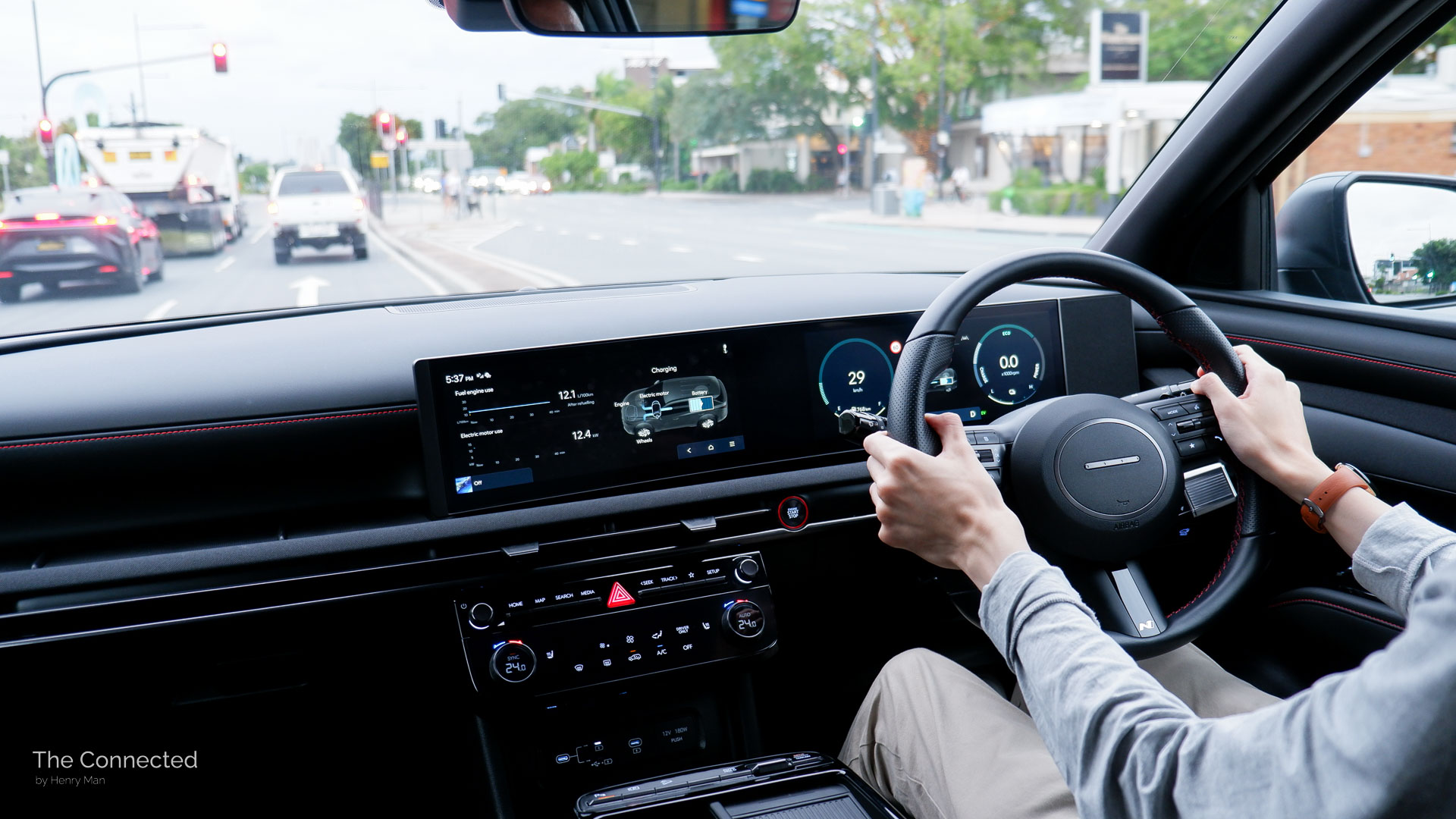
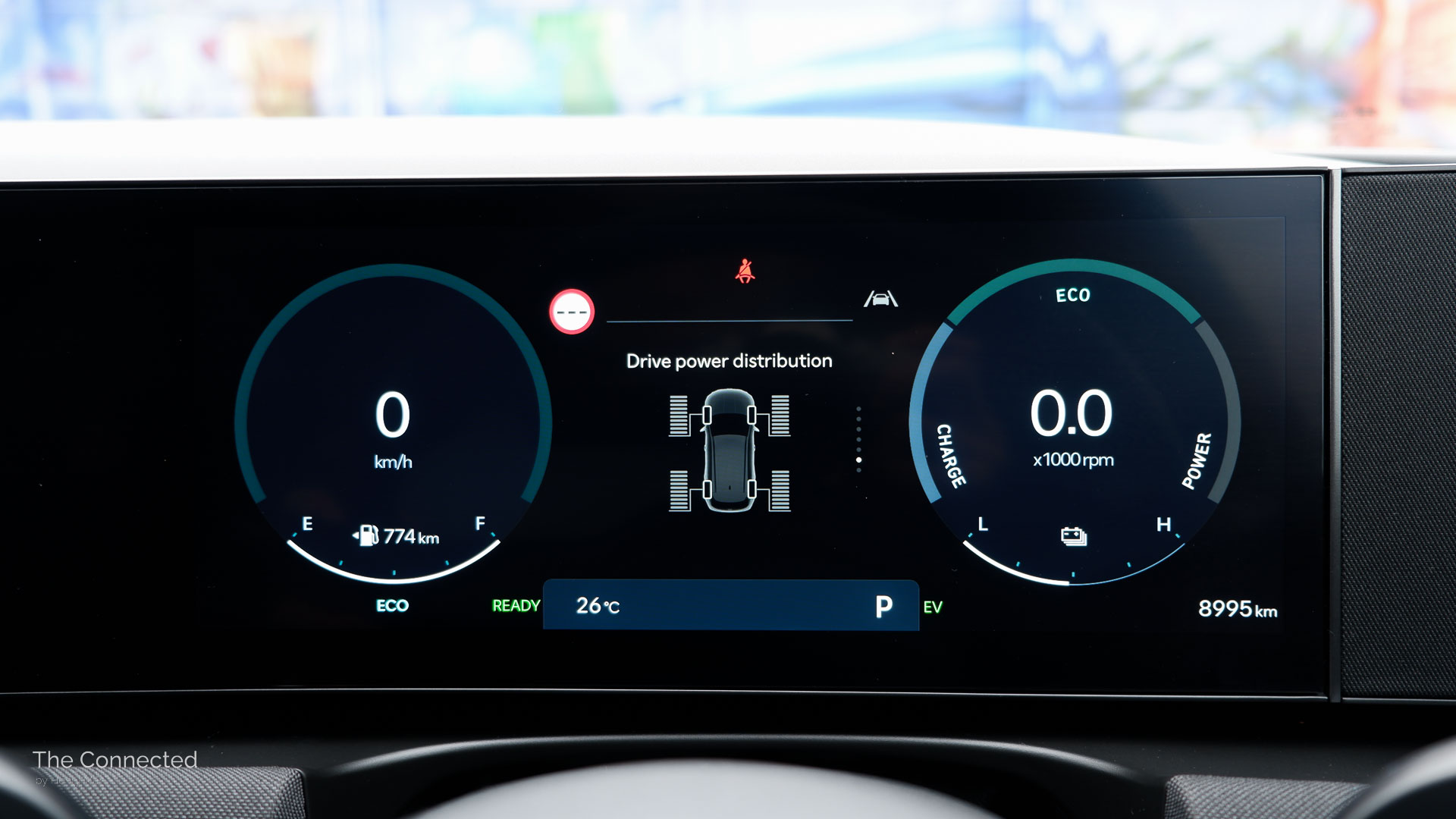

The series-parallel hybrid system works well and smoothly at transitioning between the combustion engine, electric motor and both to power the wheels – though the petrol engine can sound pretty loud and rough when activated.
Noise insulation is adequate with some audible road noise coming from the 19-inch wheels, but the suspension is compliant and comfortable.
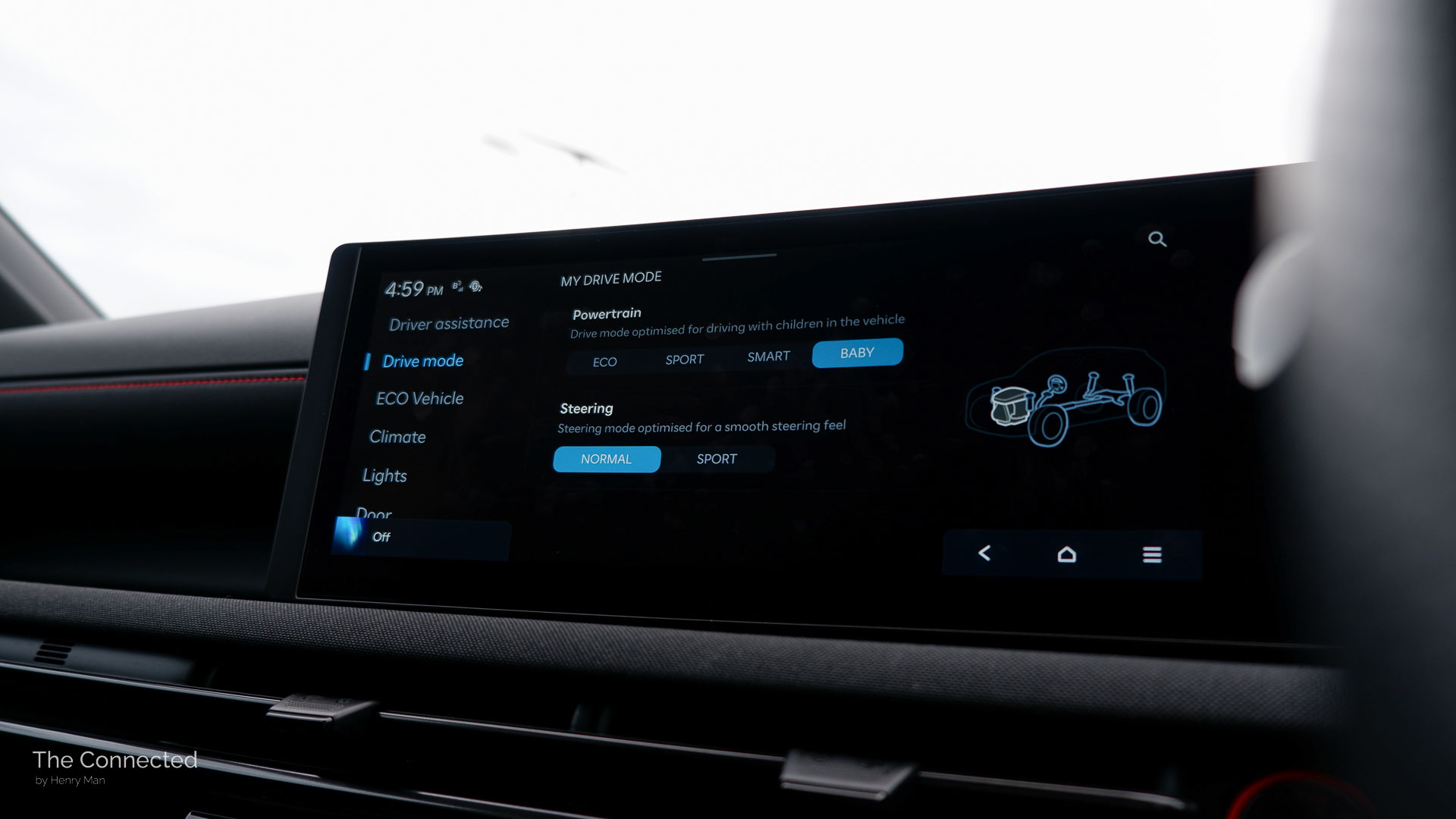
The new Tucson Hybrid debuts Baby Mode (accessible via the custom MY driving mode) which limits the acceleration and torque response.
While it does make driving a bit more comfortable, it’s a shame that it doesn’t reduce the sound of safety assist warnings and turn on Quiet Mode (turns down the speaker volume) as well, just like Tesla’s Joe Mode.
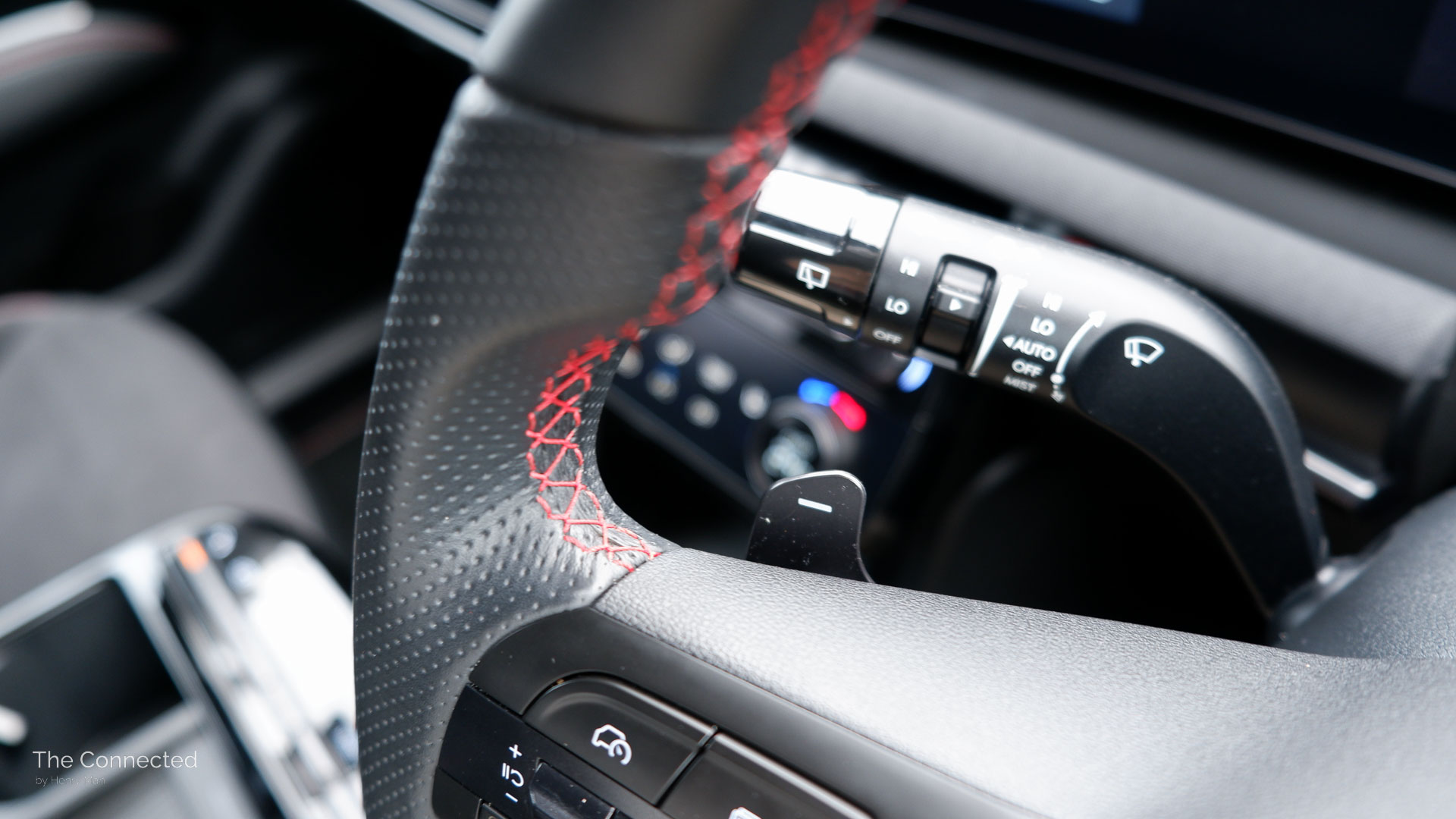


Three regenerative braking settings and an automatic function are easily toggled via the steering wheel paddle shifters, which effectively slows down the Hyundai hybrid SUV without touching the brake pedal.
I mainly left it on level one or two as the regen acts as more of an on/off switch when lifting off the accelerator, rather than progressively slowing down as per its full electric vehicles.
It’s worth noting that the regen defaults to off every time you start the Tucson Hybrid, which feels most familiar and natural.
All-round visibility is adequate with a high driving position and the standard blind-spot monitoring helping negate the notable C-pillar section.
Warranty and servicing.
2025 Hyundai Tucson Hybrid Elite AWD capped-price servicing costs:
| 1 year/10,000km | 2 years/20,000km | 3 years/30,000km | 4 years/40,000km | 5 years/50,000km |
|---|---|---|---|---|
| $340 | $340 | $560 | $410 | $340 |
The 2025 Hyundai Tucson Hybrid is backed by a five-year, unlimited kilometre vehicle warranty and an eight-year/160,000km battery warranty.
Servicing is required every one year/10,000km (whichever occurs first) – which is on the shorter side on the distance front due to the turbocharged petrol engine.
After the first five years/50,000km, it’ll cost $1990 in total to service the 2025 Tucson Hybrid.
Hyundai uniquely has an unlimited capped-price servicing program, where all scheduled maintenance prices are fixed and known from day one for the life of the vehicle.
Lifetime roadside assistance is included, too, which is renewed for one year every time you service it with a Hyundai dealer.
Up to five years of Hyundai Bluelink connected services are included from the date of activation, with subscription prices thereafter yet to be announced.
A temporary space-saver spare tyre is included underneath the boot floor of all Tucson Hybrids.
Price and rivals.
2025 Hyundai Tucson Hybrid model range pricing (accurate as at the time of publication):
| Tucson Hybrid | Elite Hybrid | Premium Hybrid |
|---|---|---|
| From $45,100 before on-road costs | From $50,100 before on-road costs | From $59,600 before on-road costs |
The 2025 Hyundai Tucson Hybrid is priced from $45,100 before on-road costs in Australia.
The hybrid powertrain is available across all models and commands a premium of between $4000 and $6000 depending on the variant.
It’s front-wheel drive as standard, but all-wheel drive hybrid is optional on the Elite for an additional $2500. AWD is the only choice on the top-spec Premium.
A non-electrified 1.6-litre turbocharged petrol engine with all-wheel drive is optional on the base Tucson and Elite, and standard on the Premium, too.
All glossy exterior colours except White Cream costs $595, with the hero Pine Green Matte available for all standard Tucson variants for $1000 extra.
It’s worth noting that Hyundai often offers nationwide drive-away promotions on the Tucson range, so there are deals to be had.
The 2025 Hyundai Tucson Hybrid directly rivals the following hybrid medium SUVs:
- Kia Sportage Hybrid (full review)
- Toyota RAV4 Hybrid
- Honda CR-V e:HEV
- GWM Haval H6 Hybrid
- MG HS Hybrid+
- Nissan X-Trail e-Power
- Subaru Forester eBoxer
- Peugeot 3008 Hybrid
Other alternatives to the Tucson Hybrid include:
- Hyundai Kona Hybrid (full review)
- Nissan Qashqai e-Power (full review)
- Mazda CX-60 (full review)
- Mitsubishi Outlander PHEV
- GWM Haval H6 GT PHEV
- BYD Sealion 6
- Volkswagen ID.4
- Tesla Model Y
- Kia EV5 (full review)
- Leapmotor C10
- Deepal S07 (full review)

Would I pick the 2025 Hyundai Tucson Hybrid Elite?
It’s no surprise to see why the Hyundai Tucson is so popular – and it’s even better than before, albeit with a higher cost.
The Hyundai medium SUV offers a family-friendly interior, with a much improved redesign making it even more practical, and a stylish design that looks unique and sporty.
Yet, the rear bumper indicators are even lower and poor design, interior materials don’t feel premium enough when the price is now above $60K for a high spec, and servicing intervals are slightly short for the hybrid.
If you’re on a budget, the Kona Hybrid small SUV is worth considering with a similarly practical, fit-for-family interior.

I’d pick the base Tucson Hybrid. It provides most essential features as standard with a sub-$50K price. Consider the N Line option for a sharper-looking package and better lights.
With an upgraded interior, better tech and a cost-effective hybrid option, the Tucson is even better than before, especially when had with Hyundai’s drive-away promotions.
Photographs by Henry Man
READ MORE: What is the point of the blue EV label?
READ MORE: 2024 Kia Sportage Hybrid review
READ MORE: 2025 Mazda CX-60 review
Pros:
- Family-friendly interior
- Frugal hybrid powertrain
- Less intrusive safety tech
- Adaptive LED headlights
- Much improved interior
Cons:
- High specs are expensive
- Too-low rear indicators
- Interior quality could feel better
- Touchy regen braking
- Shorter servicing intervals
About the Author.
Henry Man is an independent content producer passionate about the intersection of technology and transportation.
The former automotive journalist is focused on producing critically-detailed vehicle reviews, and unique short-form content. Learn more.


 The Connected by Henry Man