
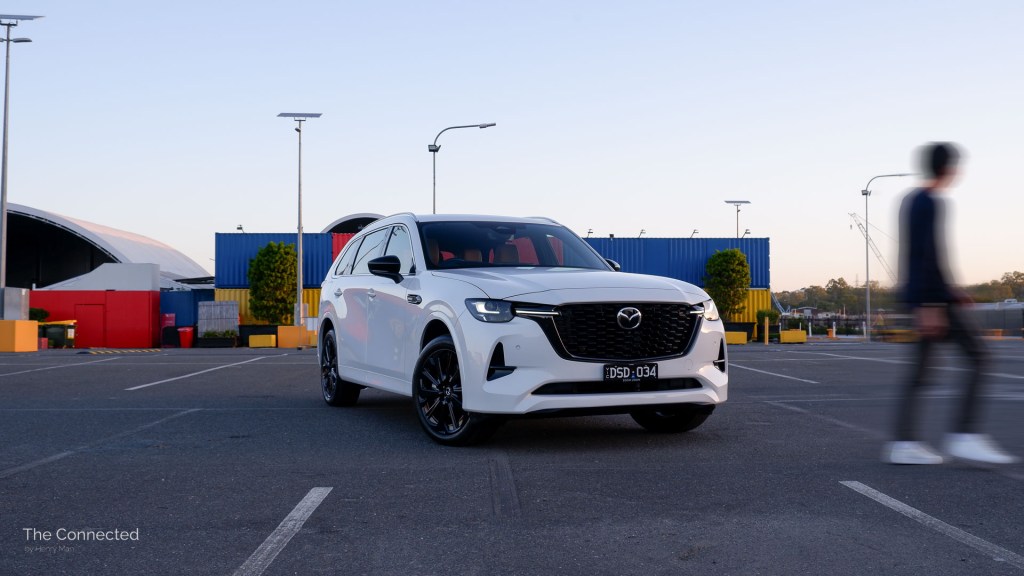
Sharp discounts have made the Mazda CX-80 plug-in hybrid more attractive, but is it worth considering?
The three-row Mazda CX-80 P50e plug-in hybrid electric vehicle (PHEV) has received a price cut of between $7650 to $8687, closing the gap with conventional G40e petrol and D50e diesel models.
Now priced from $68,100 before on-road costs, the CX-80 PHEV is an extended wheelbase version of the five-seat CX-60 – a similar approach adopted on the Tesla Model Y L and Volkswagen Tayron.
Are Mazda’s aggressive discounts enough when Chinese rivals can still offer three-row PHEVs for significantly less?
NOTE: The press vehicle was provided by Mazda Australia for a seven-day independent evaluation. Toll costs were covered, but we have no commercial arrangements with the company and it had no editorial control.

Pros.
+ Discounted pricing
+ Great to drive
+ Good brake pedal feel for a hybrid
+ Eye-catching interior
+ Non-overbearing tech with buttons
Cons.
– Loud EV motor, clunky transmission at times
– Firm ride and steering, zoomed-in mirror
– Third row shouldn’t be regularly used
– Still expensive
– Rivals offer much more EV-only range
Vehicle tested:
| Model | 2026 Mazda CX-80 |
| Variant | P50e Azami |
| Starting price | $80,300 before on-road costs |
| Exterior colour | Rhodium White Metallic (+$995) |
| Interior colour | Tan Nappa Leather (part of SP Package) |
| Options | SP Package (+$5000) |
| Country made | Japan |
Design and quality.
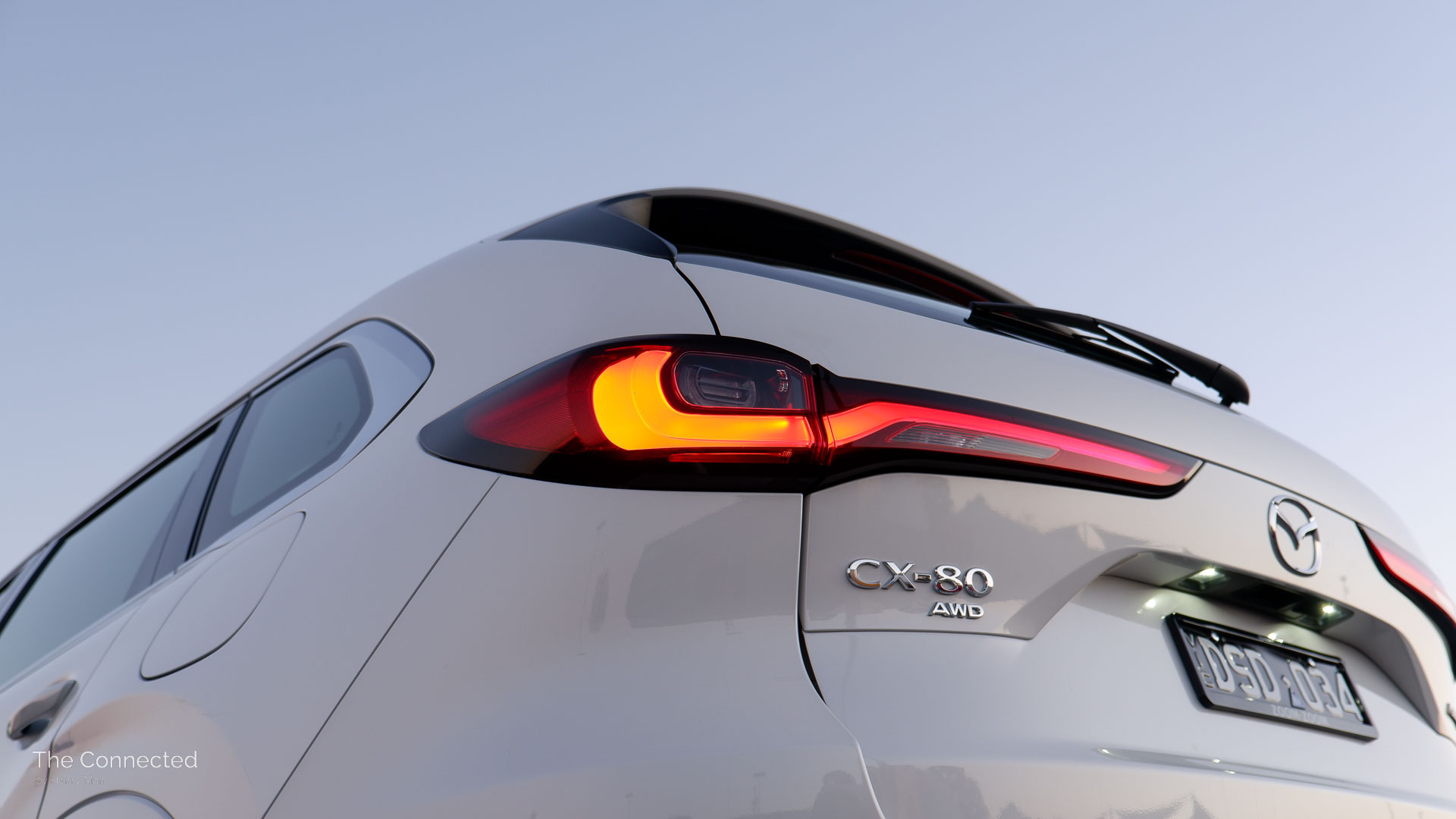
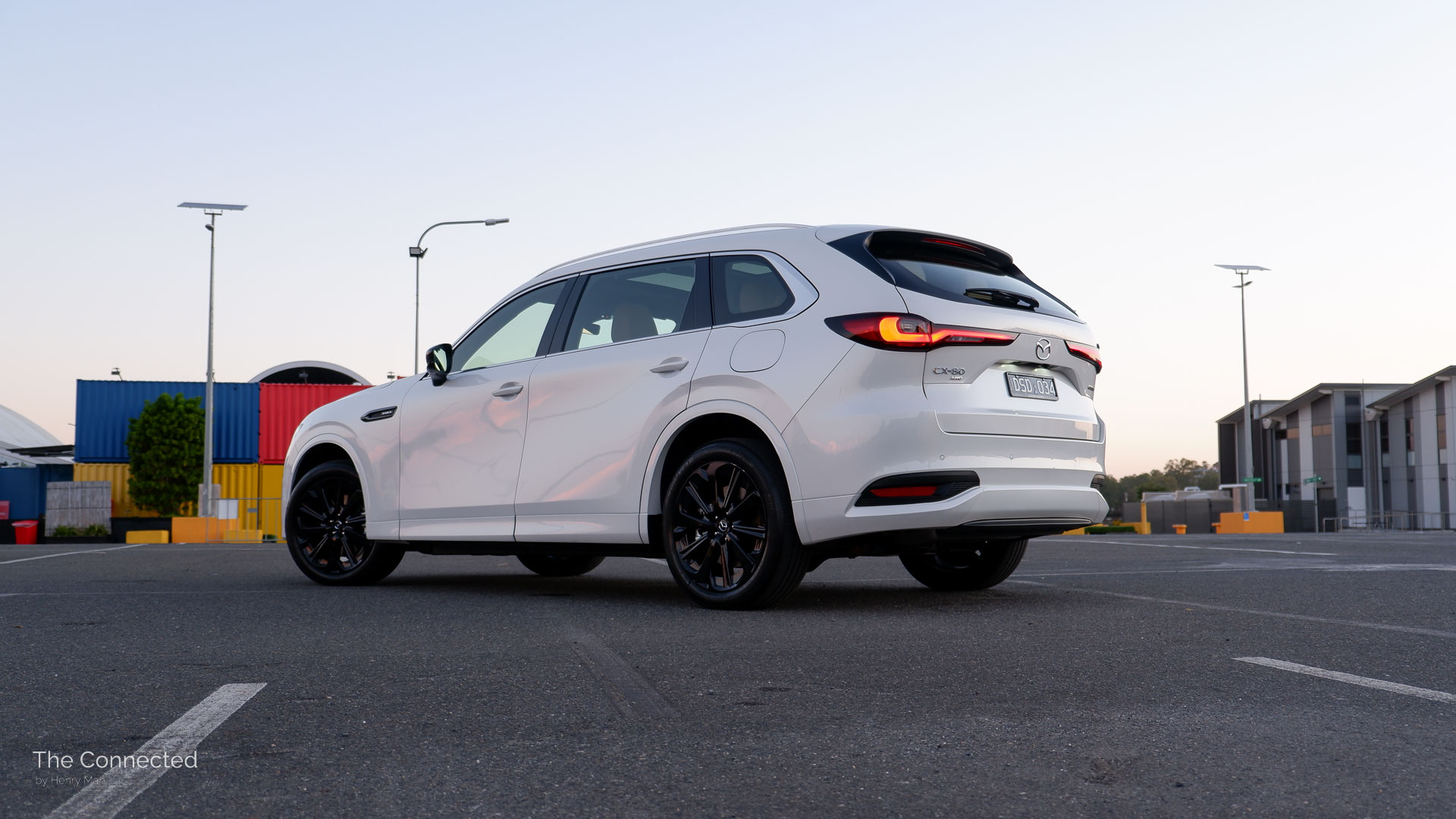
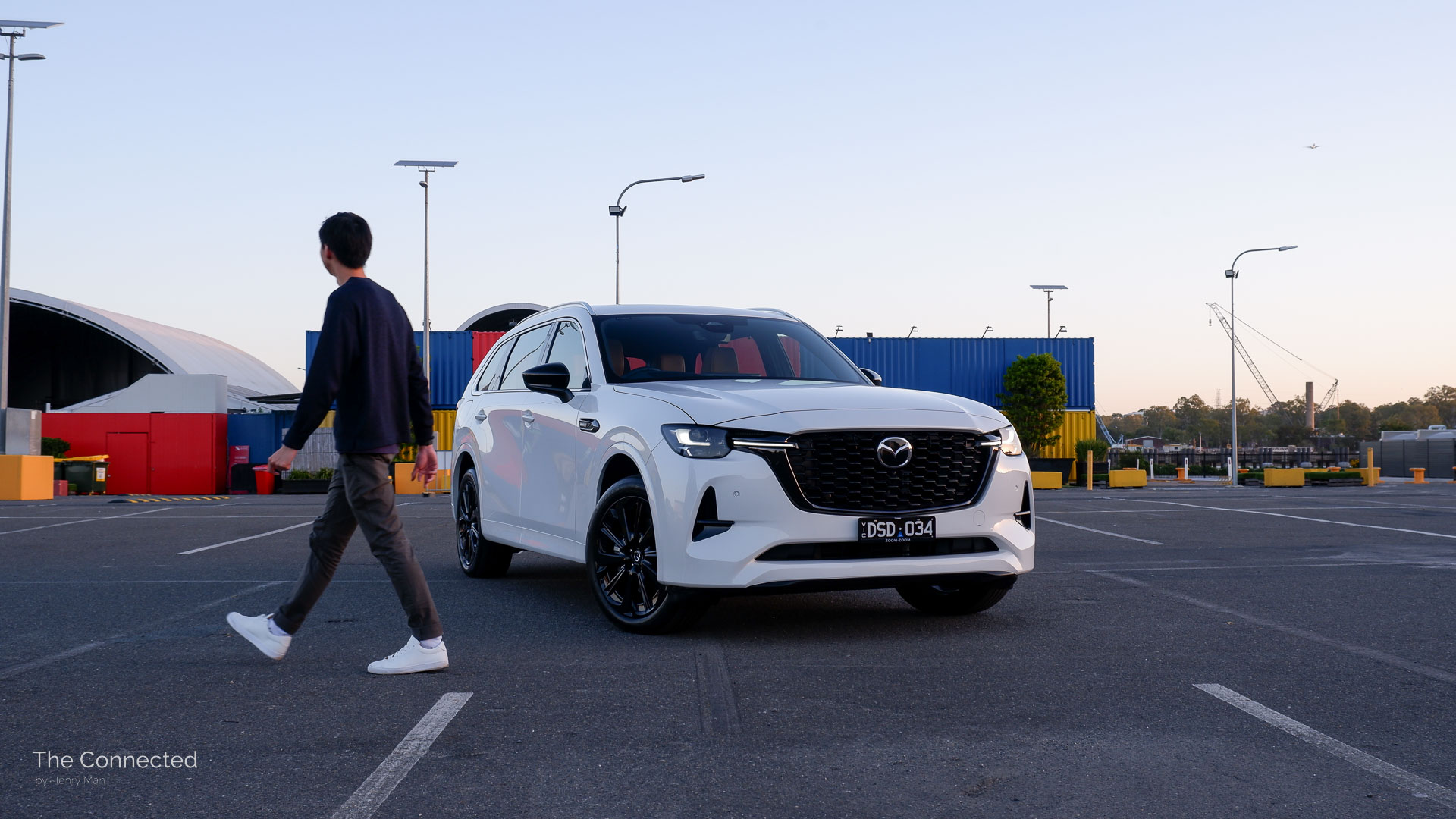
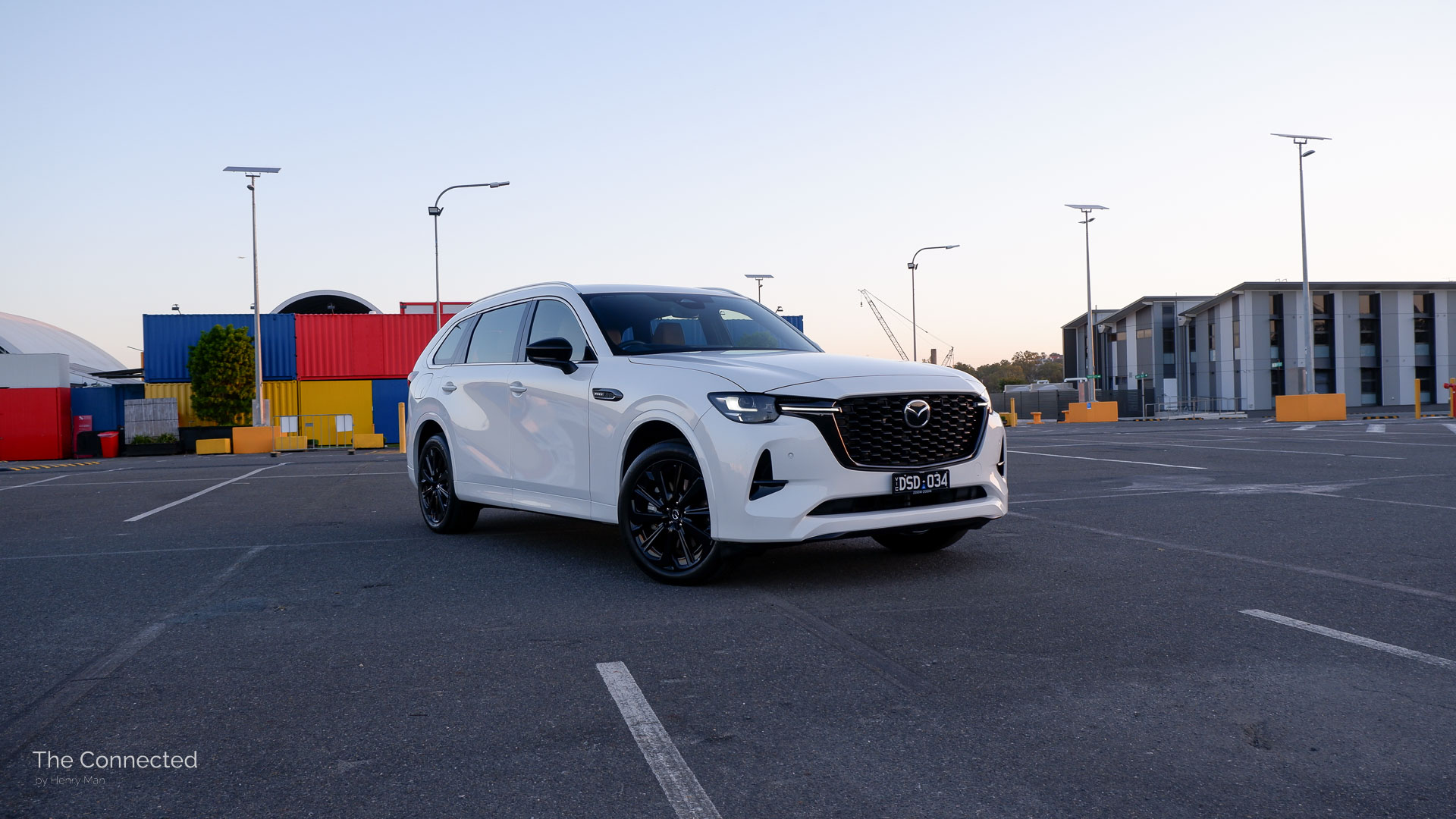
The Mazda CX-80 boasts an upmarket design with a noticeably longer rear than the CX-60.
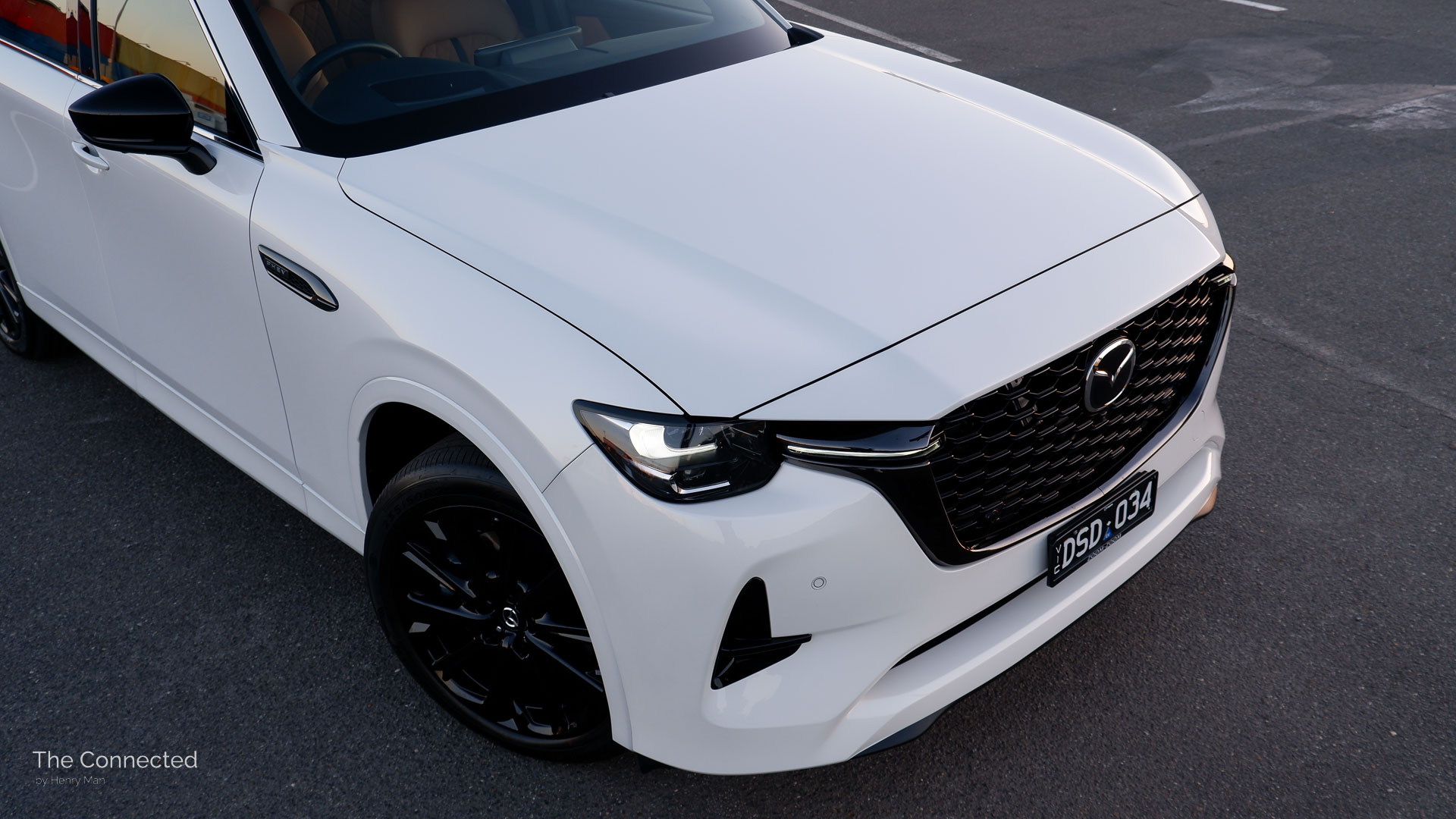
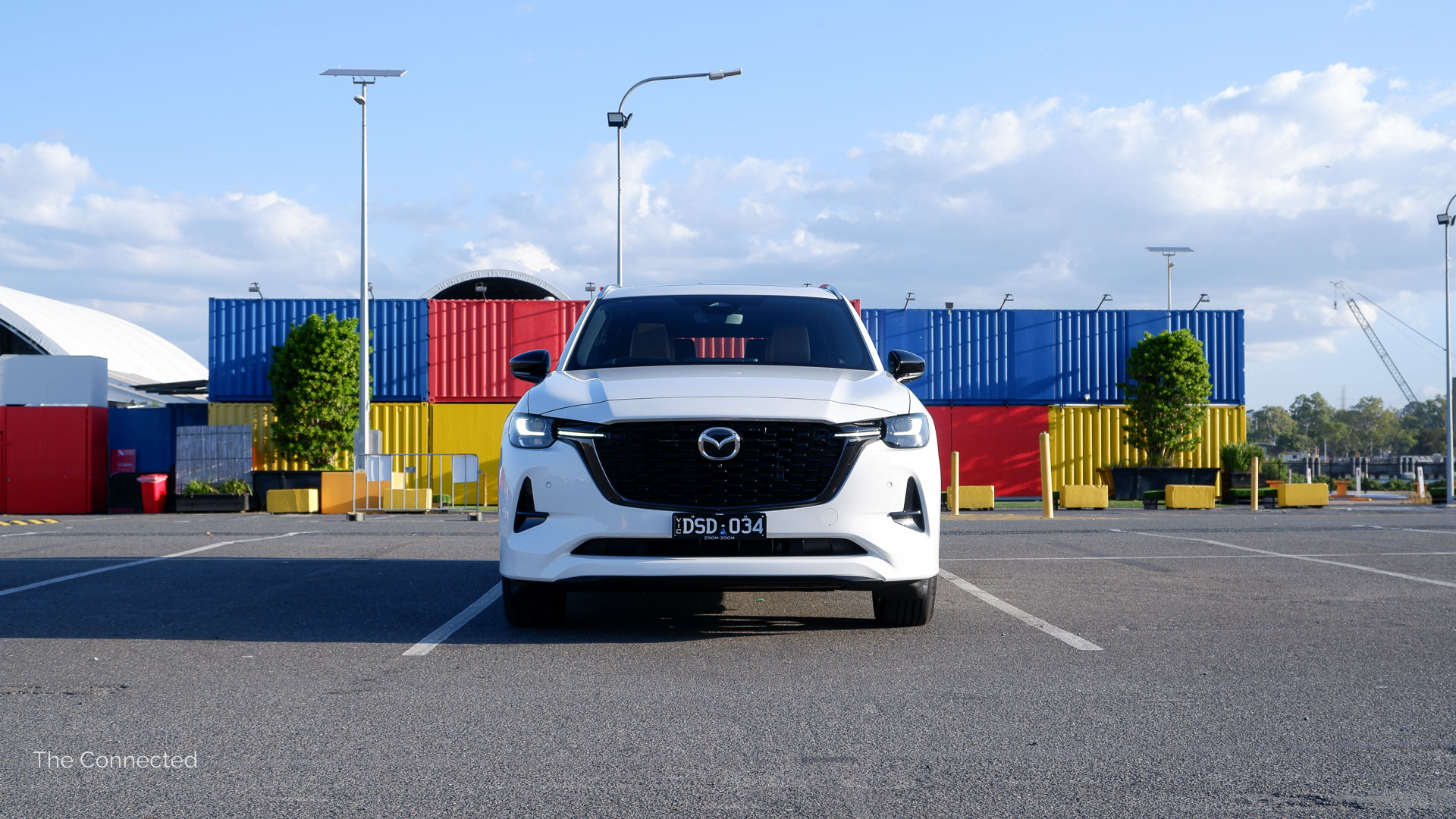
In line with other Large Architecture models, from the CX-60 to CX-90, it’s a rather understated exterior with a wide stance and a long bonnet.
Since the Mazda CX-80 is an extended wheelbase version of the midsize CX-60, it looks slightly awkward side-on with longer rear doors that bode well for practicality. It also has a unique rear bumper.
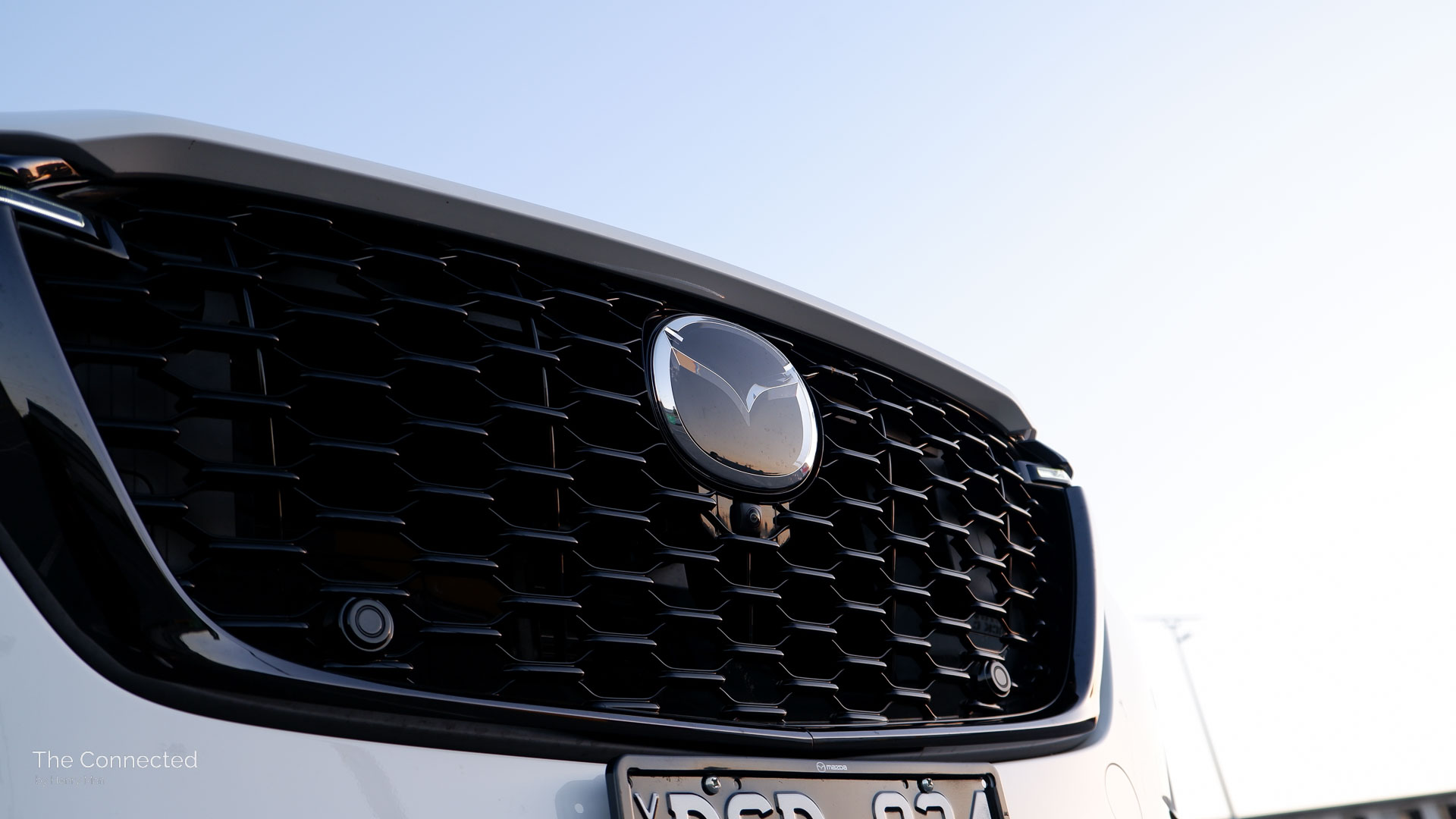
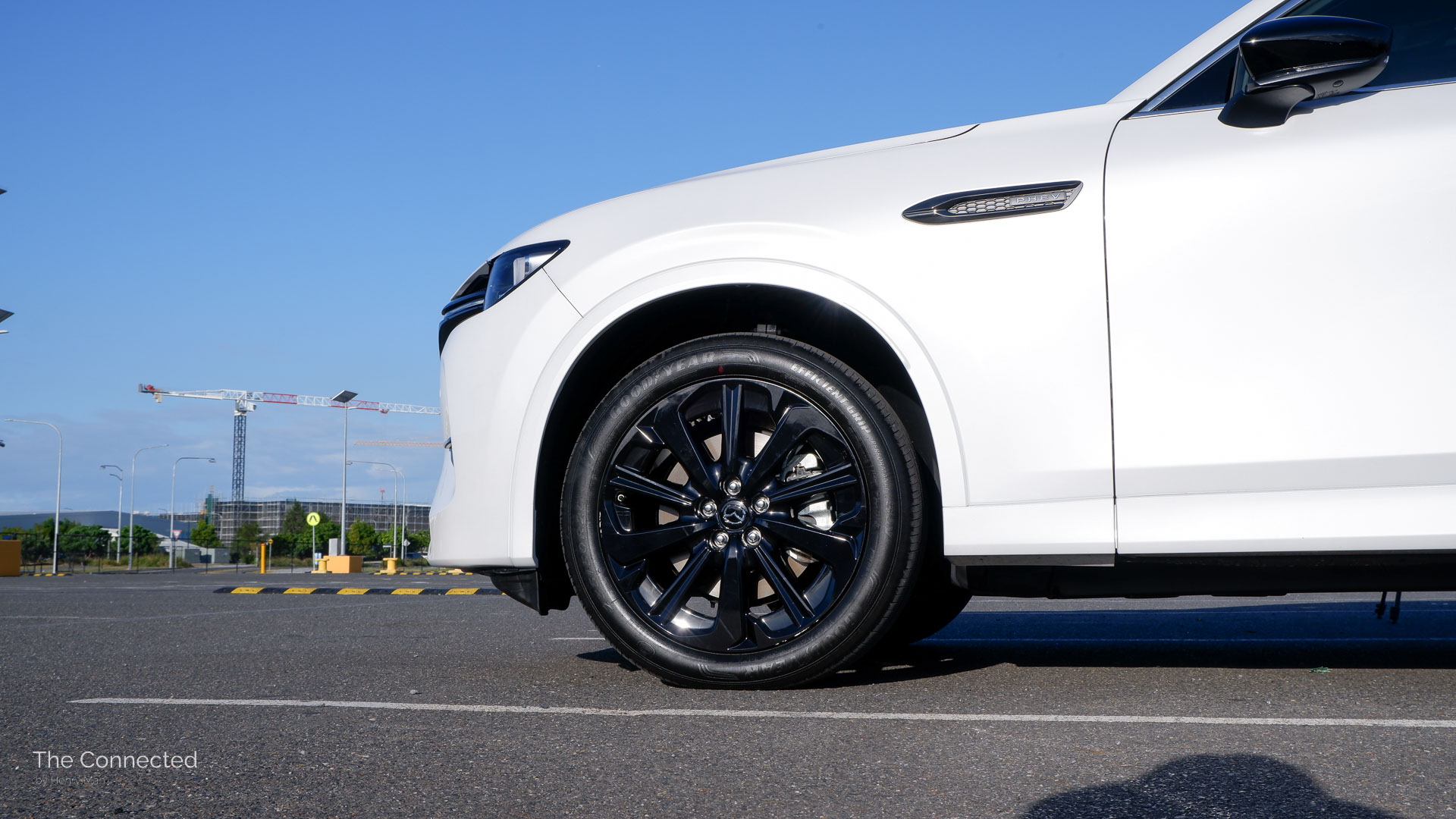
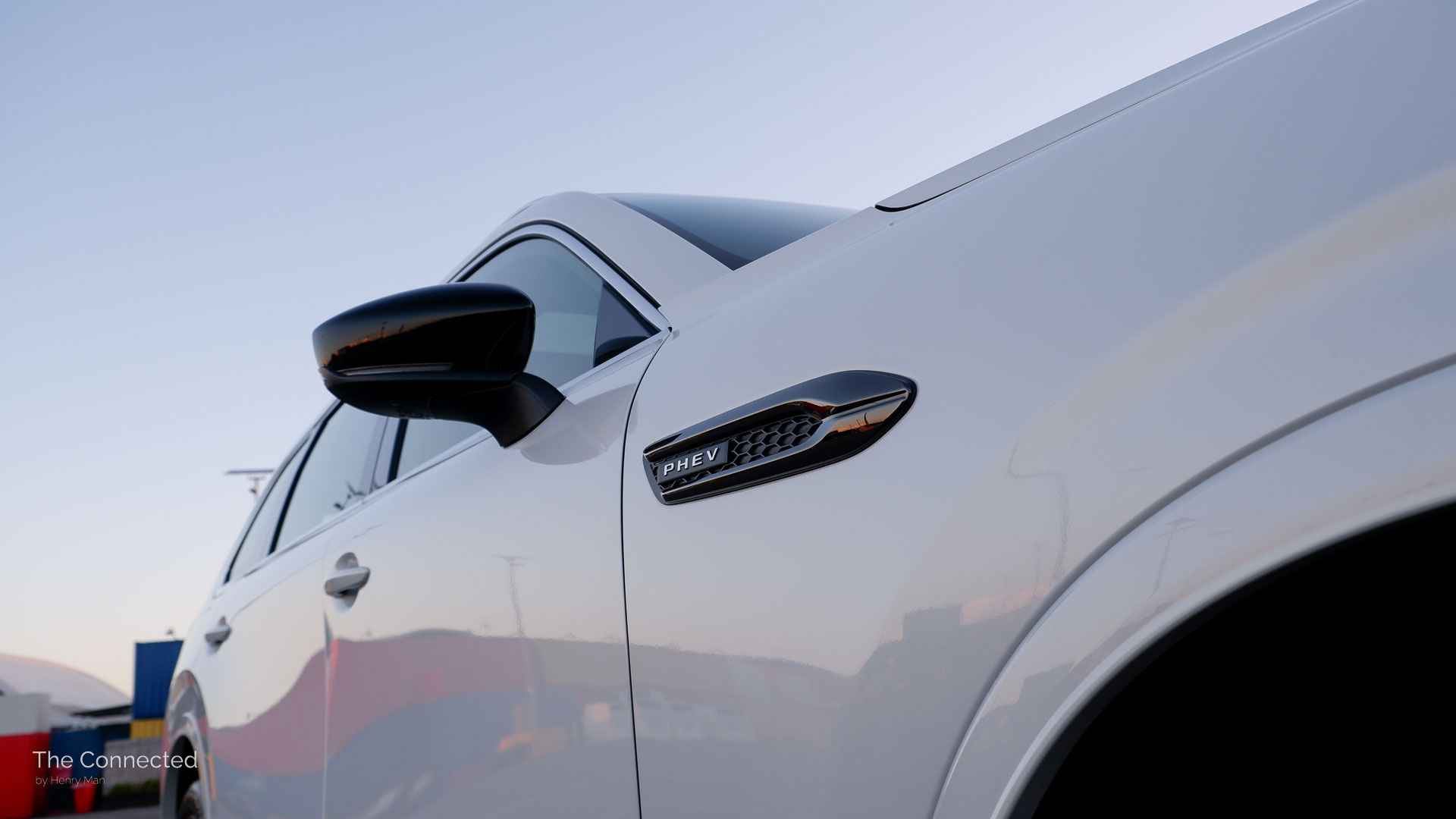
On this flagship Azami model, paying $5000 for the SP Package applies gloss black to the wheels, mirror caps and grille surround – so it ironically looks identical to the second-from-the-top GT.
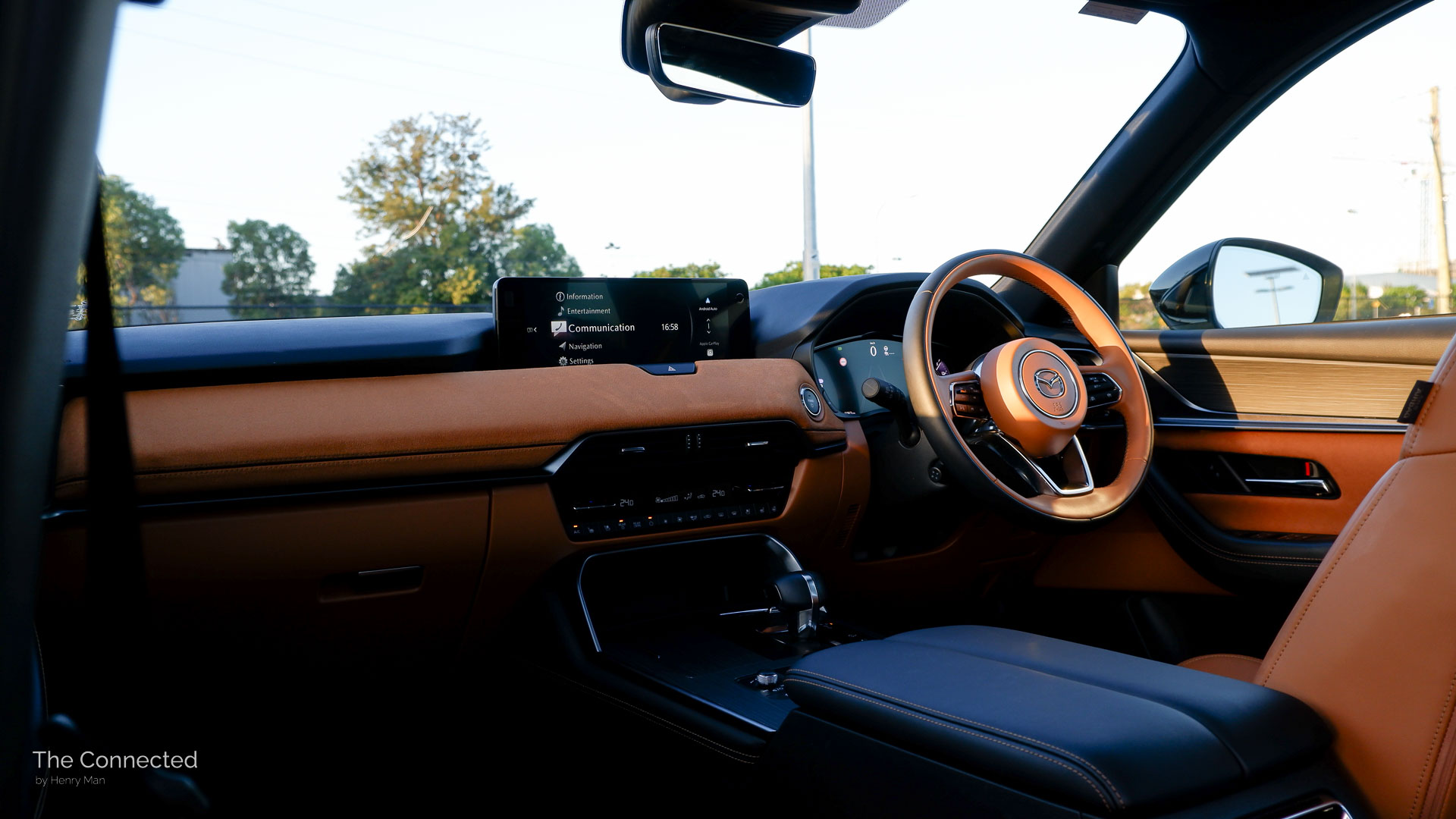
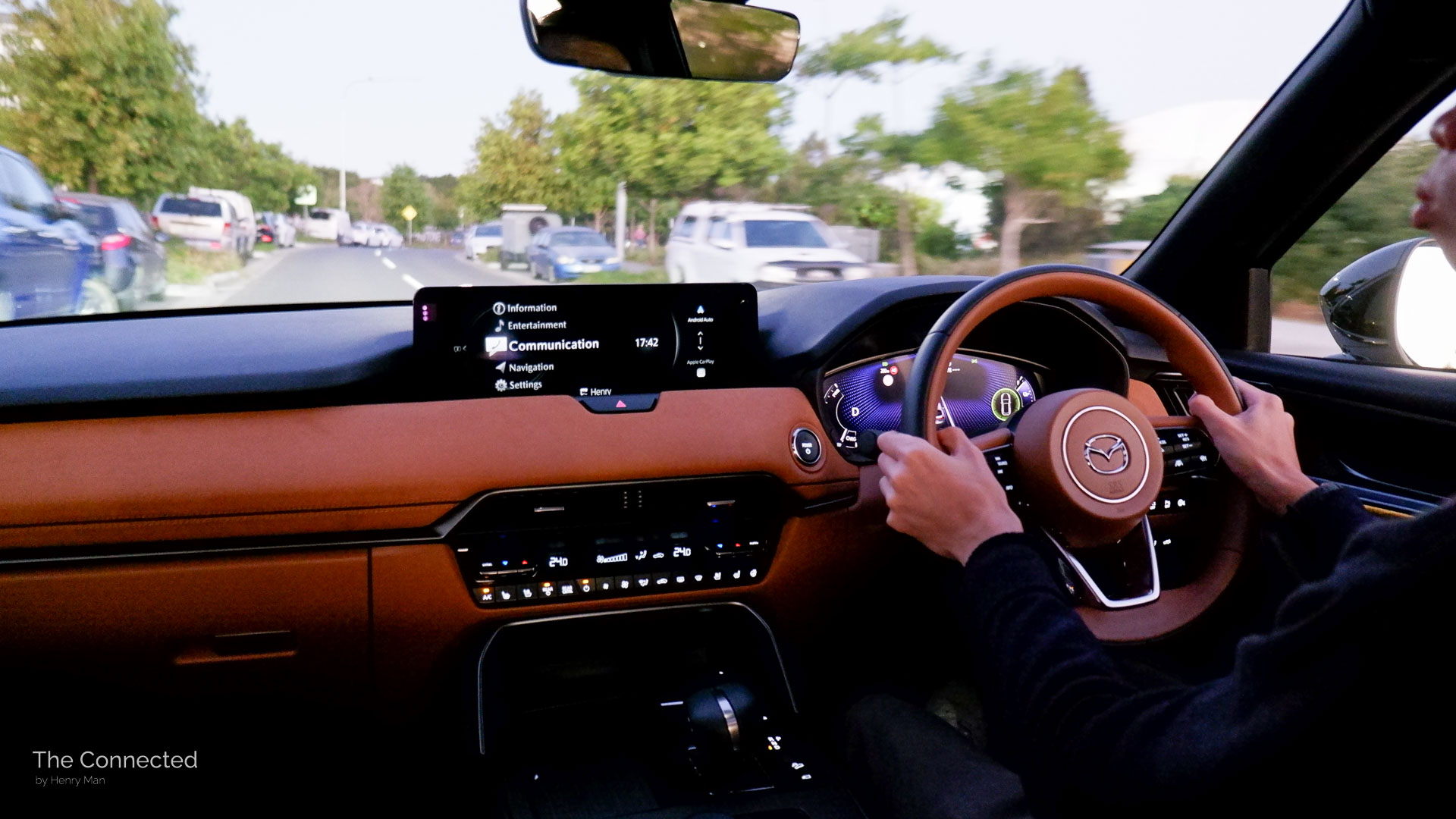
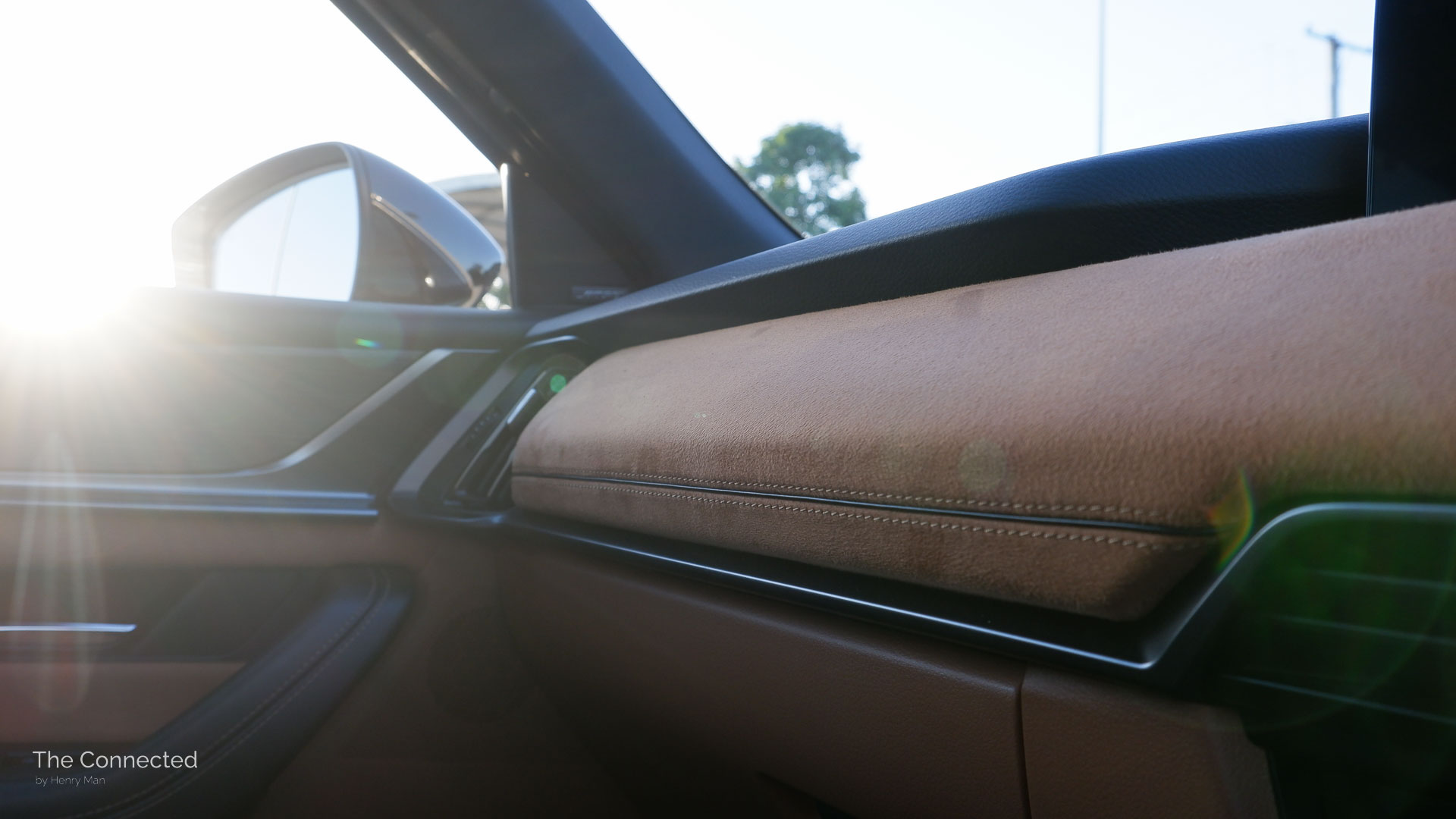
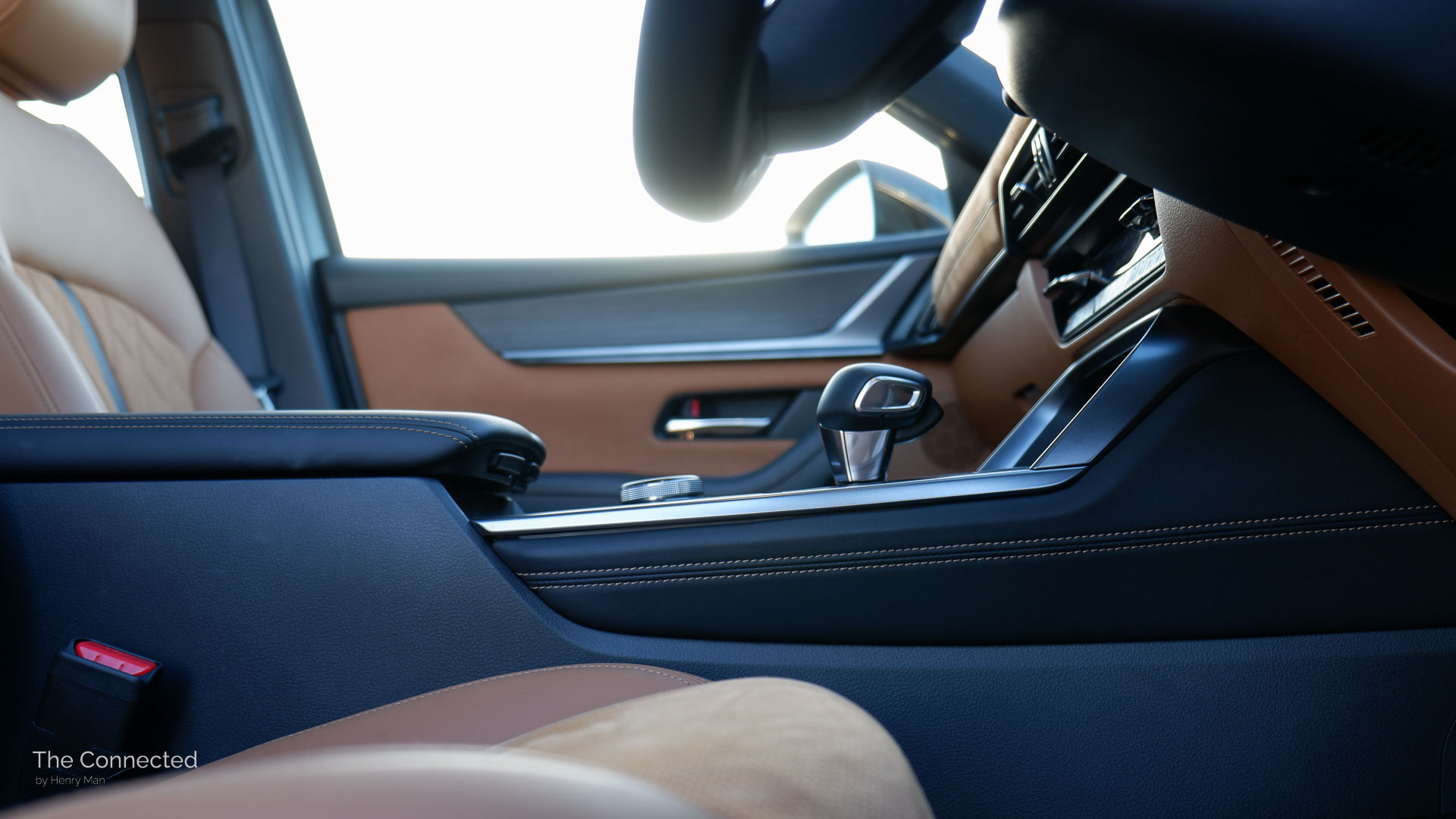
It also substantially lifts the perceived quality of the interior with a luxurious two-tone tan and black theme, plus a six-seat arrangement.
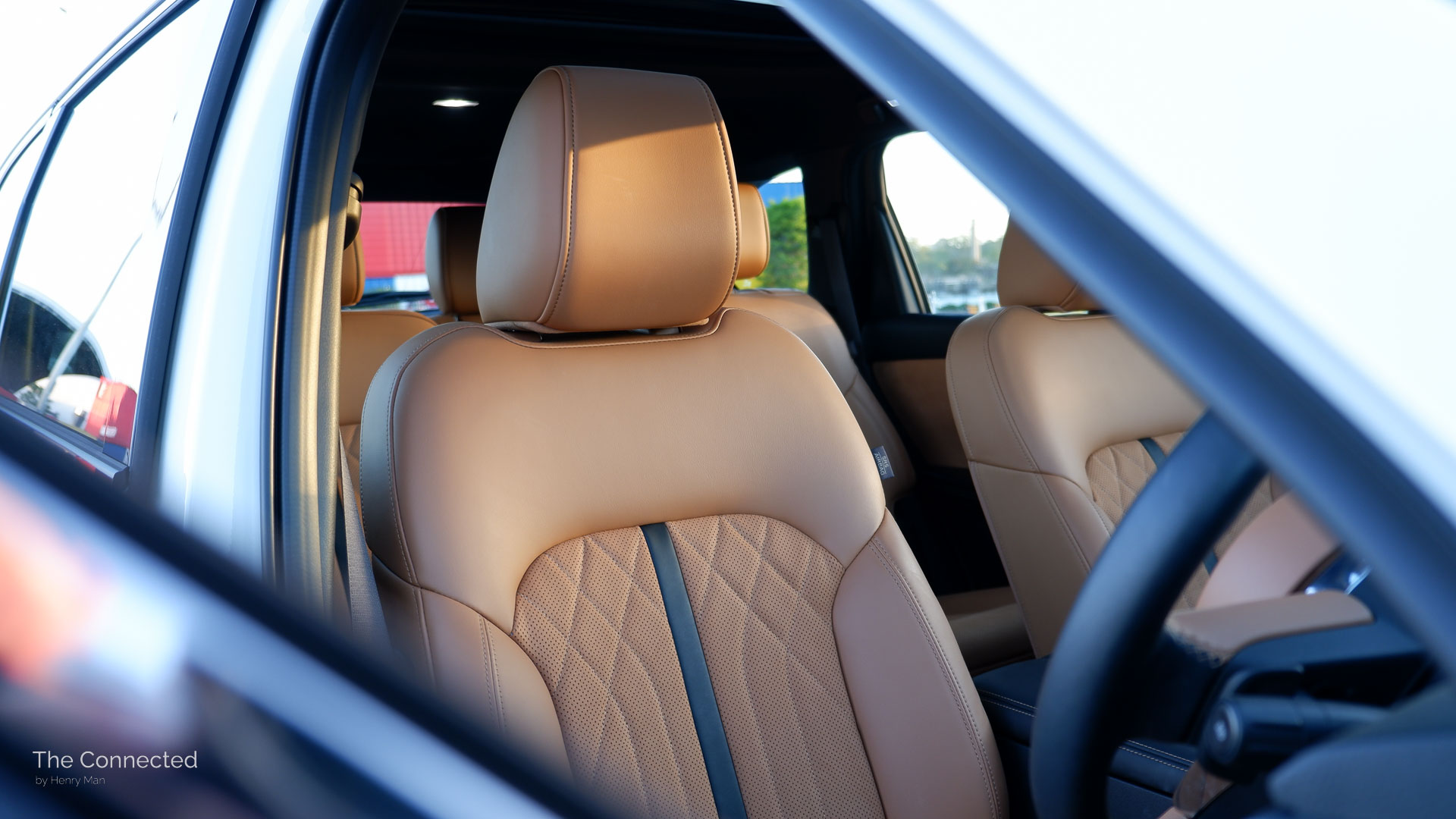
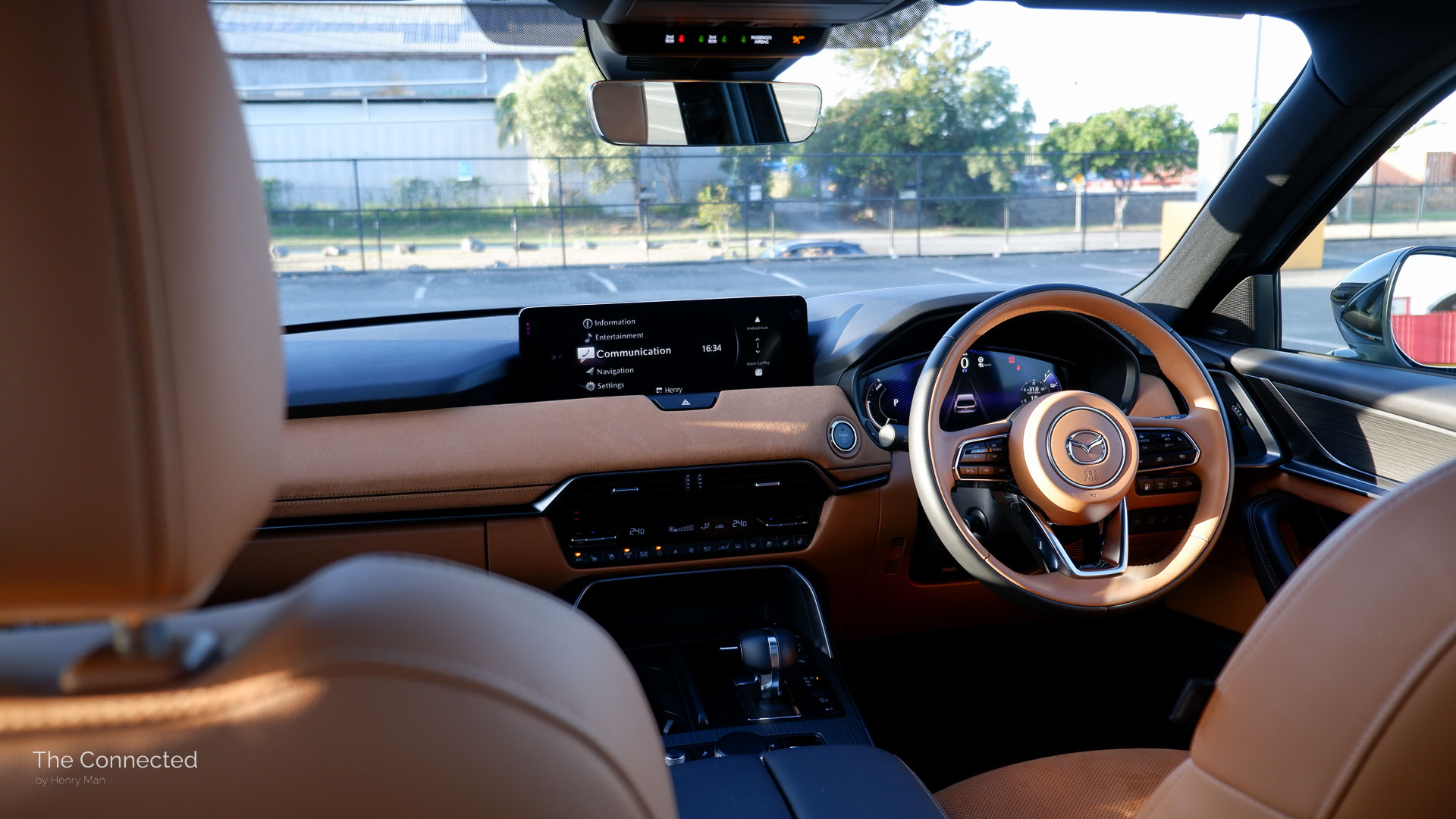
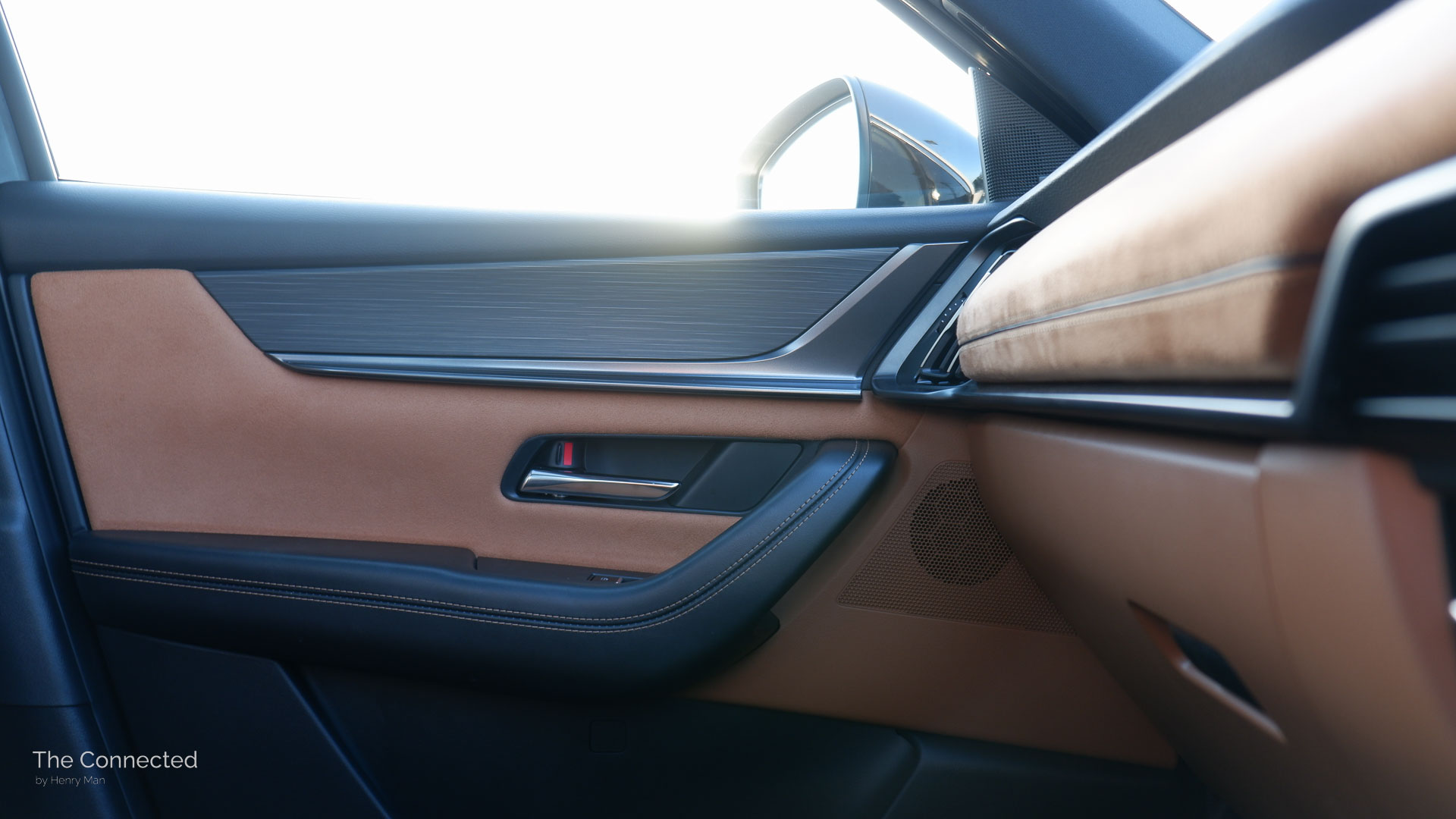
All seats feature a suede centre with Nappa leather side bolsters and a black middle stripe, the dash and door cards are plush suede with black stitching, the faux wood and metallic-look trims are darkened, the steering wheel is two-tone, and the headliner is also dark.
It’s a stunning, eye-catching and luxurious-presenting interior – surprising for a Mazda – and worth paying the extra $5000 if you can already stump up to the Azami.
However, while material quality is generally great, there are some cost-cutting signs in quality and refinement that should be better for its $80K-plus price.
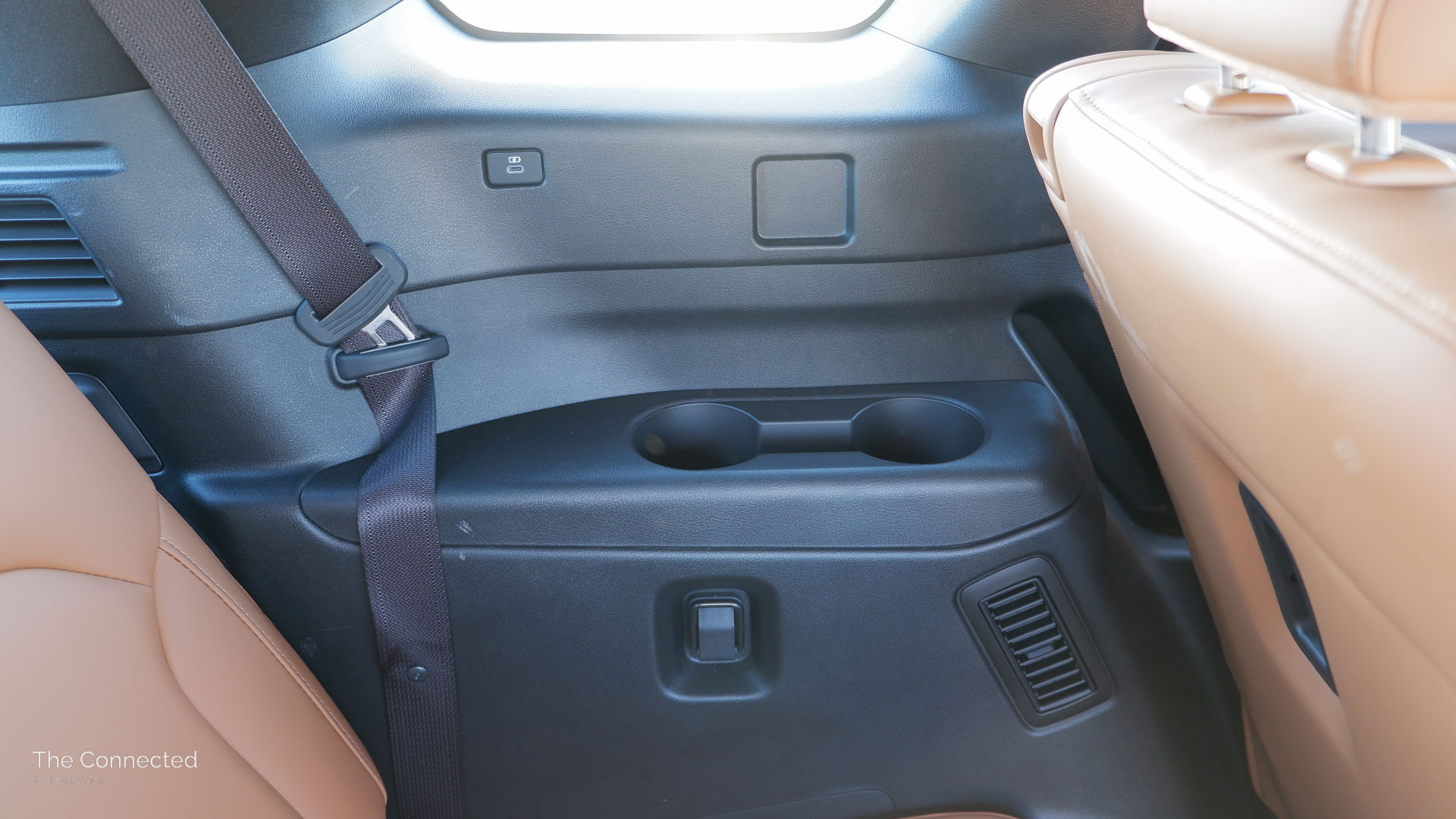
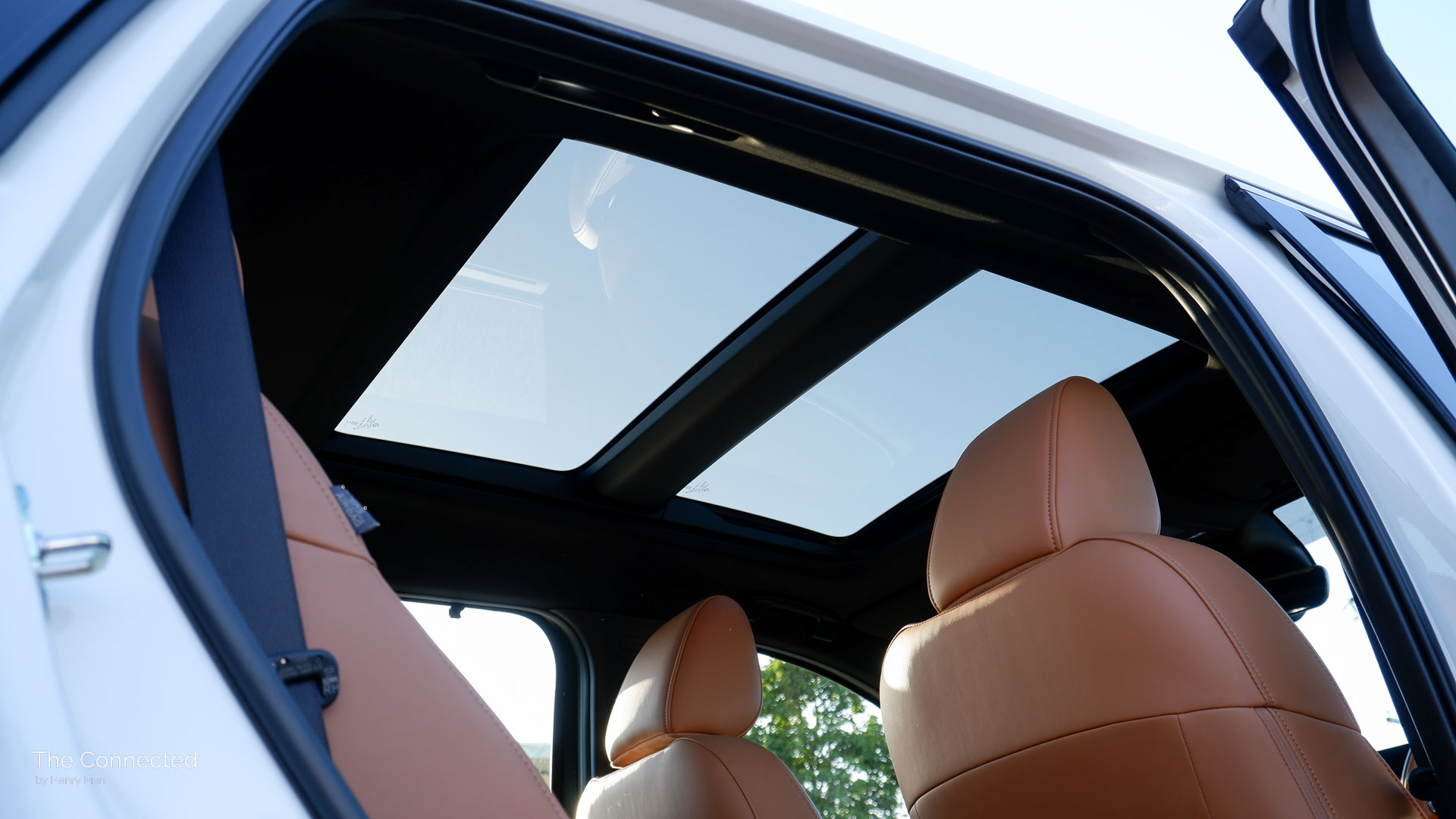
On my tester, the headliner in the front of the sunroof can be pressed in with an unnerving creak when the sunblind was open, the door closing thunks don’t sound as solid compared to even the attainable CX-3, the seat ventilation fan is loud, the boot pocket covers on each side is flimsy, and the plastic levers to adjust the second- and third row seats don’t feel sturdy.
I wouldn’t say the Mazda CX-80 Azami SP is a proper luxury SUV, but it’s close and looks stunning on the surface.
Practicality.
2026 Mazda CX-80 P50e Azami SP dimensions:
| Length x width x height | 4990 x 2134 x 1710mm |
| Wheelbase | 3120mm |
| Ground clearance | 175mm |
| Boot space (min / 3rd row folded / max) | 258 / 566 / 1971L |
| Rear seat split fold (3rd row) | 50:50 |
| Child seat anchors | 2x ISOFIX and 4x top tethers |
| Air-conditioning system | Three-zone climate control with rear 2nd and 3rd row air vents |
The Mazda CX-80 isn’t the most practical SUV, but offers three rows of seats when you need it at a pinch.
With all rows in place, the CX-80 offers a 258-litre boot which is small and good enough for some bags only.
Pulling the velcro tabs and pushing down the third row expands the cargo space to 566 litres.
While underfloor space is limited, it is impressively designed to neatly fit the included retractable cargo cover and a big charging cable bag.
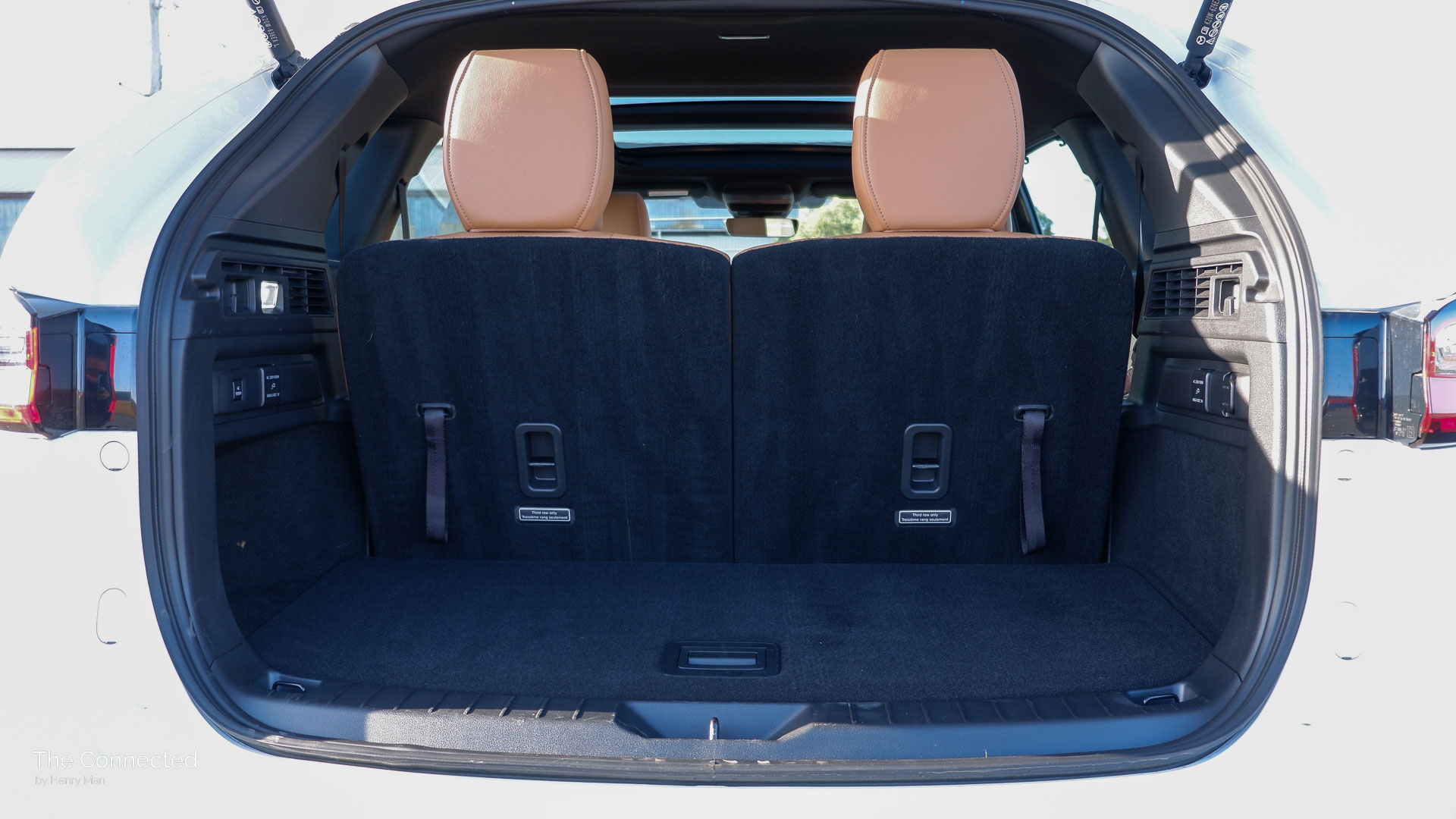
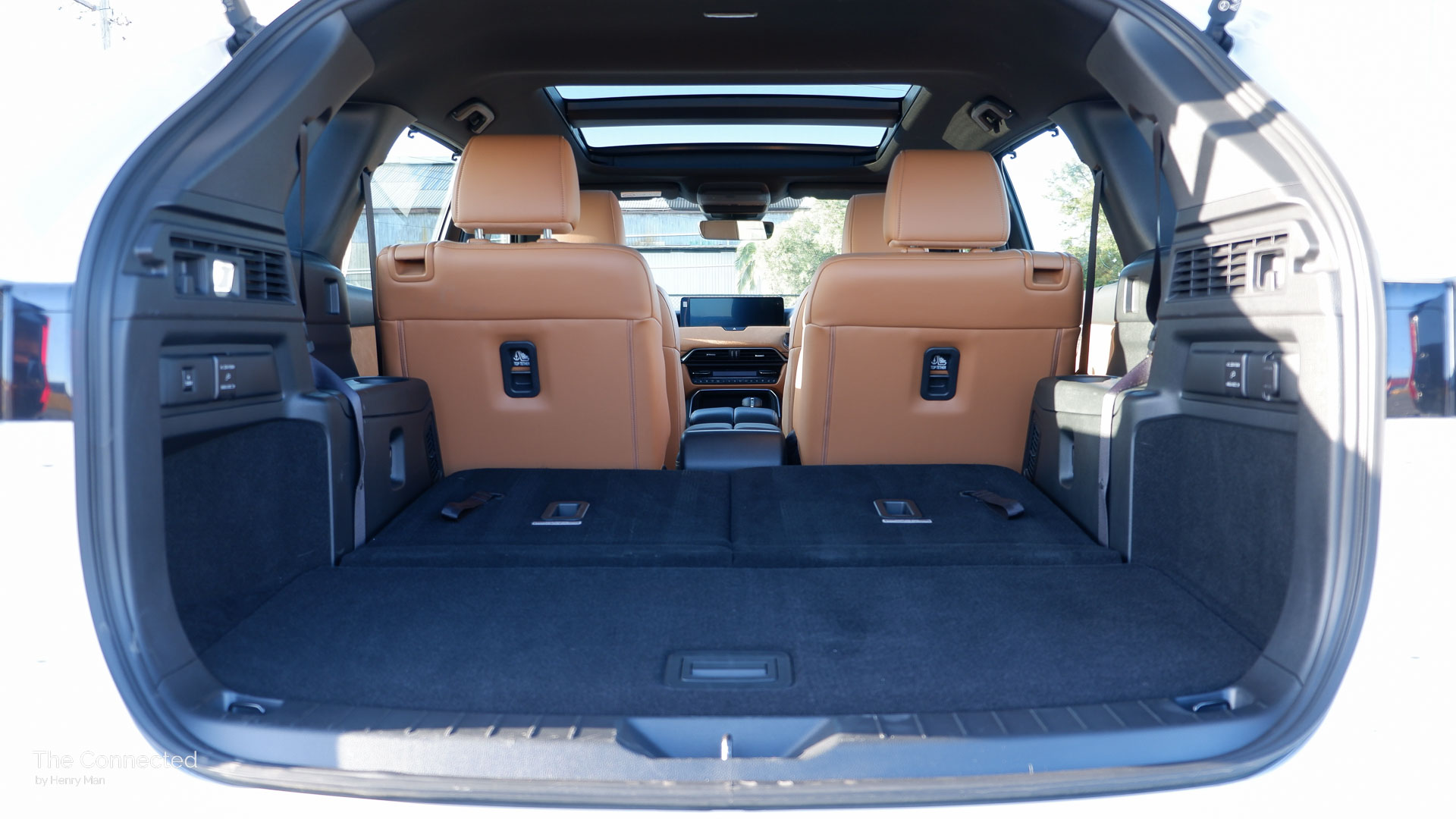
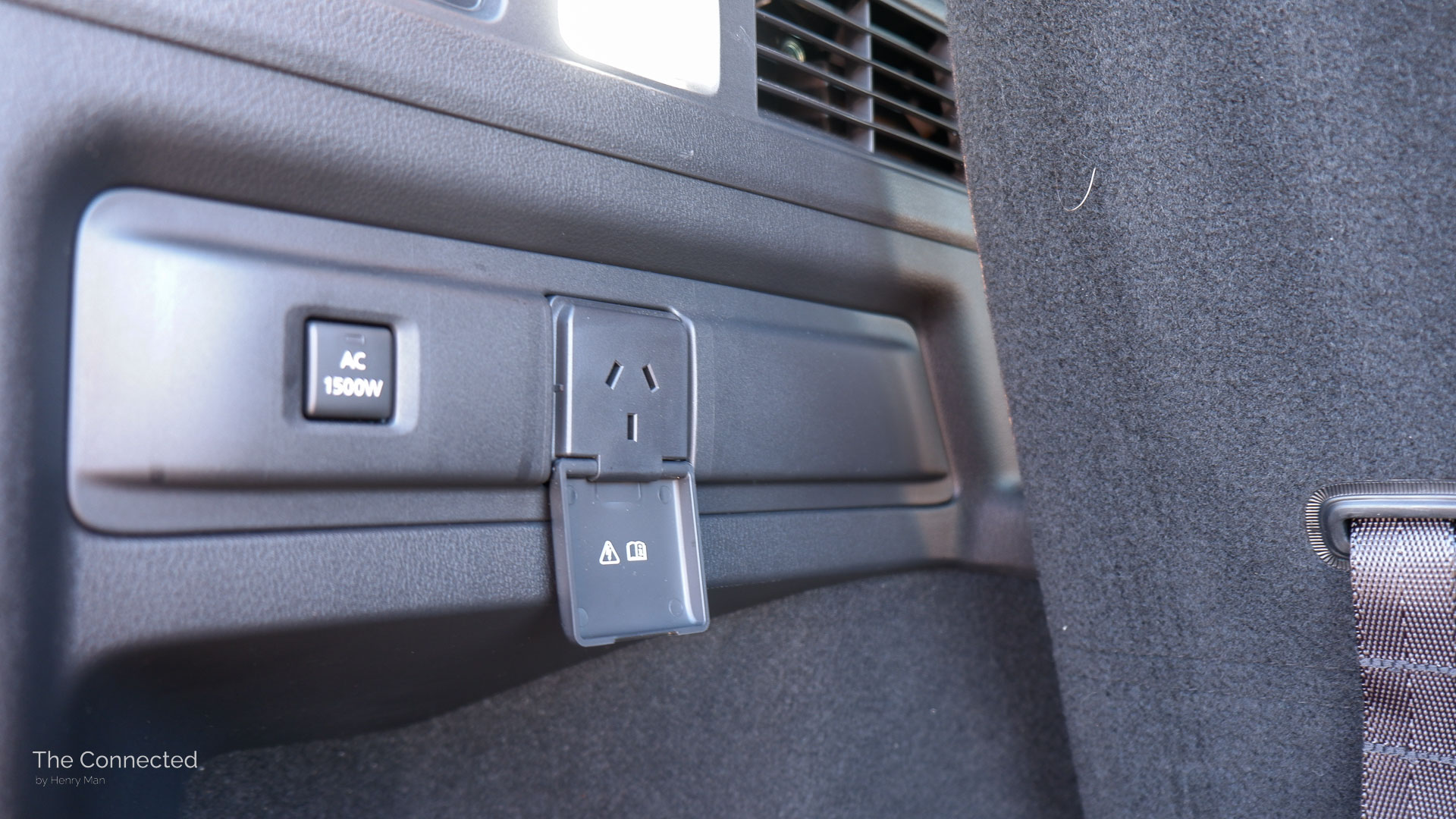
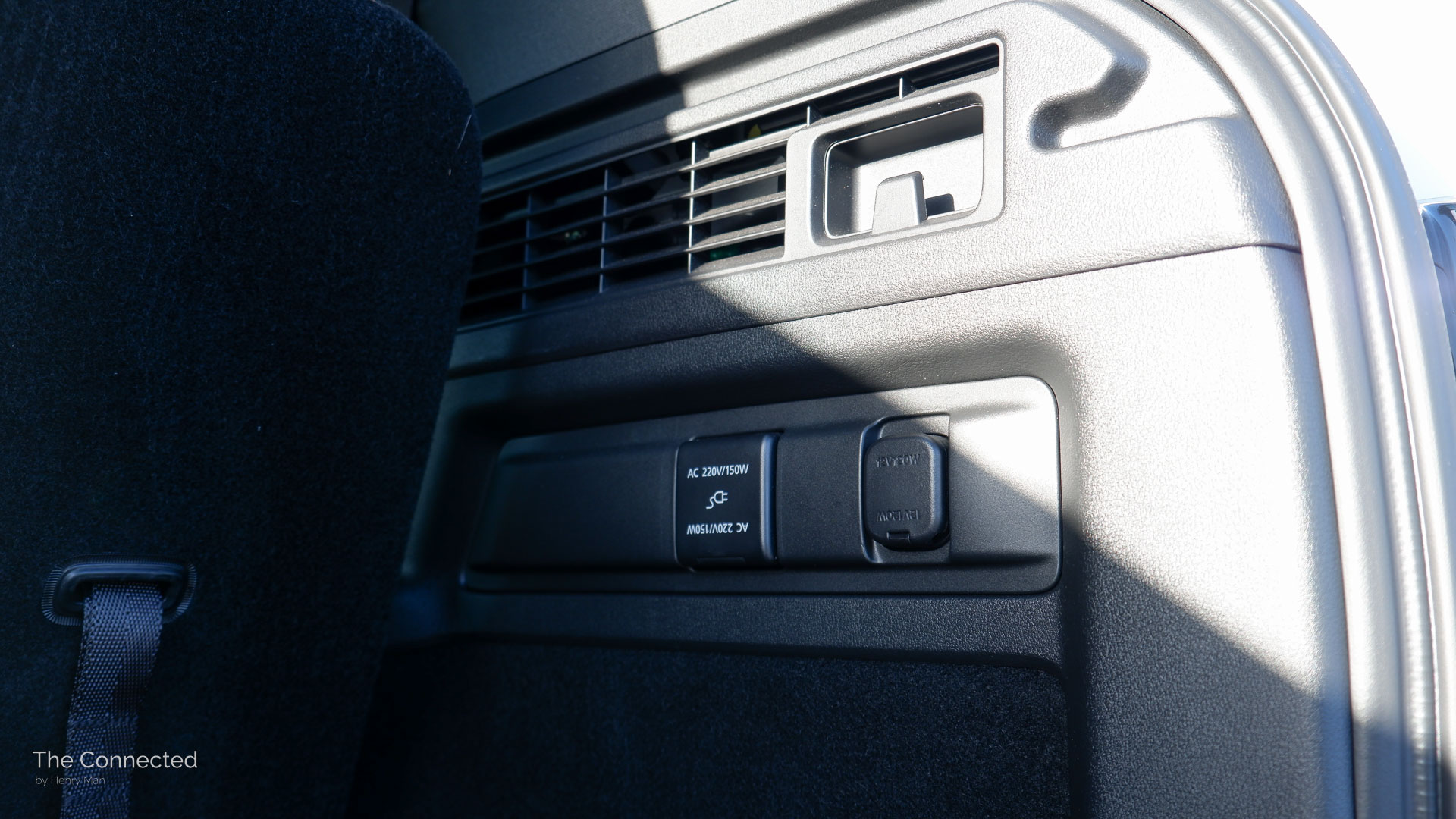
An LED light effectively illuminates the boot, but the cargo cover isn’t as cleverly integrated with the tailgate as per its CX-60 twin and, while there are solid bag hooks on each side, they’re placed so close to the outer edge of the boot that it isn’t as useful.
The right side of the boot has a 150-watt vehicle-to-load (V2L) domestic power socket and a 12-volt socket, while the left side offers a more powerful 1.5kW V2L plug which can be enabled with pressing a button.
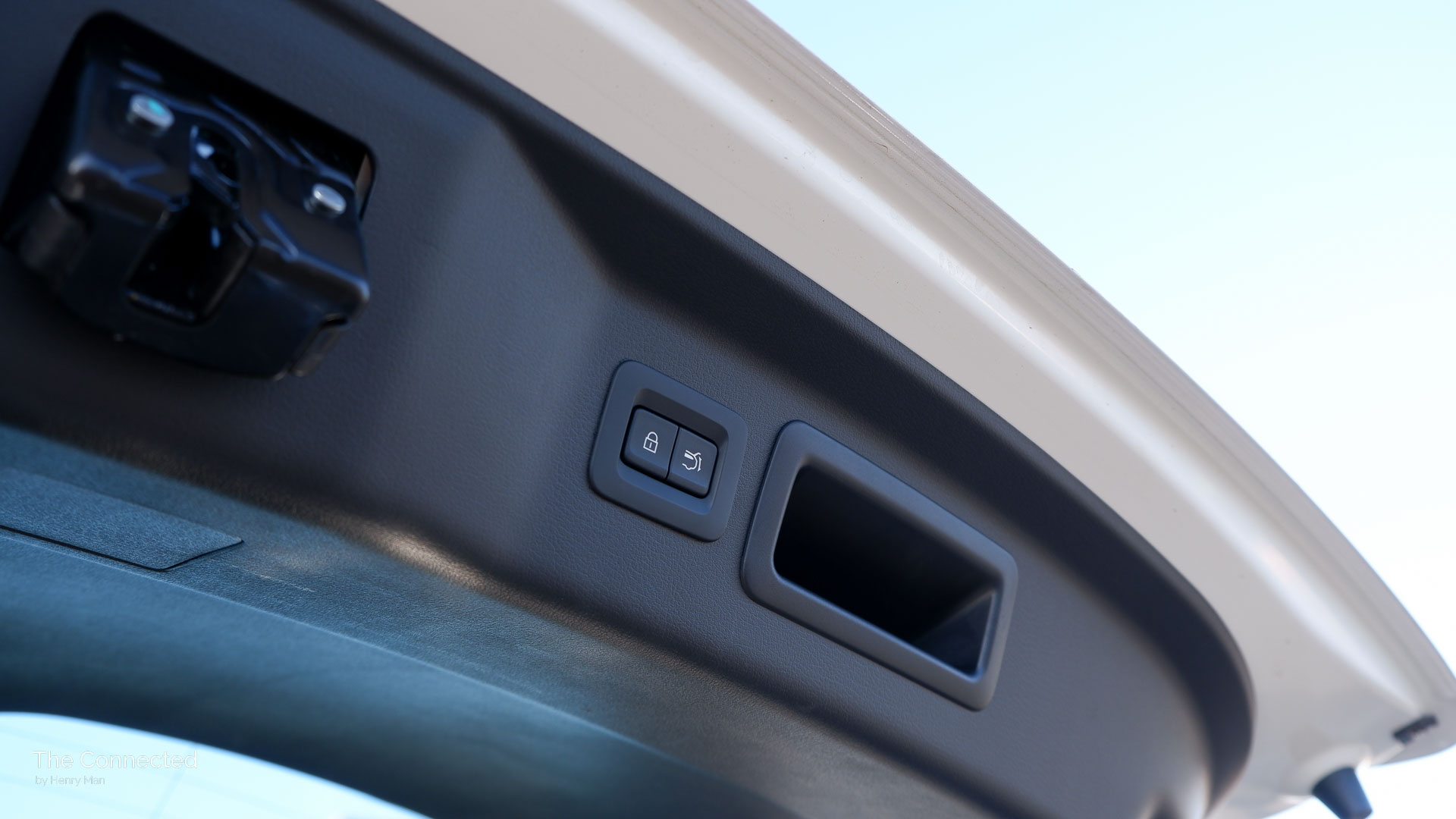
The hands-free electric tailgate opens and closes with an easy kick under the bumper even when the car is on. There’s a handy button to close the boot and lock all doors, too, even though the buttons are tiny.
But the key advantage of the CX-80 is having three rows of seats without driving a properly large SUV.
The rear doors are longer than the CX-60 with no wheel arch intrusion and a wide opening.
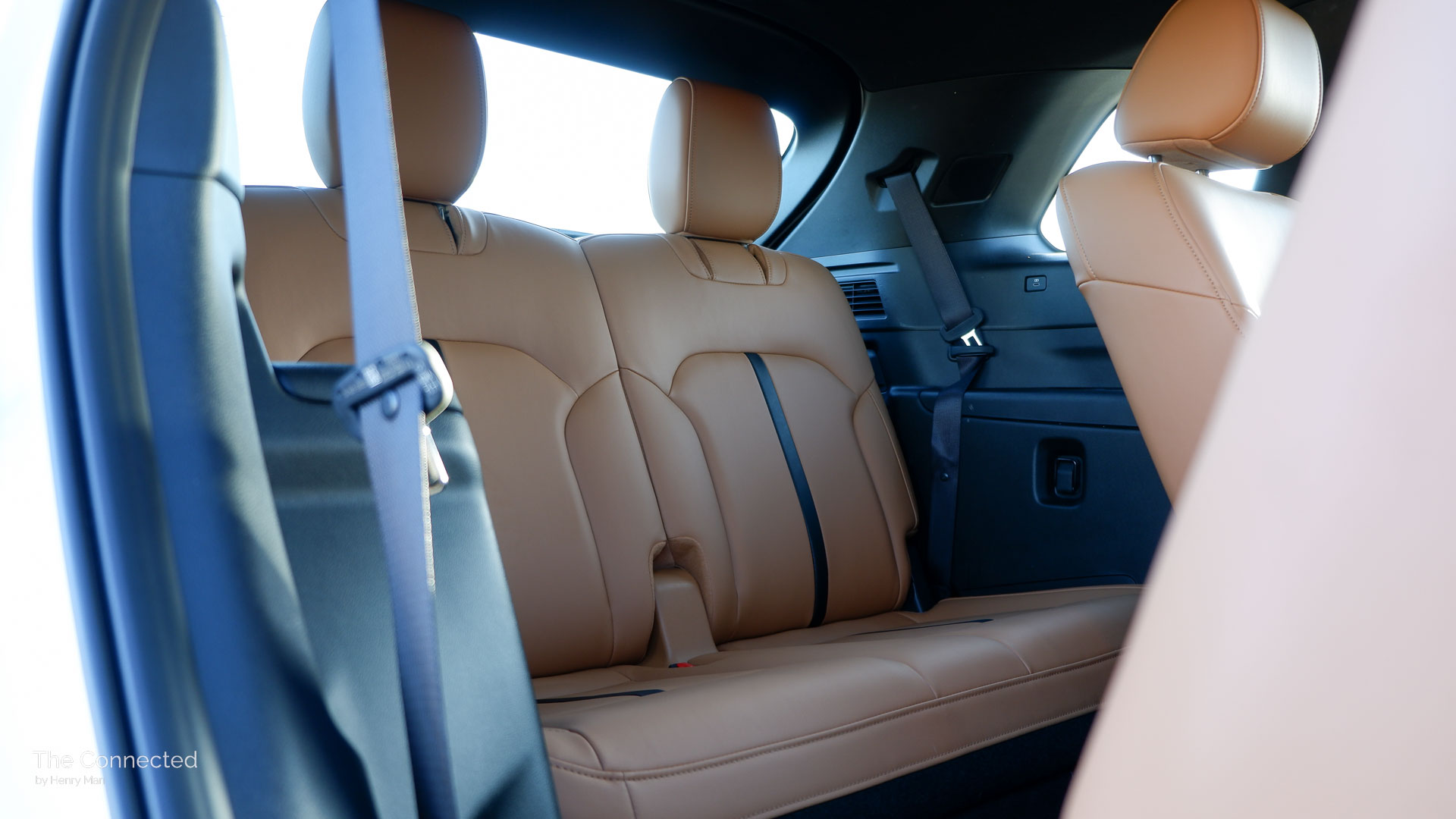
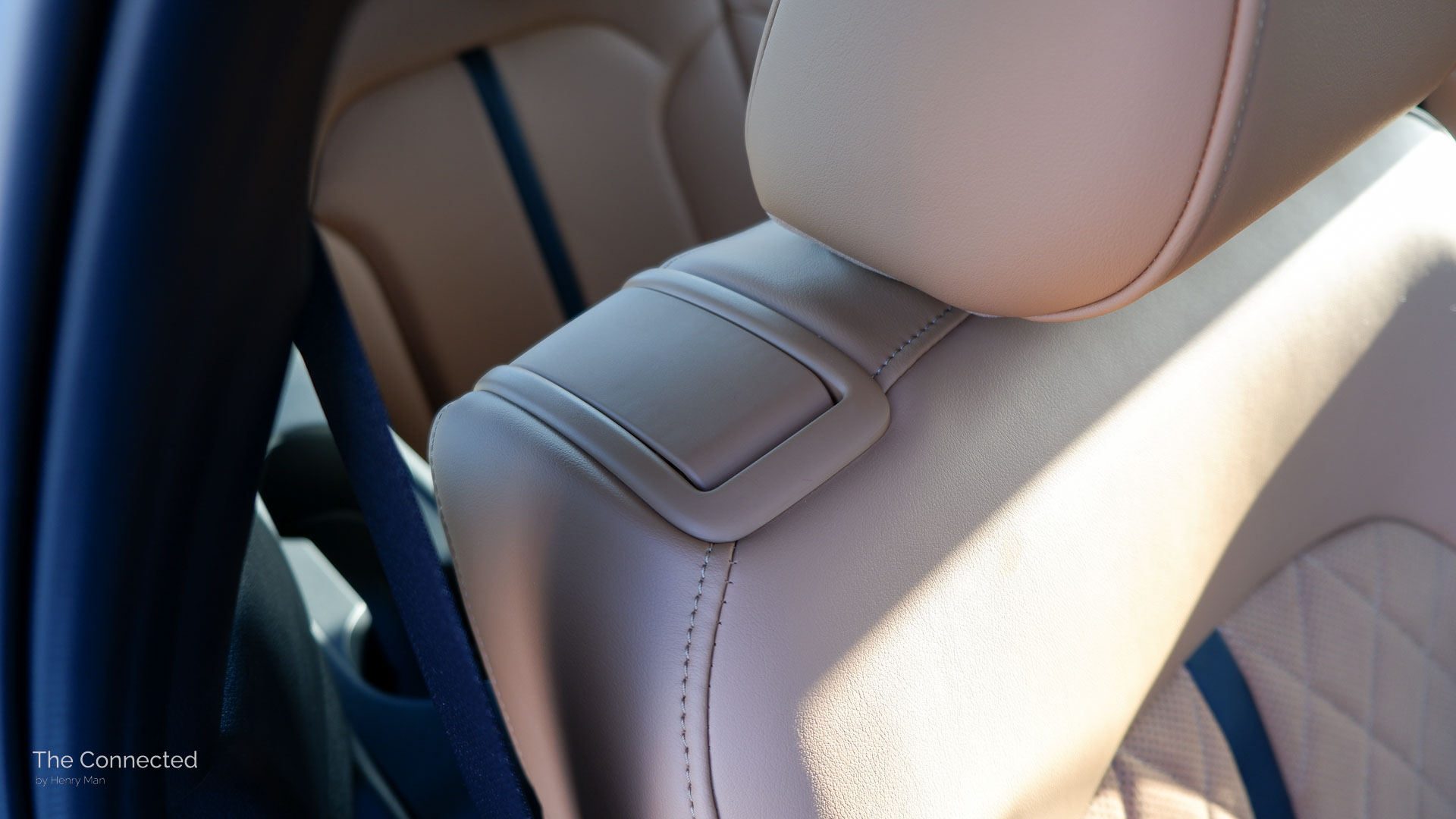
To get in the third row, passengers need to pull a plastic tab atop the second row, then manually push the seat back and base with some force as it’s rather heavy.
There aren’t seatbelt holders for the second row so they dangle and slightly get in the way, plus Mazda doesn’t include pillar grab handles to help with ingress and egress.
Once in, the third row is tight and best suited for small kids with child seat anchor points available on both seats, but not ISOFIX. The air vents are also awkwardly placed down at the wheel arch facing passenger’s knees.
You’ll need to slide the second row to yield more legroom for the third row, but even then it’s still restrictive and the floor is very high being on top of the rear axle.
Since the second row doesn’t provide much legroom to begin with, sliding it forward further restricts it.
The Mazda CX-80’s third row shouldn’t be used regularly for teenagers and adults. That’s where the larger CX-90 comes into play with more room for families who need to use all three rows full-time, rather than when needed.
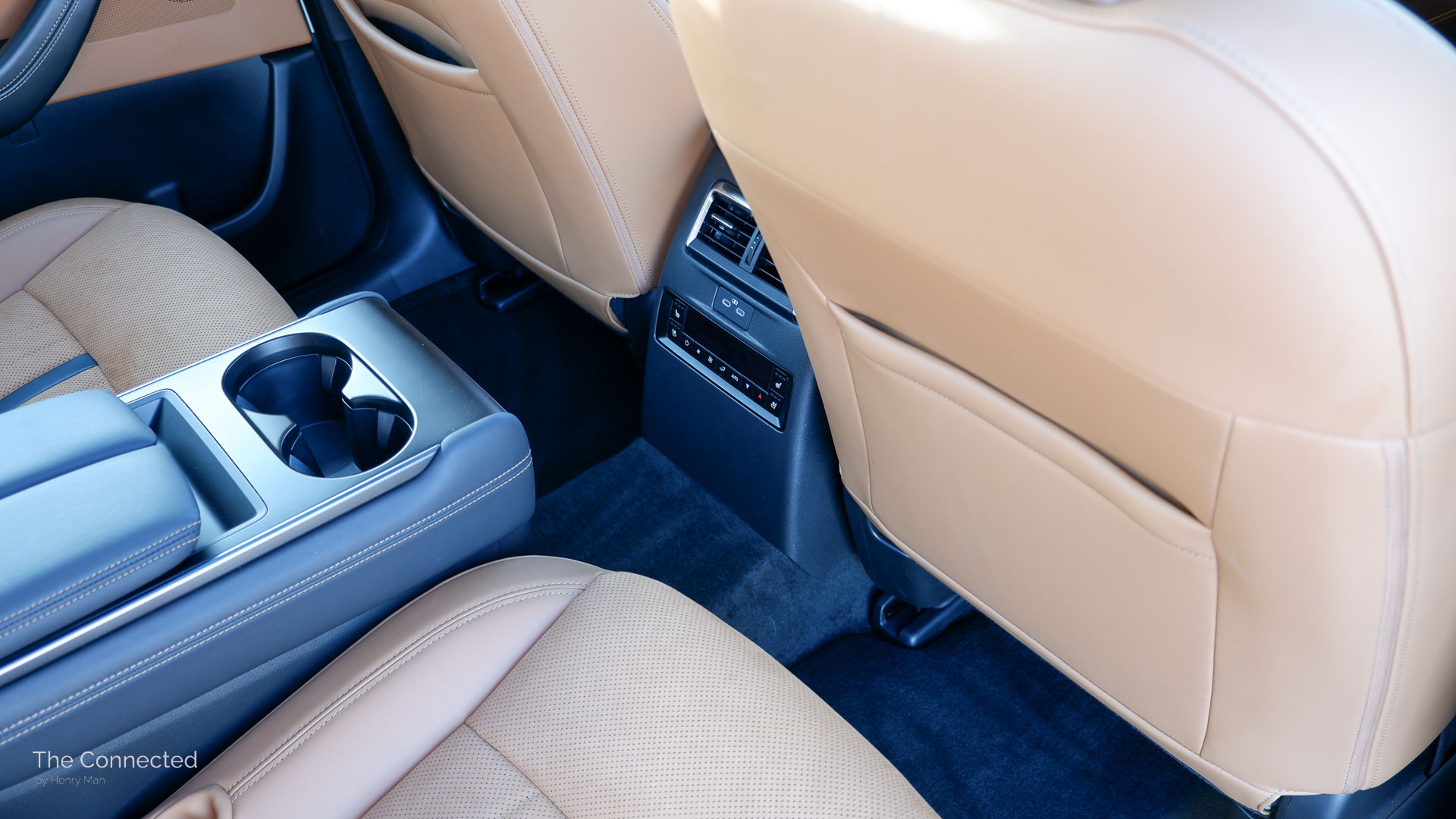
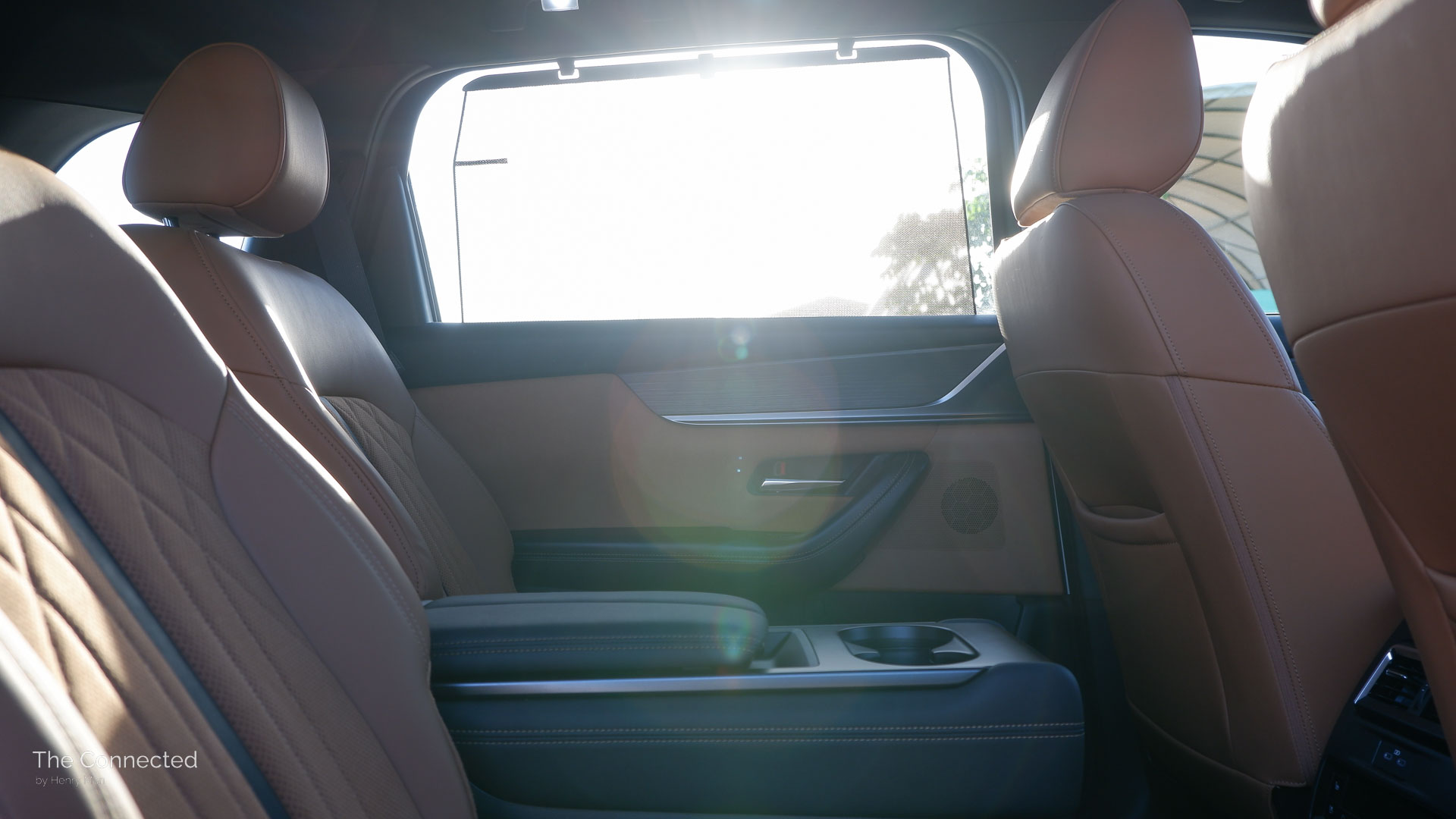
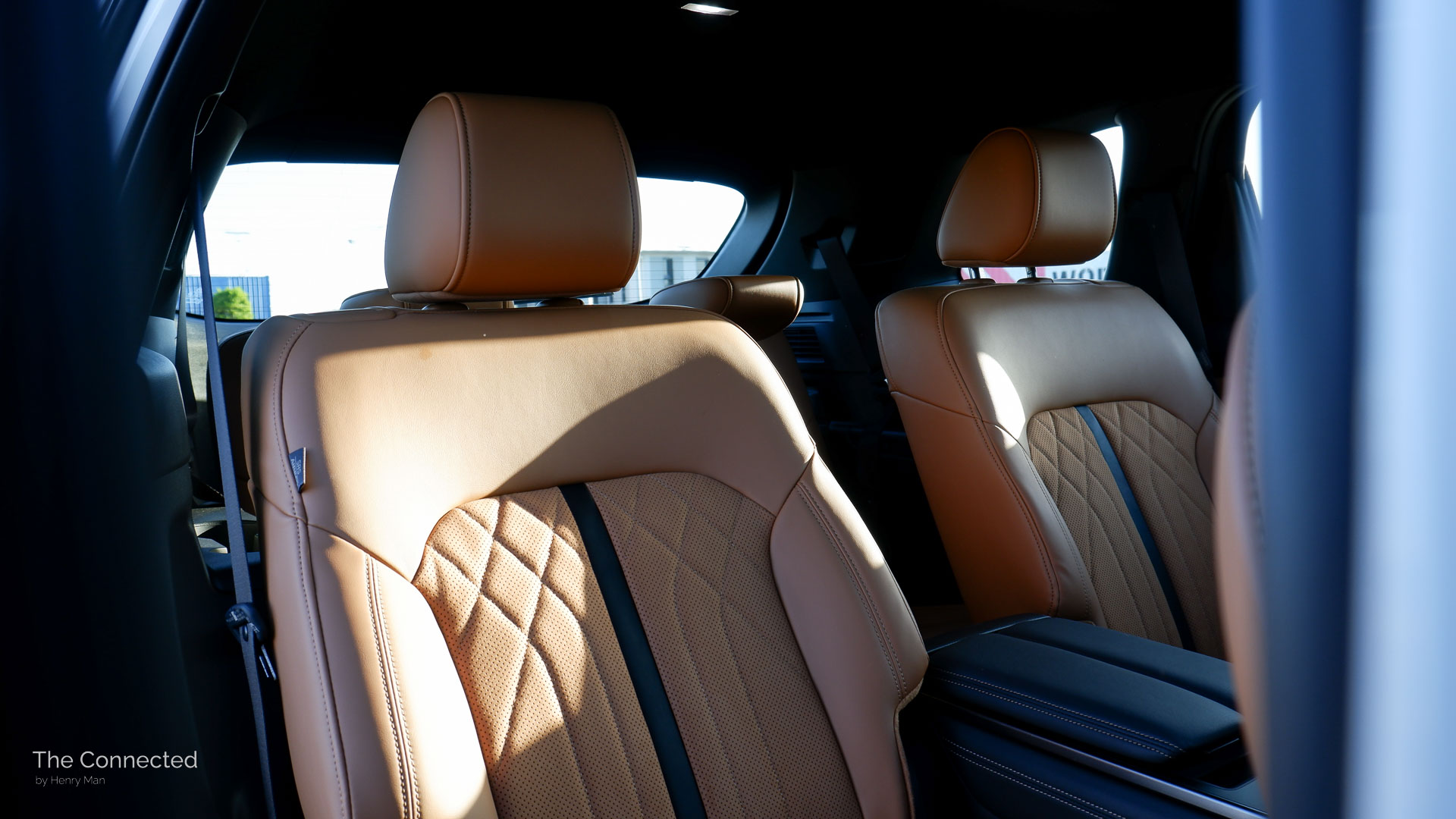
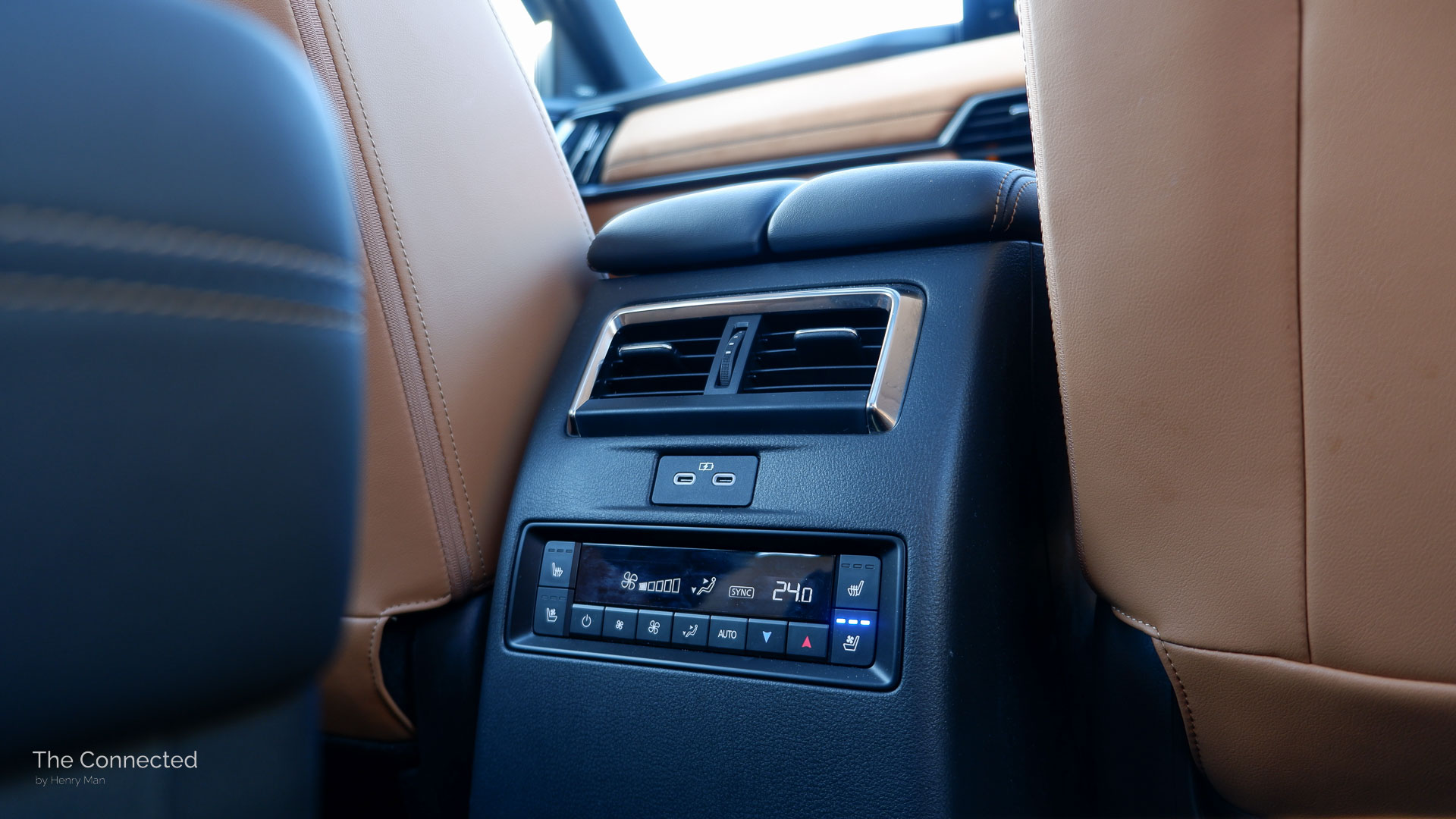
Second row legroom is good with space to place your feet underneath the front seats, although the centre floor hump makes sitting three abreast difficult with the standard seven-seat setup.
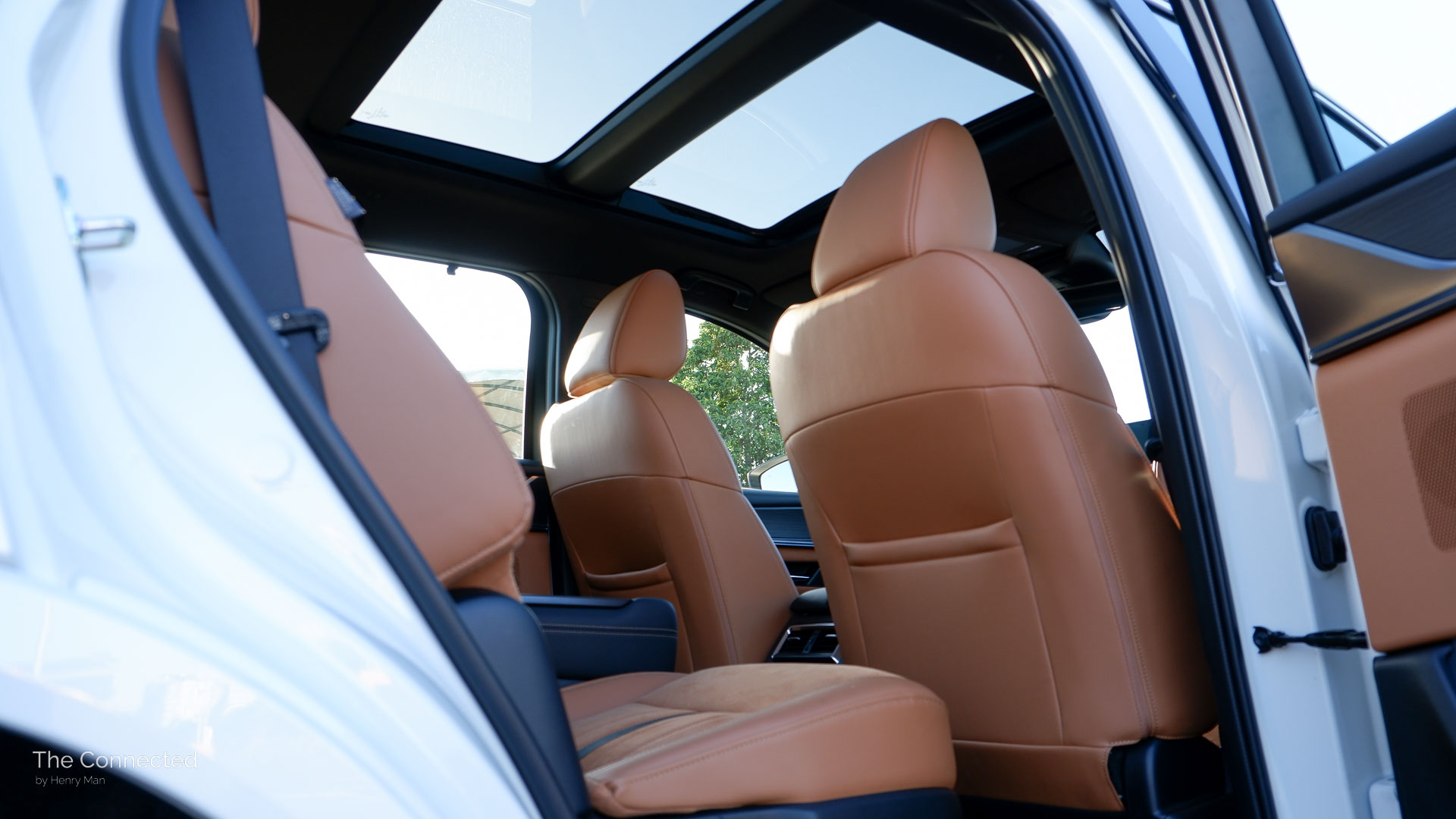
Part of the $5000 SP Package on the Azami is a six-seat captain’s chair configuration which breaks up the second row with two individual seats complete with three-level heating or ventilation.
This option also appropriately fits a centre console divider – effectively filling the annoying floor hump – with a deep split opening storage box and a slide-out tray closer to the floor. As a result, occupants can’t walk through the middle like on a Hyundai Palisade.
Other amenities include a built-in retracting window blind – which is useful given the tinted glass is weak, even though it doesn’t completely cover the sides – two USB-C charging ports, and soft seatback pockets.
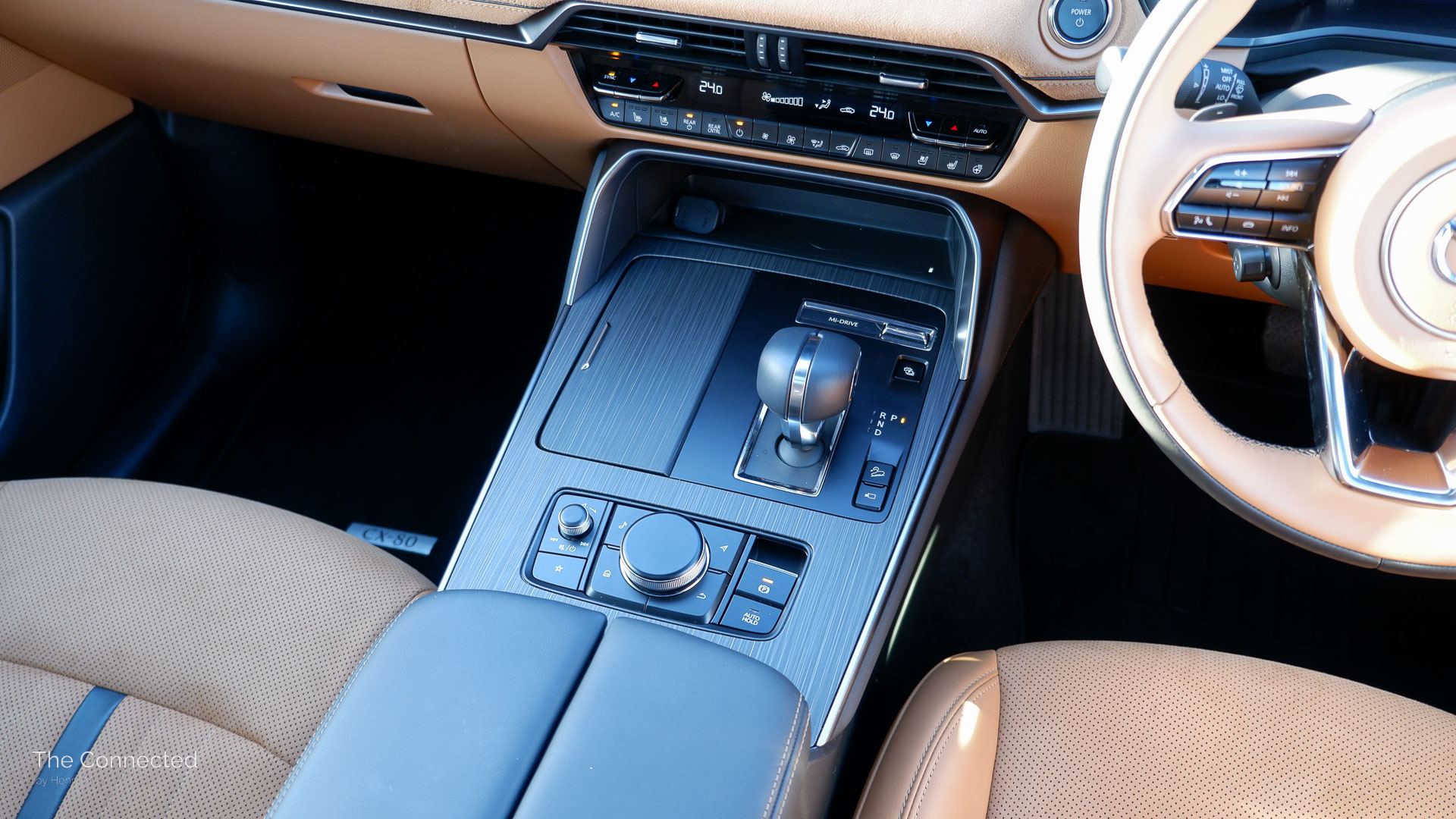
It’s a similar theme in the front row. While the centre console is large, there’s a lot of blank unused space with only a narrow rubberised tray in front, two small-ish gripped cup holders (which can be covered with a lid), and a shallow split opening centre armrest box where two USB-C ports sit.
Unlike other brands, there’s no open tray underneath the console.
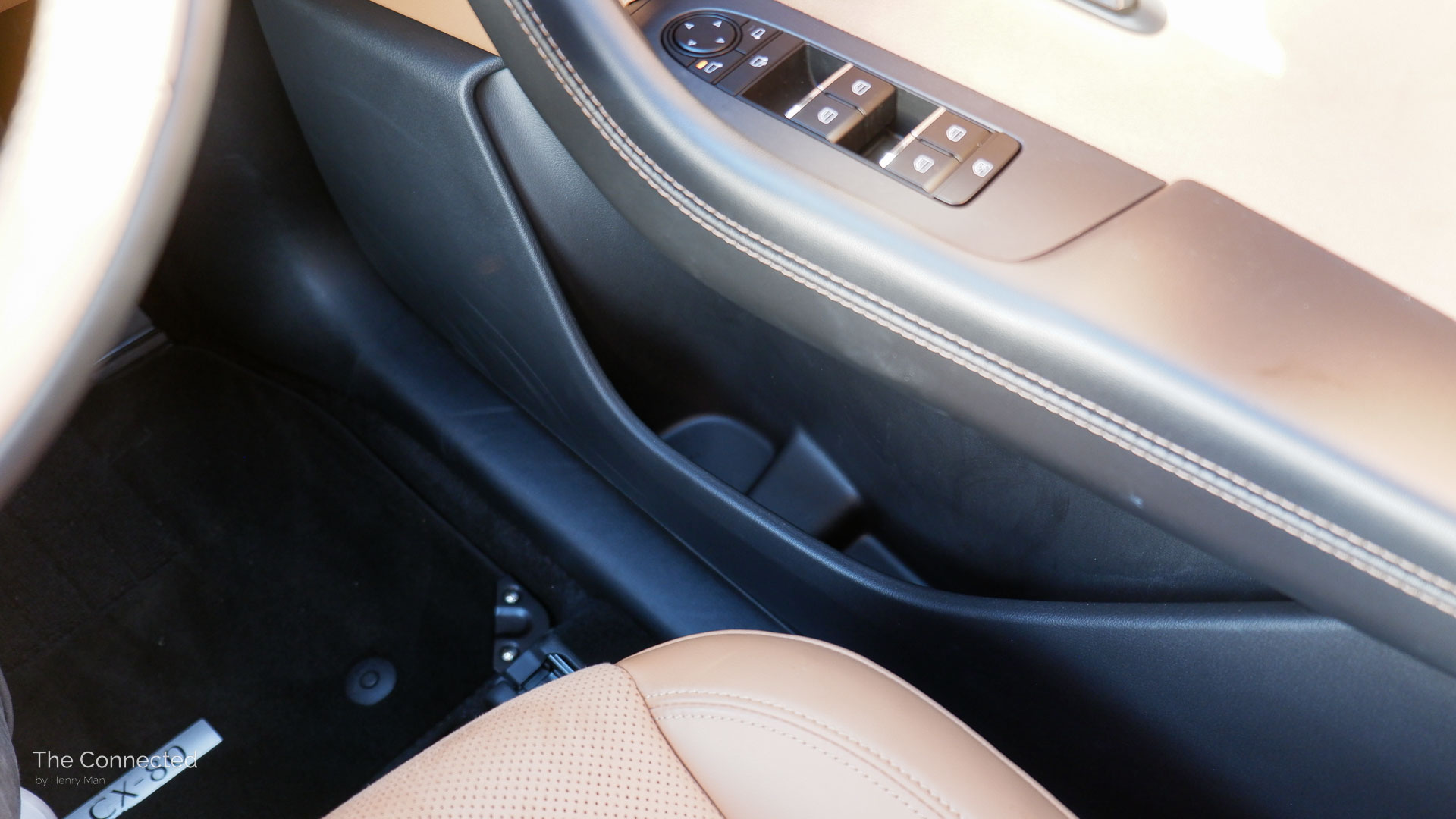
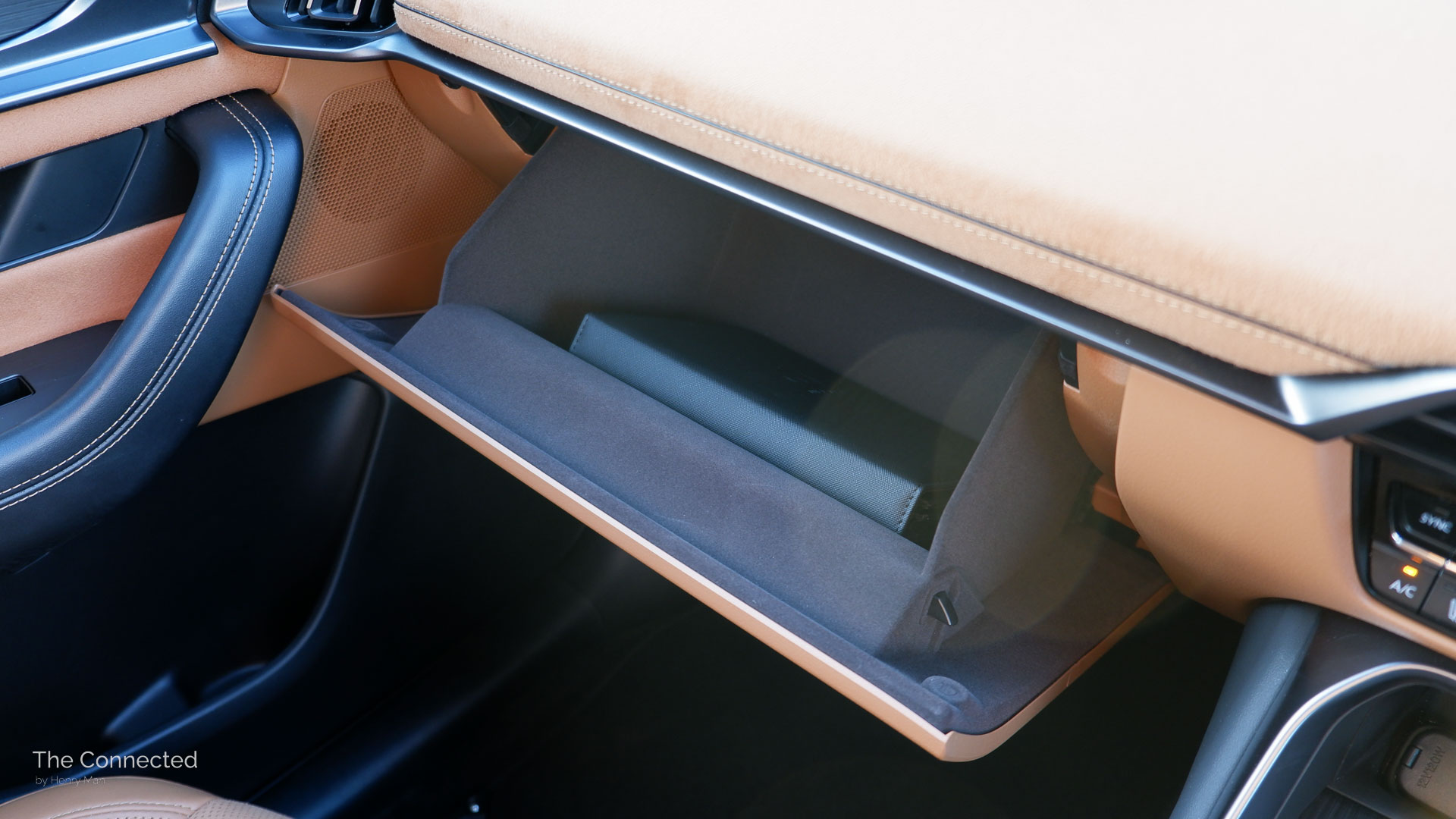
The glovebox is lined in a felt surface with an LED light and all door pockets are a good size.
Meanwhile, the CX-80’s front seats are supportive with three-level heating or ventilation. The driver benefits from two position memory settings – though the heated steering wheel feels lukewarm at best.
Technology.
2026 Mazda CX-80 P50e Azami SP tech features:
| 12.3-inch touchscreen running Mazda Connect software | 12.3-inch driver instrument display |
| Wireless/wired Apple CarPlay and Android Auto | Head-up display |
| Built-in maps | Qi wireless charging pad |
| Infotainment controller dial | 6x USB-C, 2x 12-volt, 1x 1500-watt and 2x 150-watt V2L power sockets |
| OTA software update capability | 12-speaker Bose |
| Mazda Connected Services with MyMazda mobile app (three years included) | Proximity key with door puddle lights |
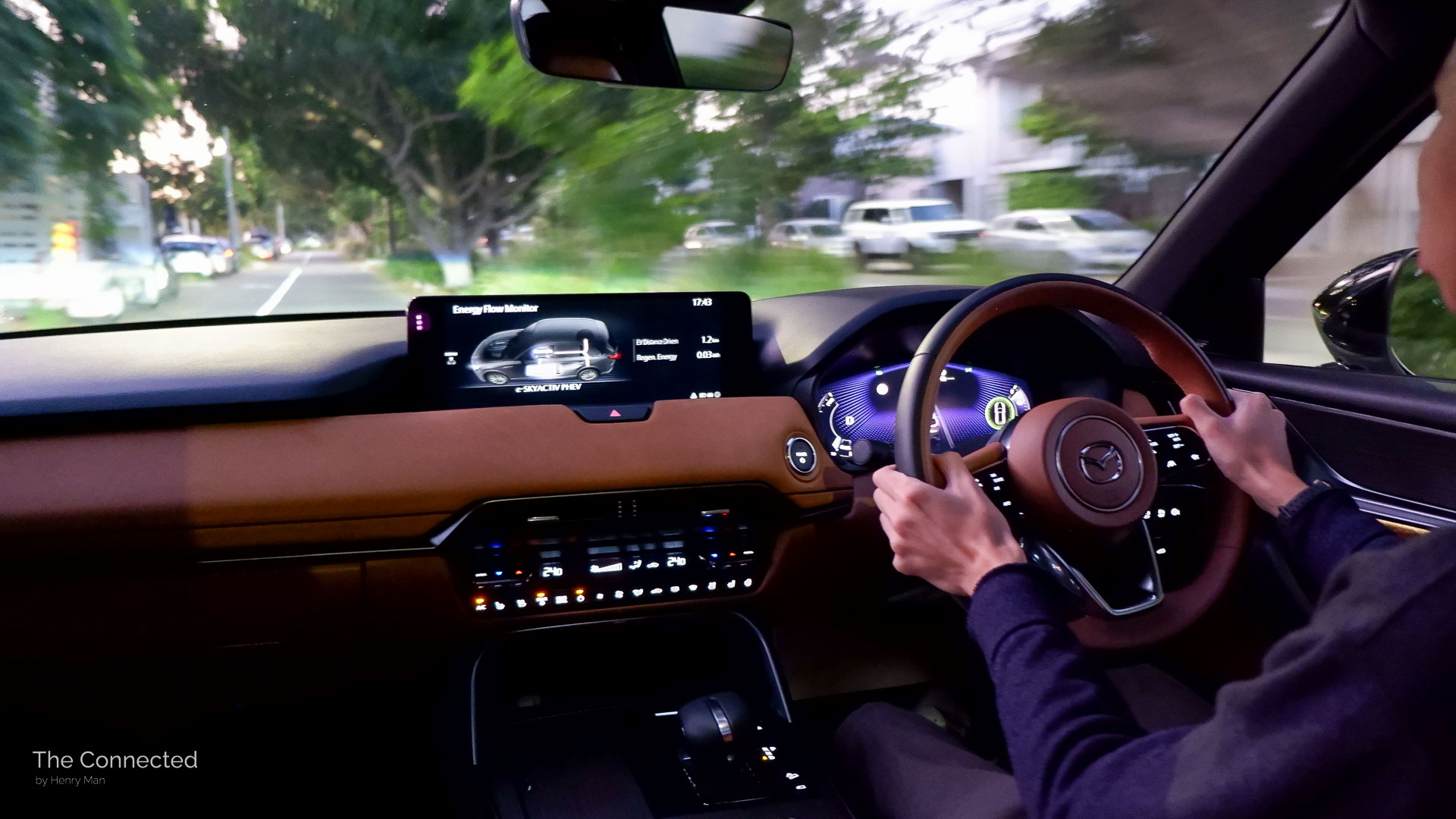
In a time where automakers, including Mazda, are shifting to big screens and barely any buttons, the CX-80 is a breath of fresh air.
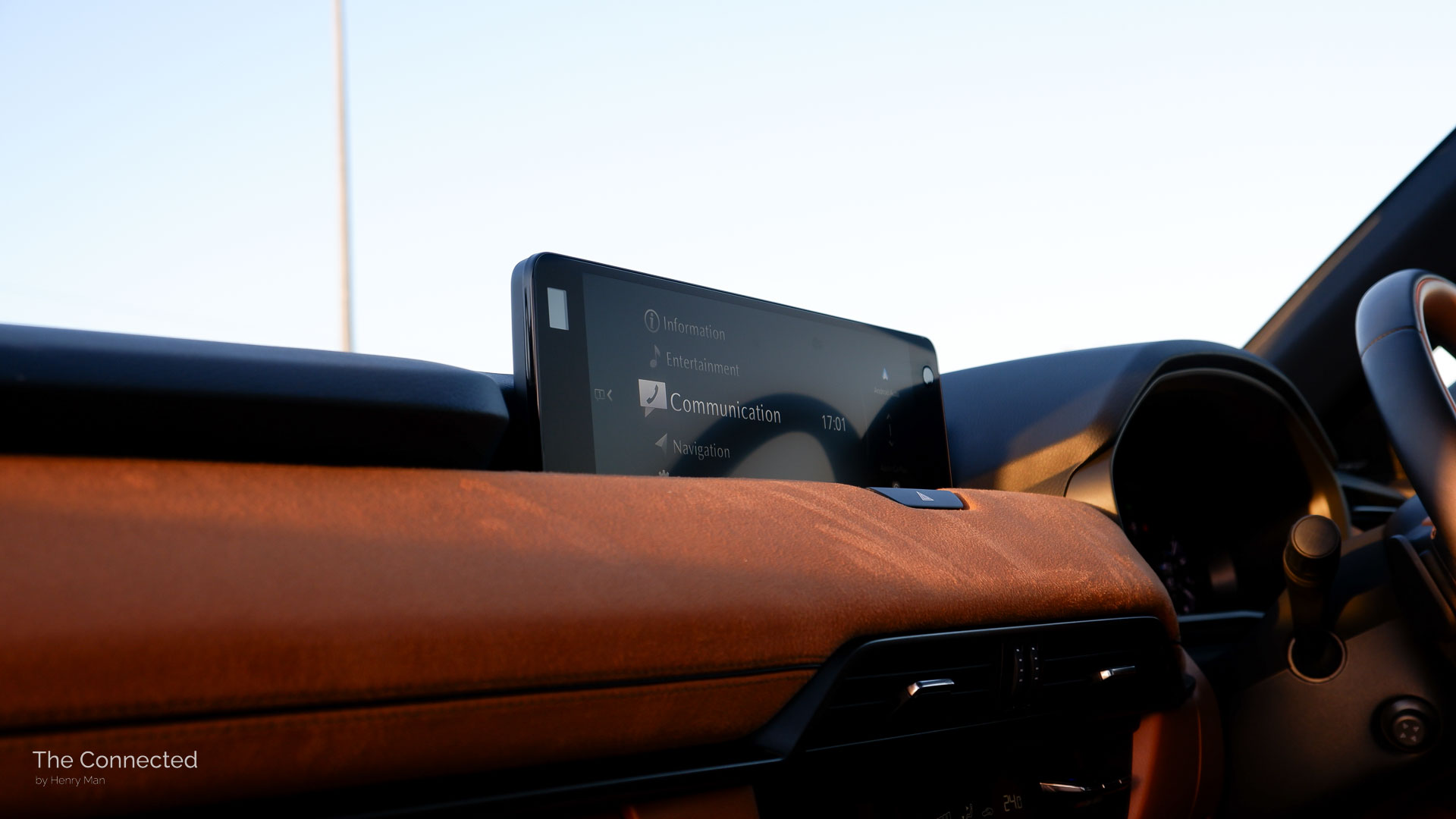
Featuring a high resolution 12.3-inch widescreen, it is positioned perfectly in the driver’s line of sight and inserted into the dashboard.
This design discourages people from using the touchscreen. Mazda requires owners to use the ergonomic rotary dial and shortcut buttons at the centre console only for the built-in Mazda Connect software.
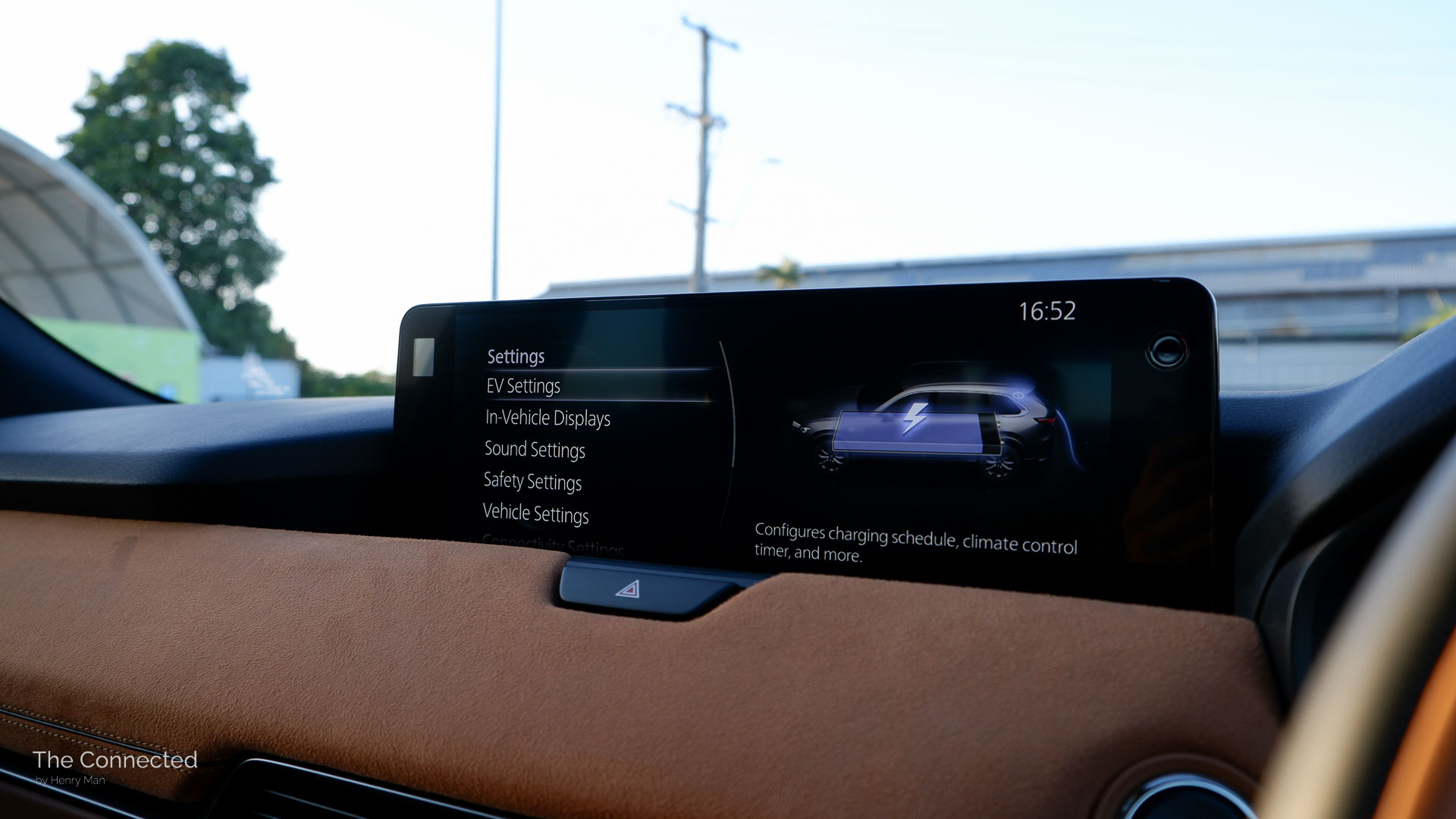
It is easy to operate with a simple layout and a classical dark theme, even though the settings pages look long-winded.
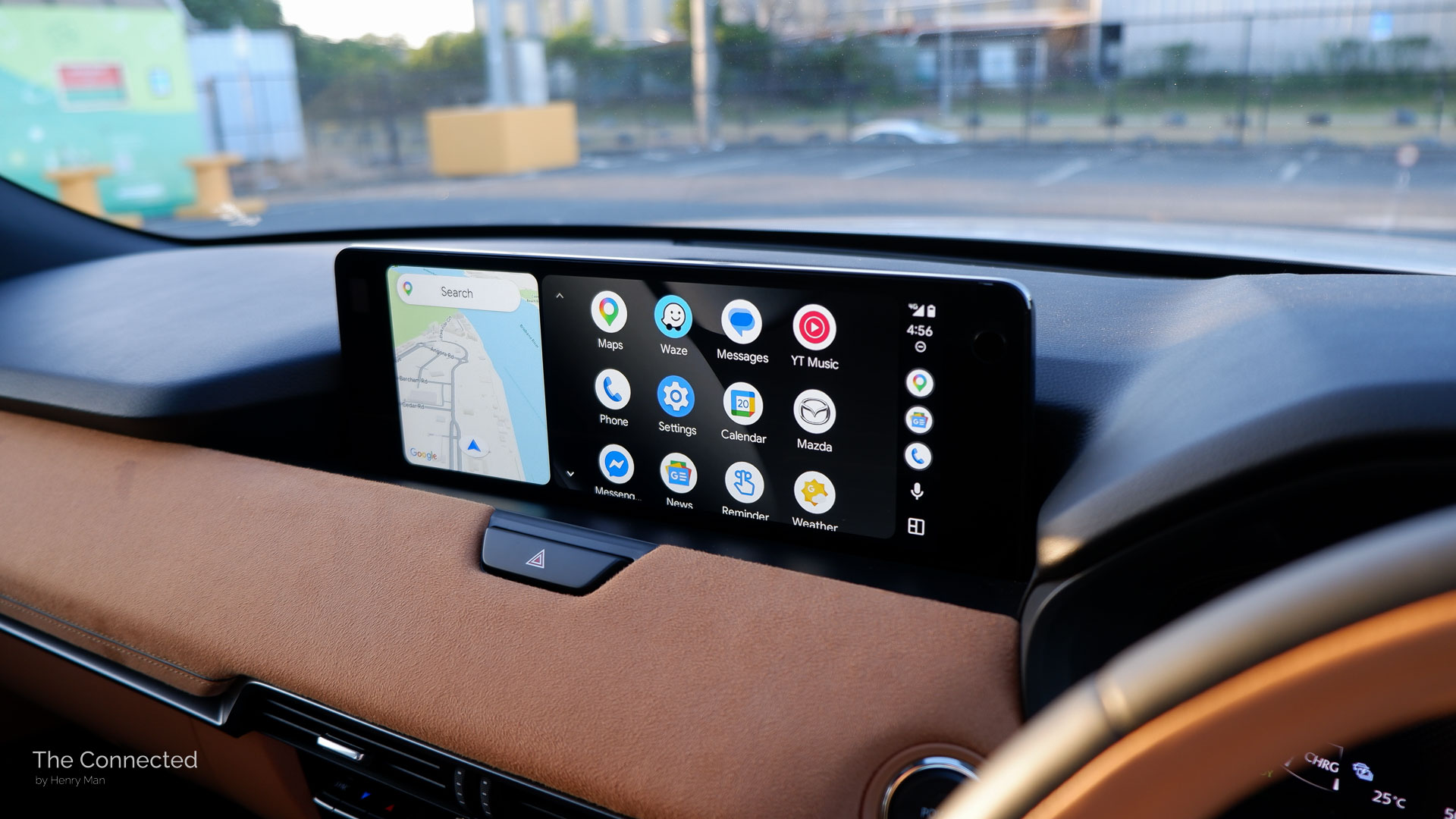
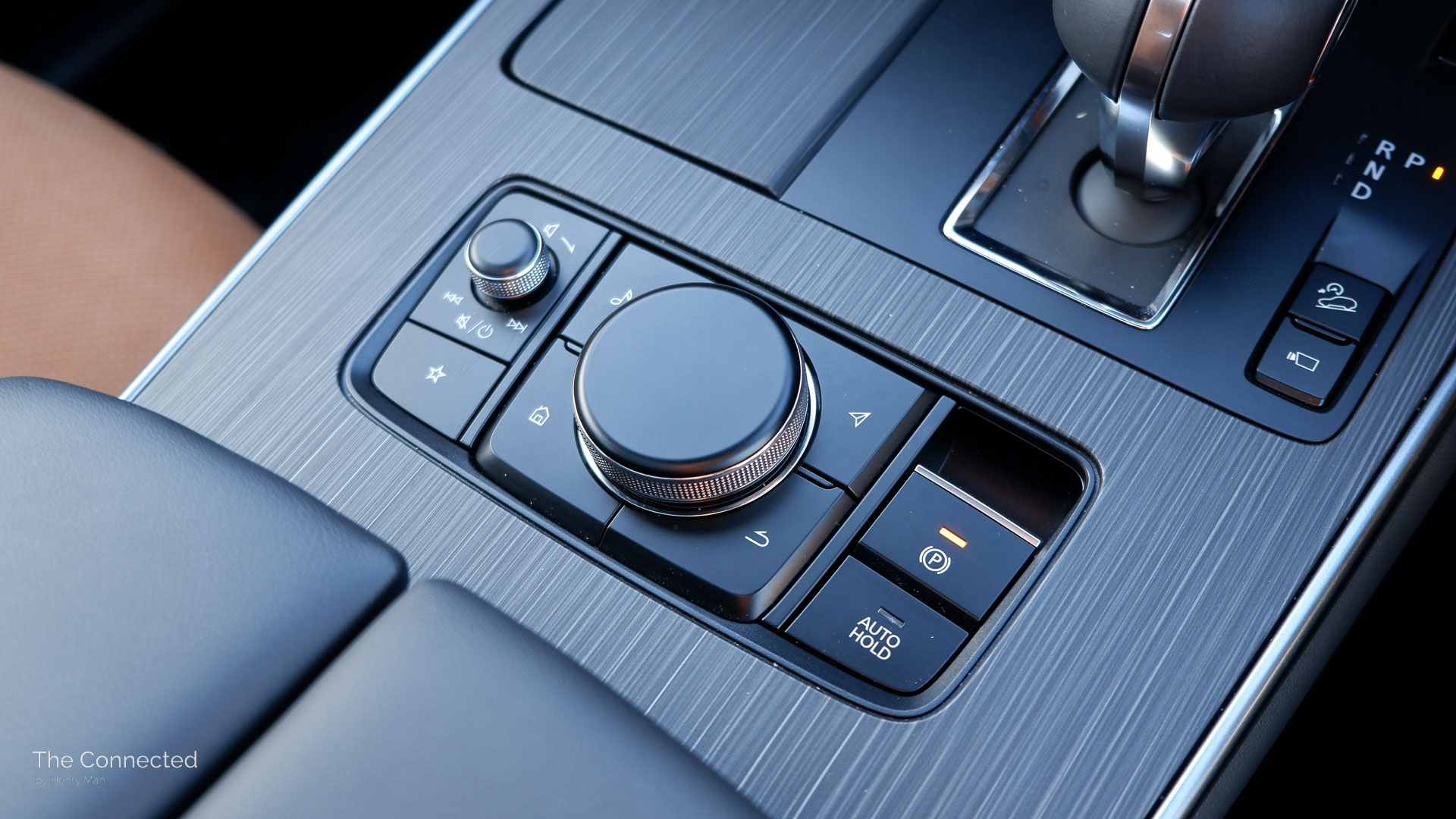
Wireless Apple CarPlay and Android Auto connect quickly and reliably every time, and the touchscreen is also enabled while stopped and driving (with the ‘Touchscreen in Motion’ setting enabled).
The clicky rotary dial and shortcut buttons also work in the smartphone projection systems, with the latter being handy to quickly switch between navigation and audio apps.
Touching the screen directly is still fastest as these smartphone projection interfaces are designed with touch in mind, but since the screen is a far reach away and using the dial can feel tedious, I found myself not using the screen at all or using voice control – being less distracted as Mazda intended.
On the other hand, scrolling through each interface element in Apple CarPlay or Android Auto using the dial can feel tedious and take more time than necessary.
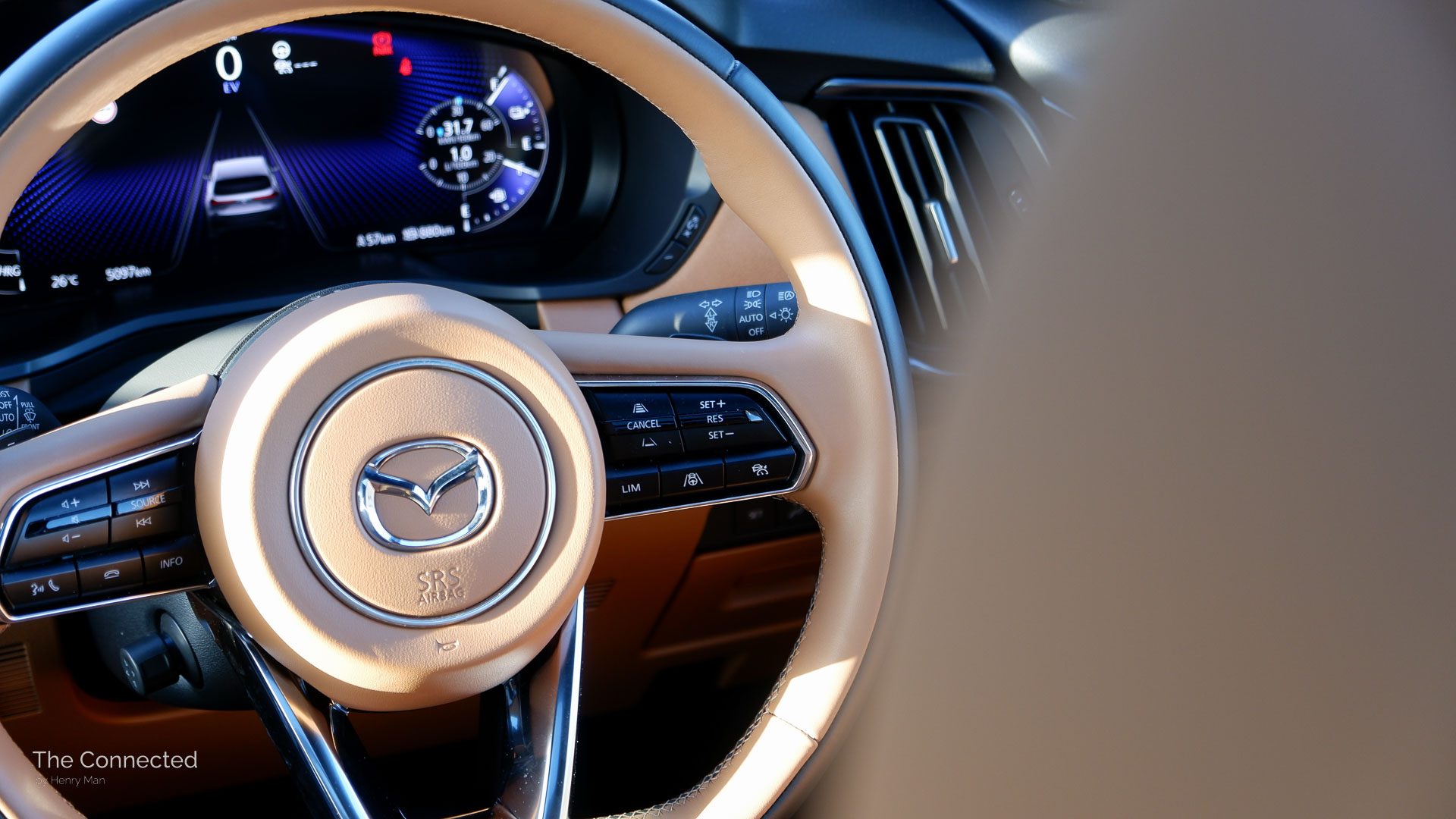
Additionally, a tiny dial at the centre console conveniently provides volume and forward/backward audio controls, while physical steering wheel buttons are also easy to use – even though they’re on the smaller side.
The Qi wireless charging pad is slow and non-ventilated, so phones often overheat and stop charging.
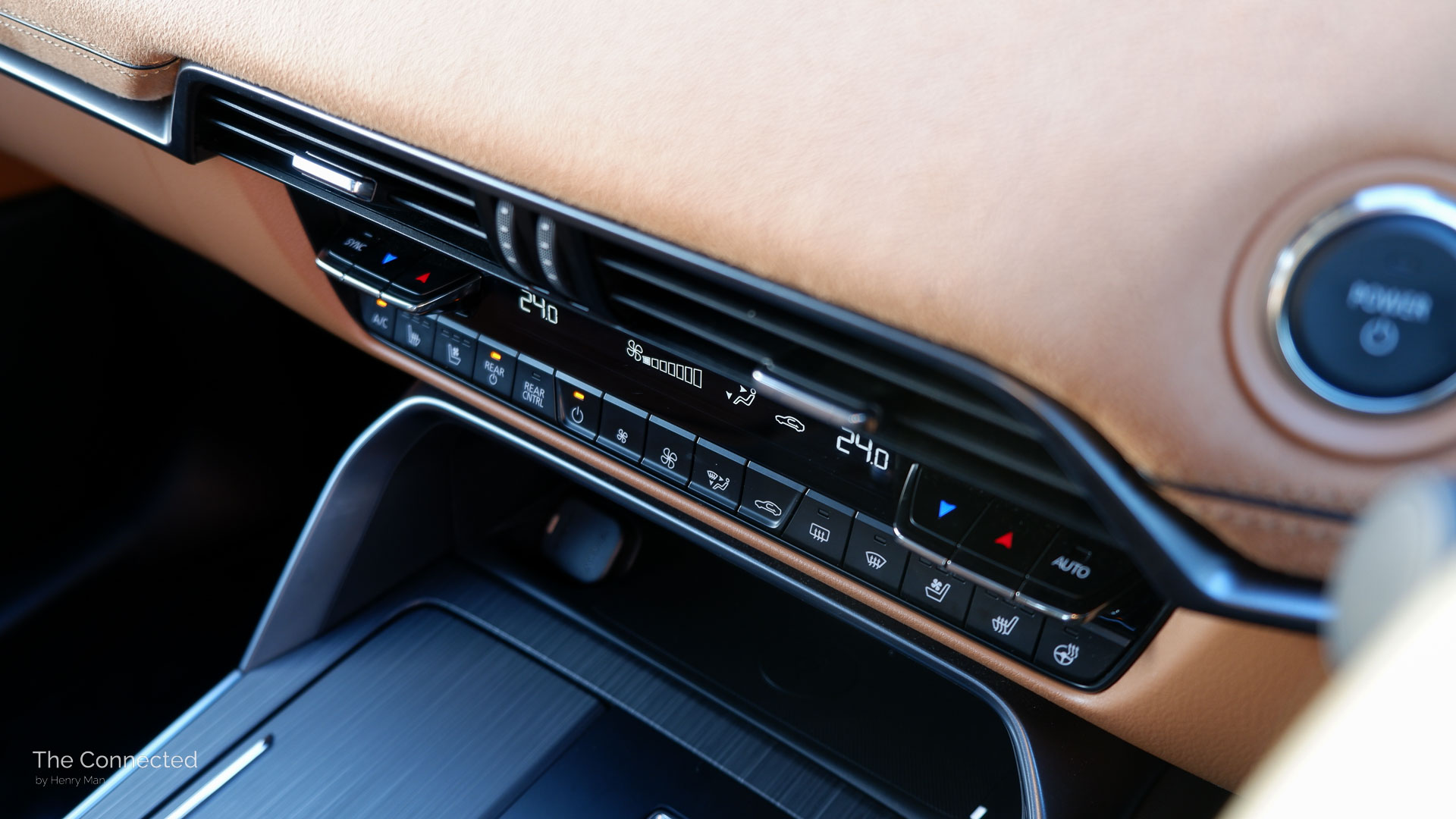
The three-zone climate buttons are small but simple and not as distracting to operate with a dedicated LED display and clicky buttons, but you can’t remotely toggle the second row heated and ventilated seats from the front.
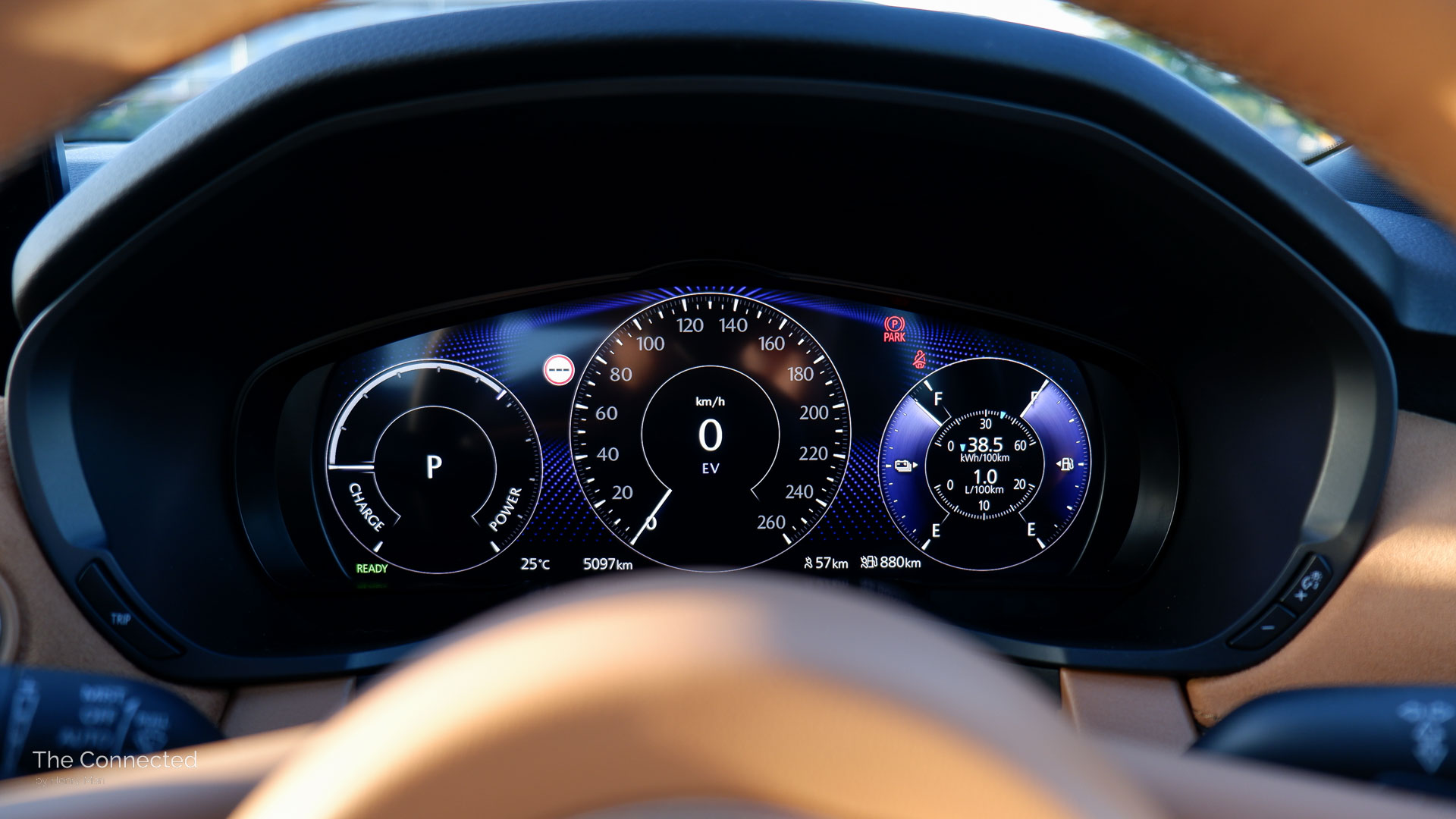
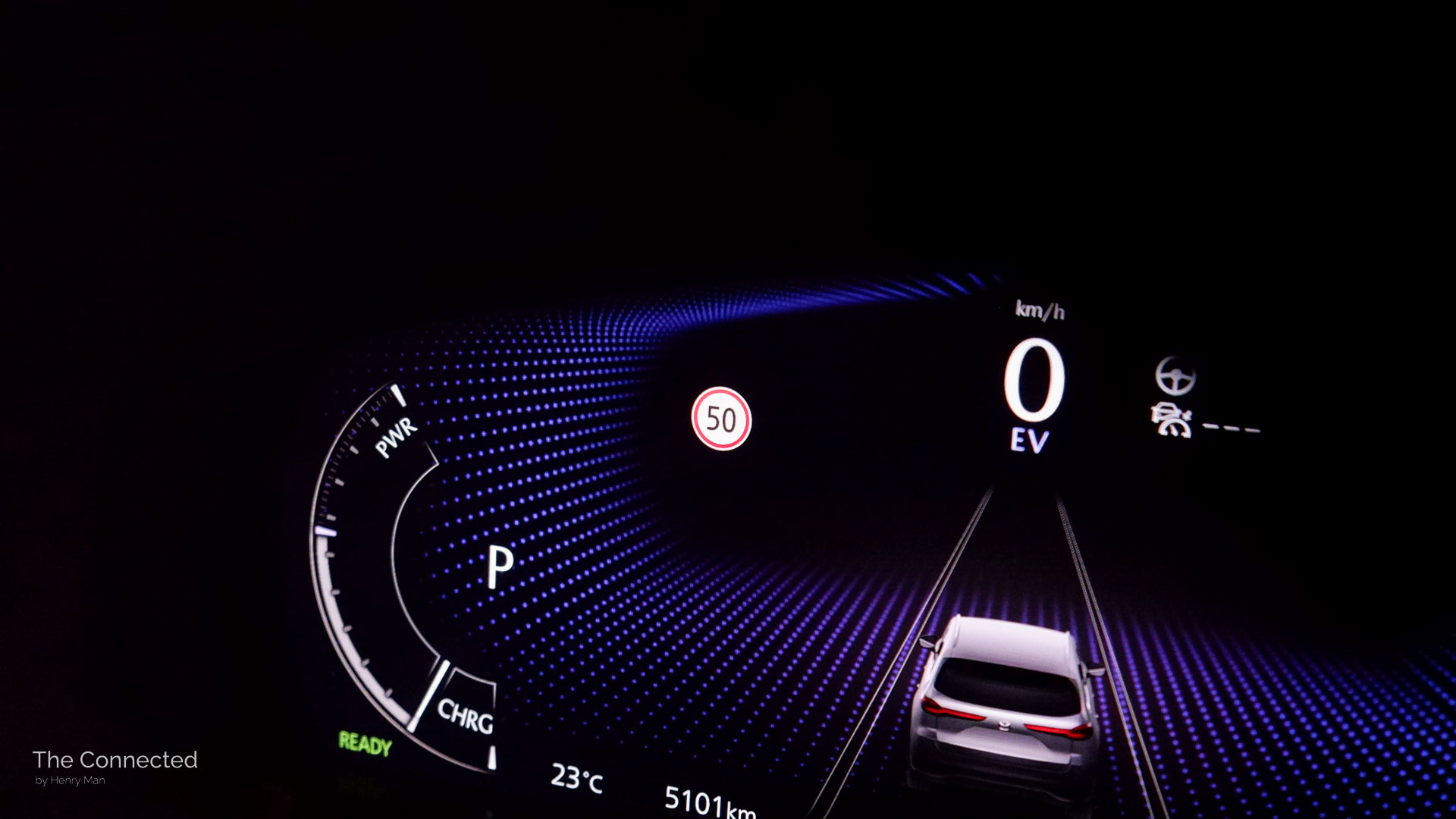
The 12.3-inch driver instrument cluster is also simple with analogue and digital themes, a cool animation when switching drive modes, and minimalist visualisations of surrounding vehicles.
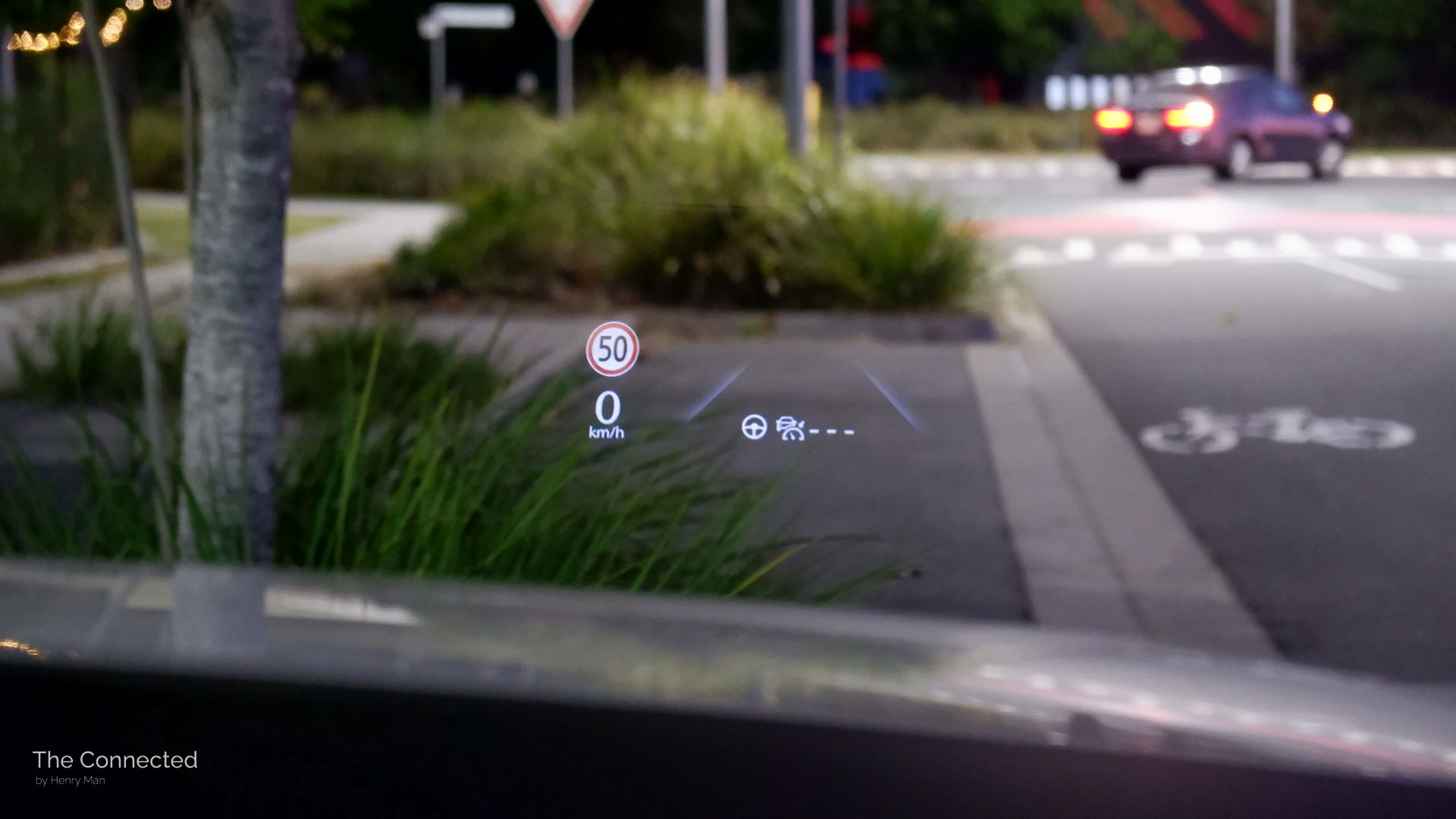
Meanwhile, the head-up display (HUD) is also very clear with a legible speed readout and safety assists on the windscreen. Mazda’s HUD now even shows lane guidance and the estimated time of arrival when using Apple CarPlay and Android Auto navigation apps.
Every new CX-80 SUV comes with a three year subscription to Mazda Connected Services.
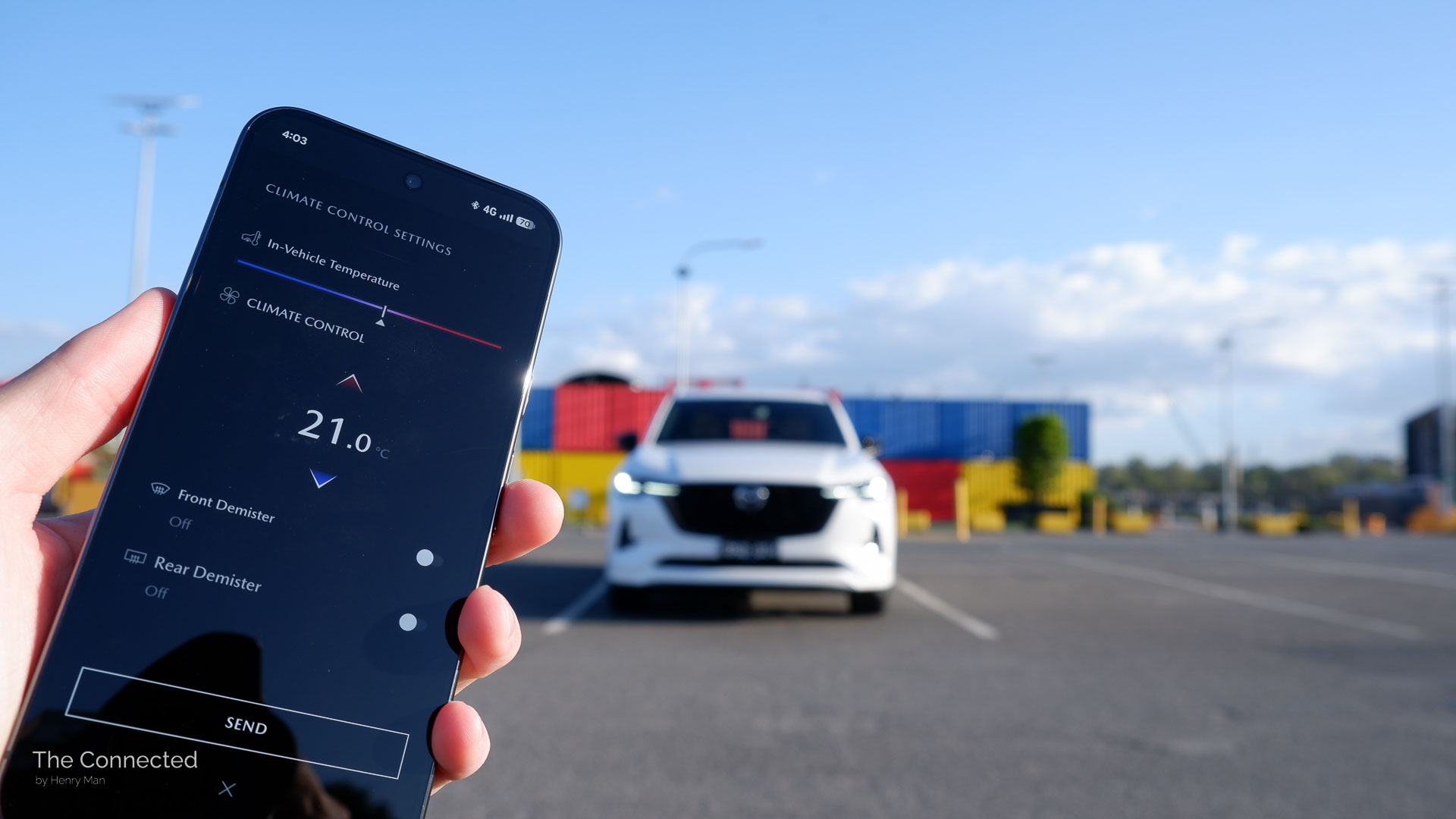
The plug-in hybrid exclusively offers more MyMazda mobile app functionality by being able to pre-start the climate control, set the temperature and activate the demisters. That’s in addition to monitoring the EV charge status, fuel level, remote door locking, and location tracking.
The app itself isn’t designed as well compared to the Hyundai Bluelink and Tesla offerings, but at least it’s functional – albeit on the hybrid CX-80 only.
Safety.
2026 Mazda CX-80 P50e Azami SP safety features:
| Front AEB with vehicle/pedestrian/cyclist/junction turning detection | 360-degree camera system |
| Rear AEB | Front and rear parking sensors |
| Blind-spot assist | Driver attention monitoring camera |
| Rear cross-traffic assist | Auto-dimming rear-view mirror |
| Lane-keep assist | Mazda Connect emergency services calling and location tracking |
| Adaptive cruise control with lane-centring assist | Full LED headlights with adaptive matrix auto high beam function |
| Door open warning | Full LED tail-lights |
| Road sign detection |
The Mazda SUV has quiet and non-invasive safety assistance systems that operate in the background, rather than take over the driver. It’s a gold standard for other carmakers.
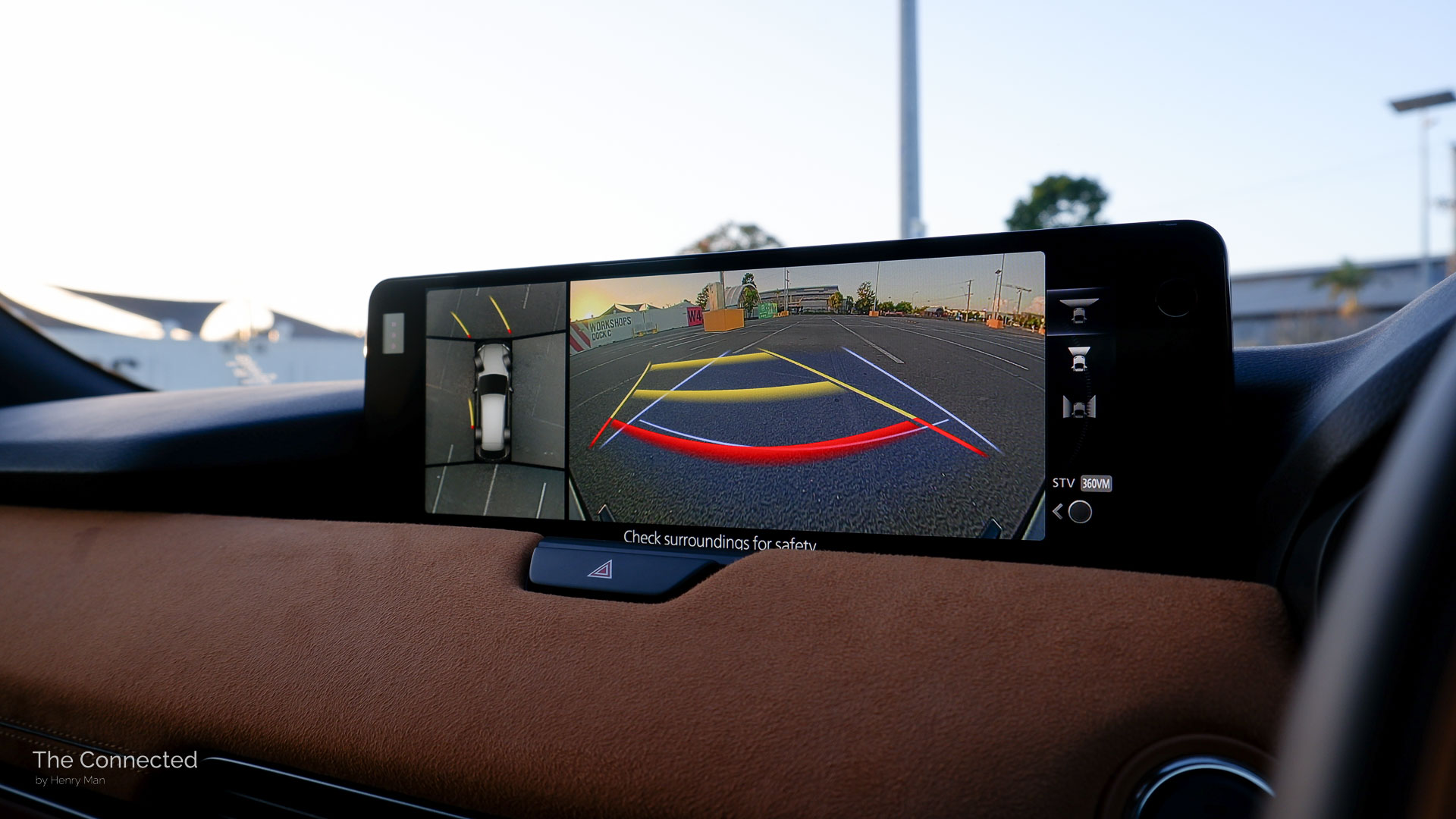
The CX-80 features discreet clear 360-degree cameras which can be activated at any speed with a button press (although it cuts out after a few seconds and the reversing camera is positioned lower to the ground), discreet lane-keep assist intervention, and dependable adaptive cruise control and lane-centring assist.
The road sign detection system doesn’t annoyingly chime every time you overspeed by default, while the driver attention monitoring camera never went off in my testing – to the point where I question whether it’s actually working.
The head-up display also neatly shows the detected speed sign, adatpive cruise status, and whether there is something in your blind spot with subtle symbols.
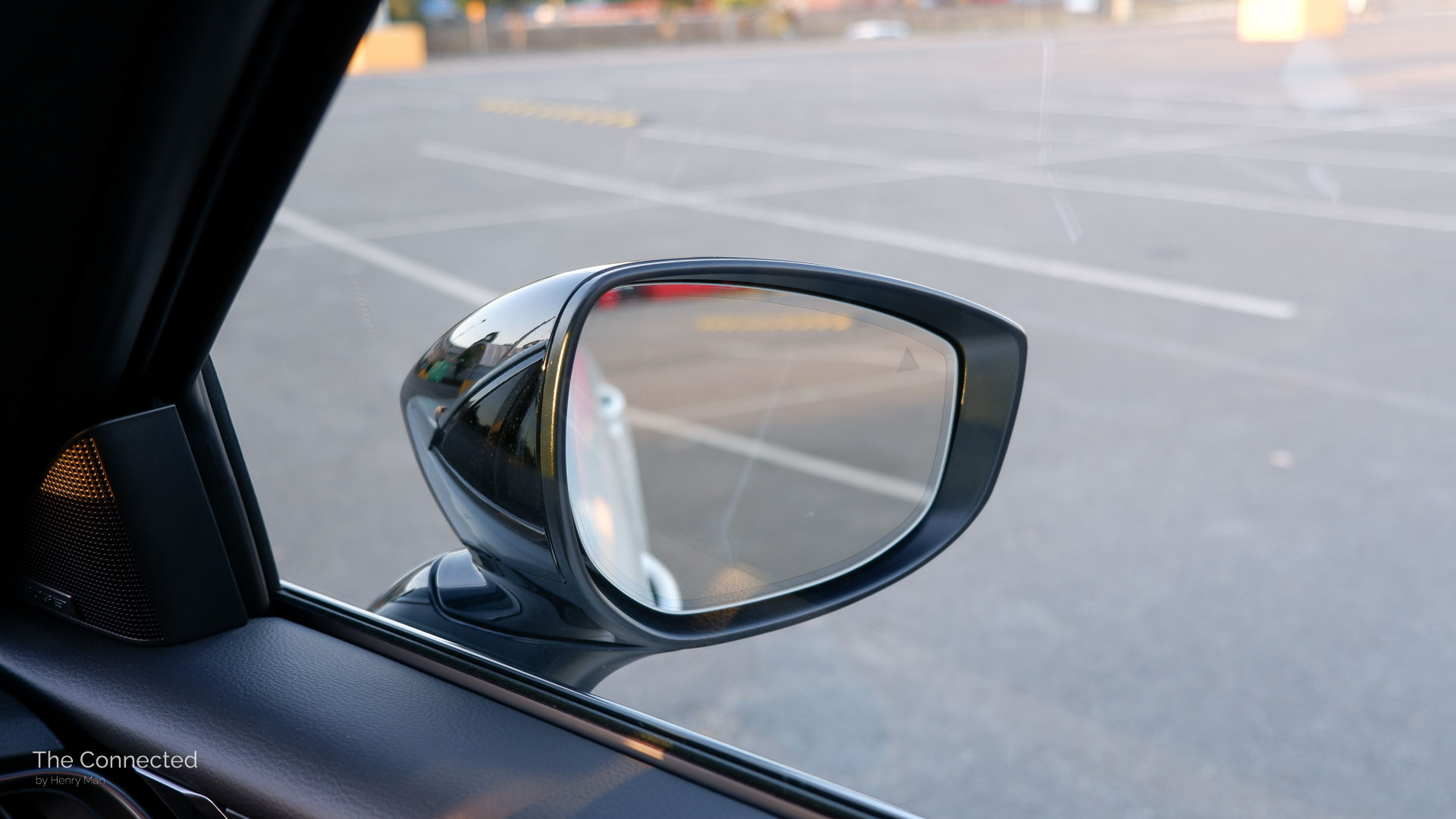
Blind-spot monitoring is crucial since Mazda chooses to implement a flat right wing mirror.
This results in a very zoomed-in view – making changing lanes, parking, and driving at night more difficult since it’s more susceptible to reflecting other vehicle headlights into the driver’s eye.
The left wing mirror is conventional convex wide angle.
Furthermore, the full LED lights perform well at night – bolstered by the adaptive high beam function which effectively blocks individual pixel bulbs to not glare other road users in the pitch black night.
The 2026 Mazda CX-80 received the full five-star safety rating by the Australasian New Car Assessment Program (ANCAP) under 2024 testing criteria.
Range and fuel consumption.
2026 Mazda CX-80 P50e Azami SP fuel and efficiency specs:
| Claimed driving range (combined cycle) | N/A |
| Claimed EV-only driving range | 65km |
| Claimed energy efficiency | N/A |
| Battery size and type | 17.8kWh lithium-ion |
| Max AC / DC charging | 7.2kW / N/A |
| Everyday charging limit recommendation | 80% (generally) |
| Claimed fuel efficiency (combined cycle) | 2.7L/100km |
| Fuel tank size | 70L |
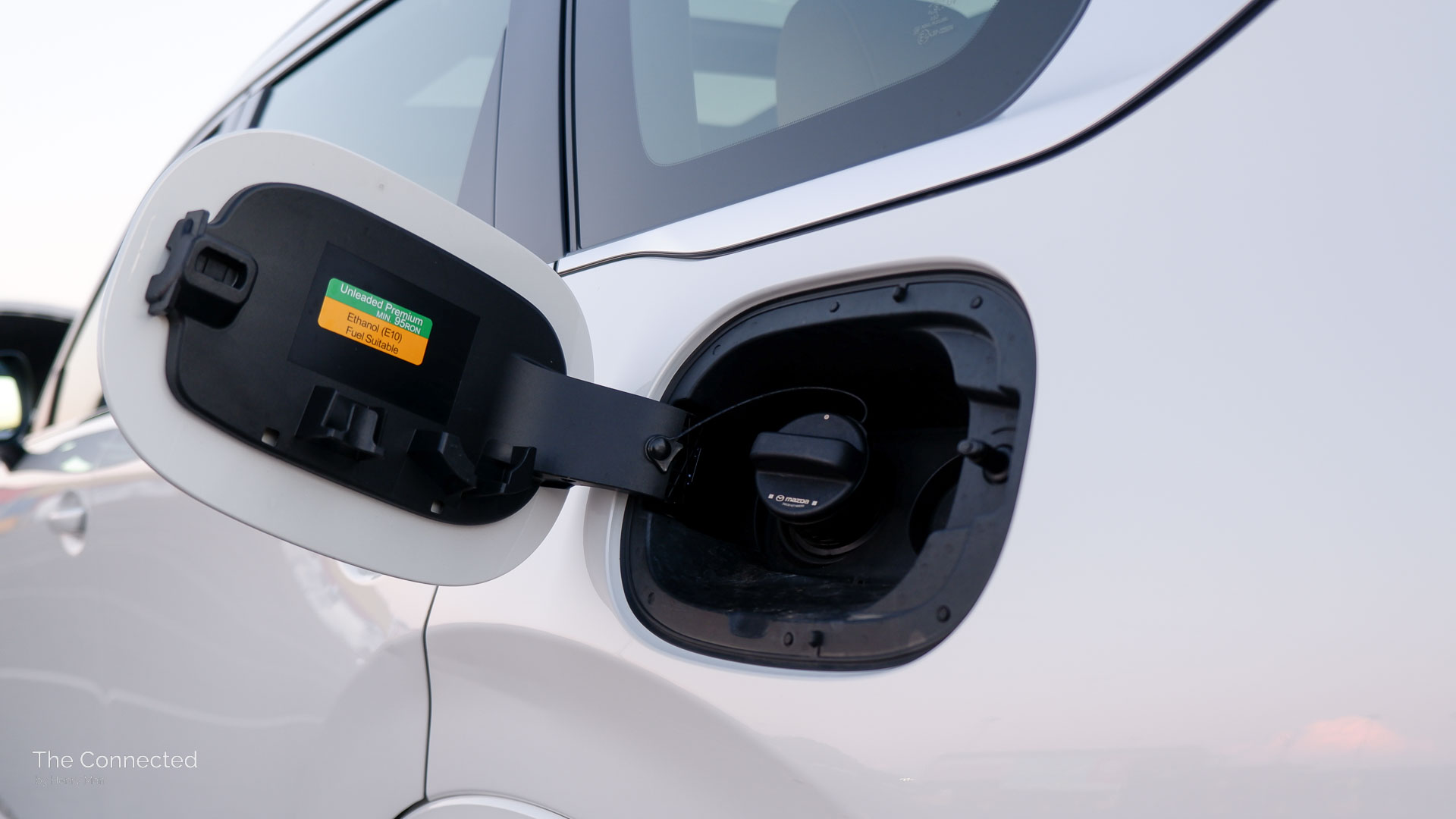
| Minimum fuel quality requirement | 95 RON premium unleaded |
The Mazda CX-80 PHEV offers good fuel efficiency, but has limited real-world EV-only range compared to its rivals.
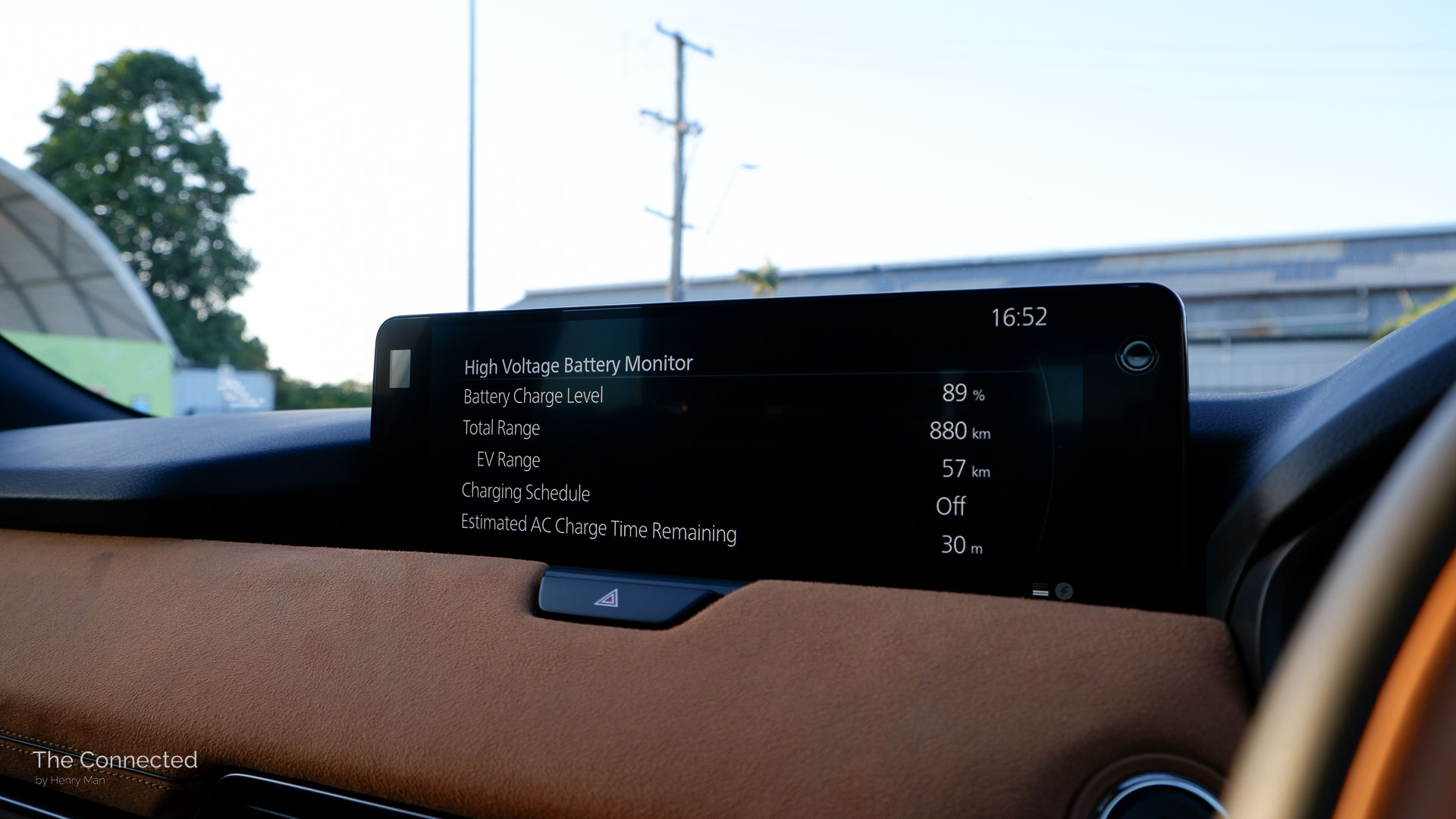
In my testing, the CX-80 indicated around 60km of real-world EV-only range on a full charge. With some more idling, it only provided about 42km with a super high 30.8kWh/100km energy consumption.
That’s rather unimpressive despite having a sizable 17.8kWh battery pack, with rivals such as the Volkswagen Tayron eHybrid, BYD Sealion 8, and Chery Tiggo 9 offering more than 100km claimed EV-only range.
Limiting the daily charge level to 80% is generally recommended for battery longevity, with the CX-80 only able to be charged at up to 7.2kW AC single-phase speeds so forget about plugging in a DC public fast charger (which isn’t necessary for PHEVs anyway).
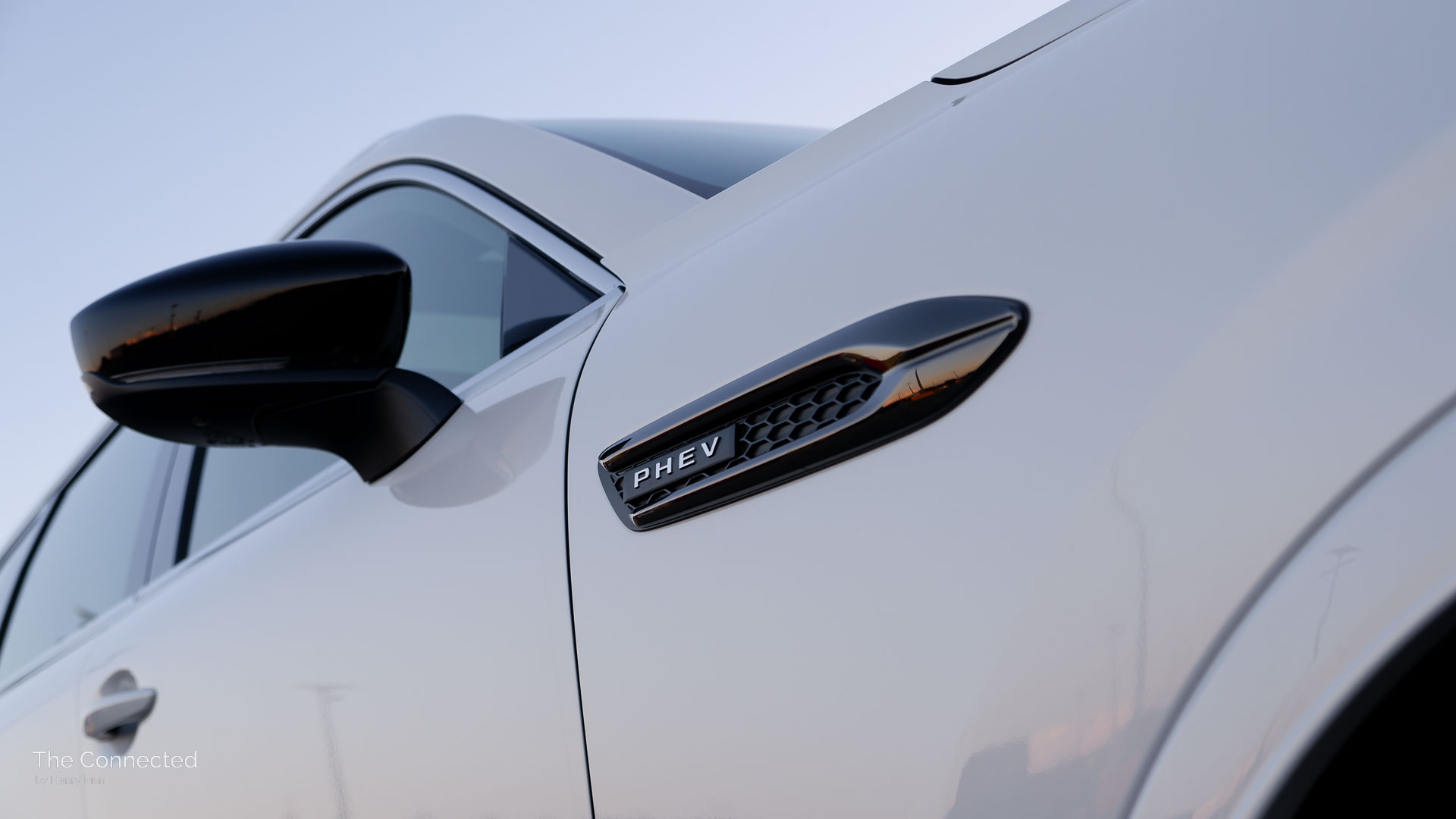
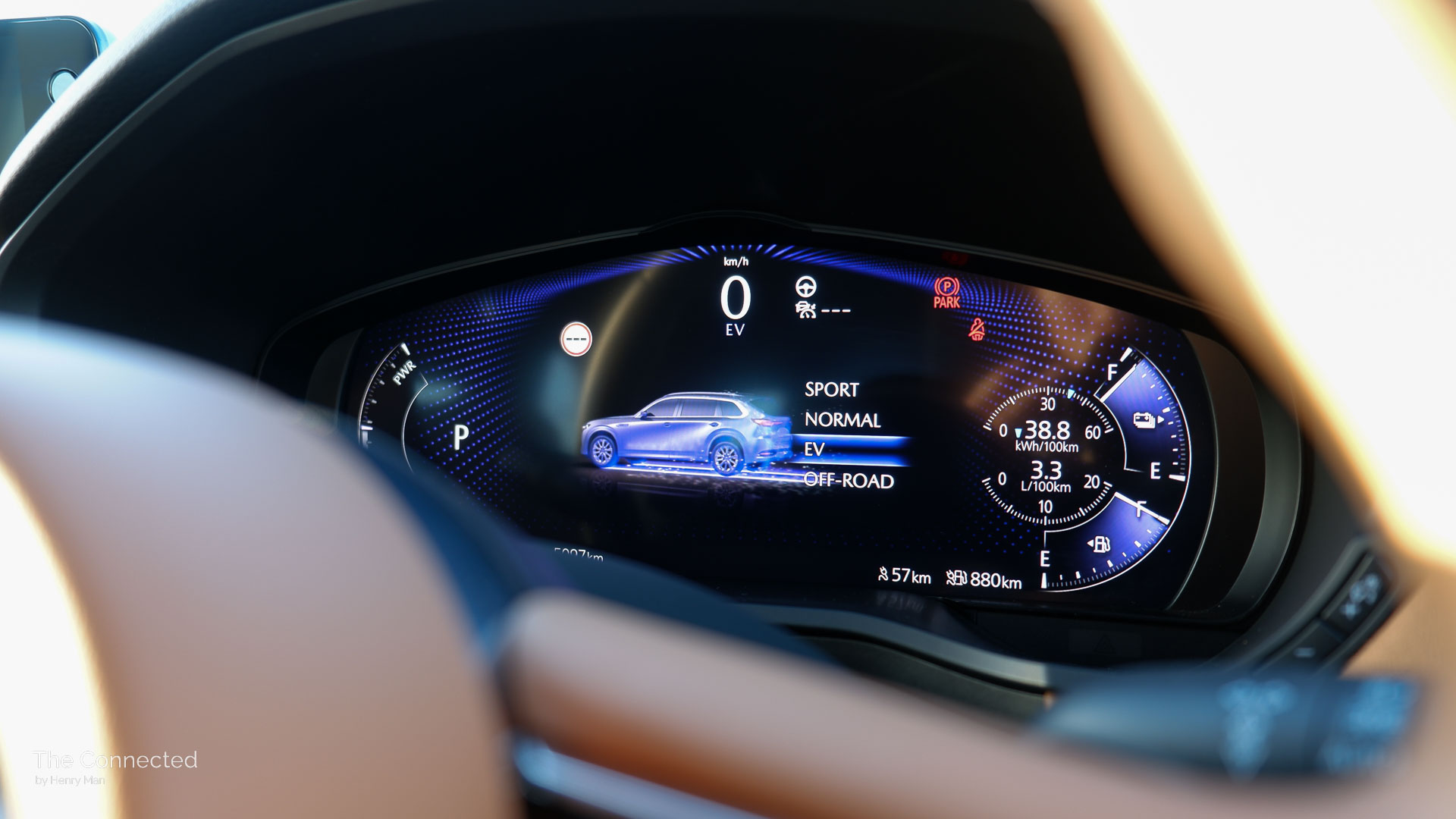
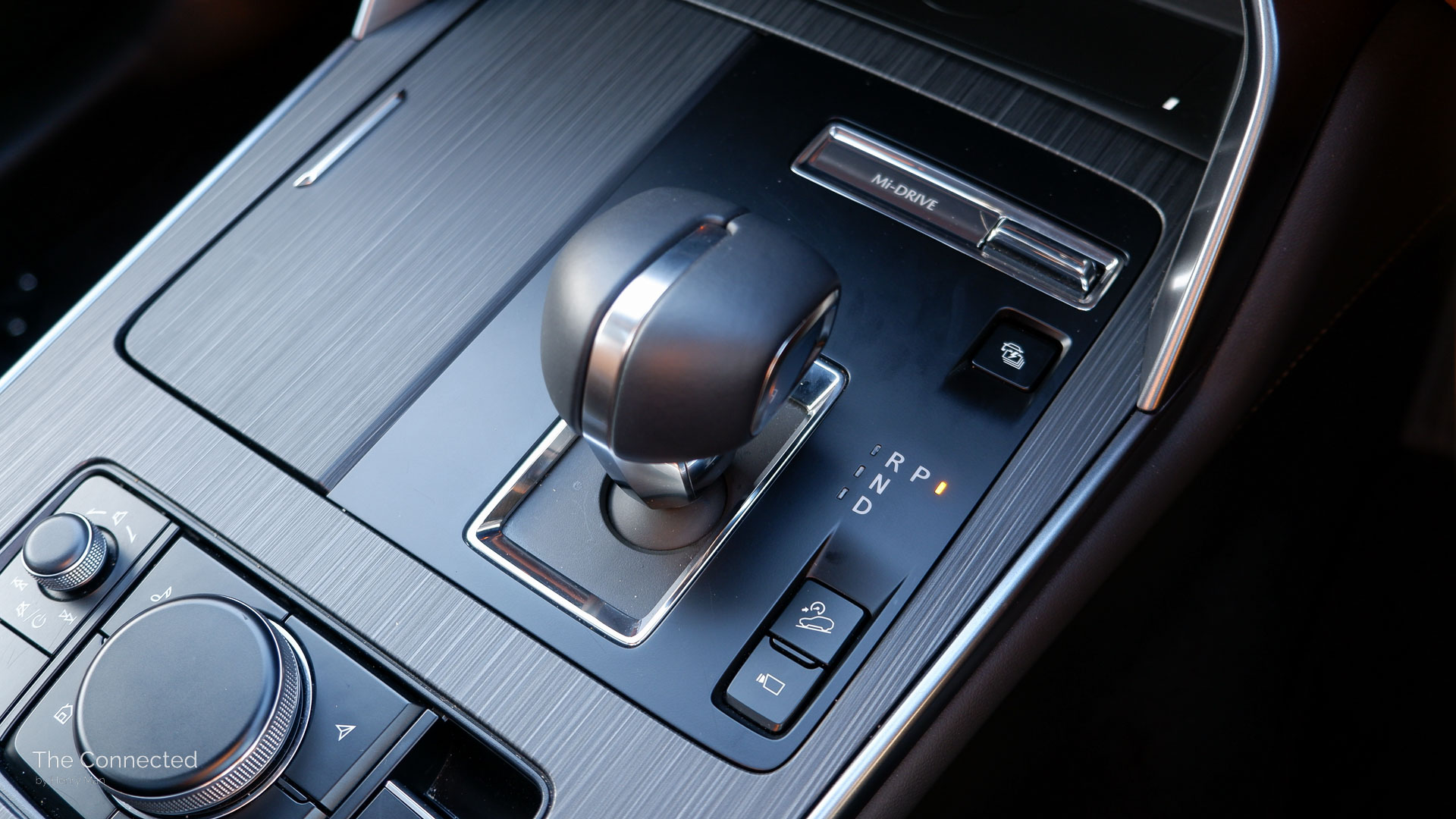
The clicky Mi-Drive switch allows drivers to easily force EV-only mode or switch to the Normal or Sport modes. A separate button on the centre console can force the engine to charge the battery to a desired ‘charge target’ level.
Unfortunately, the battery percentage is only displayed within the infotainment system under the ‘Information’ app, then ‘High Voltage Battery Monitor’ sub-menu.
Once the battery is empty (EV-only mode cuts off at 10%), the CX-80 PHEV achieved 6.8L/100km on hybrid-only mode – which is good for about 897km of range with a 70-litre fuel tank.
Pricier 95 RON premium unleaded petrol is the minimum requirement.
Combined, expect around 939km of real-world driving range on the Mazda CX-80 PHEV.
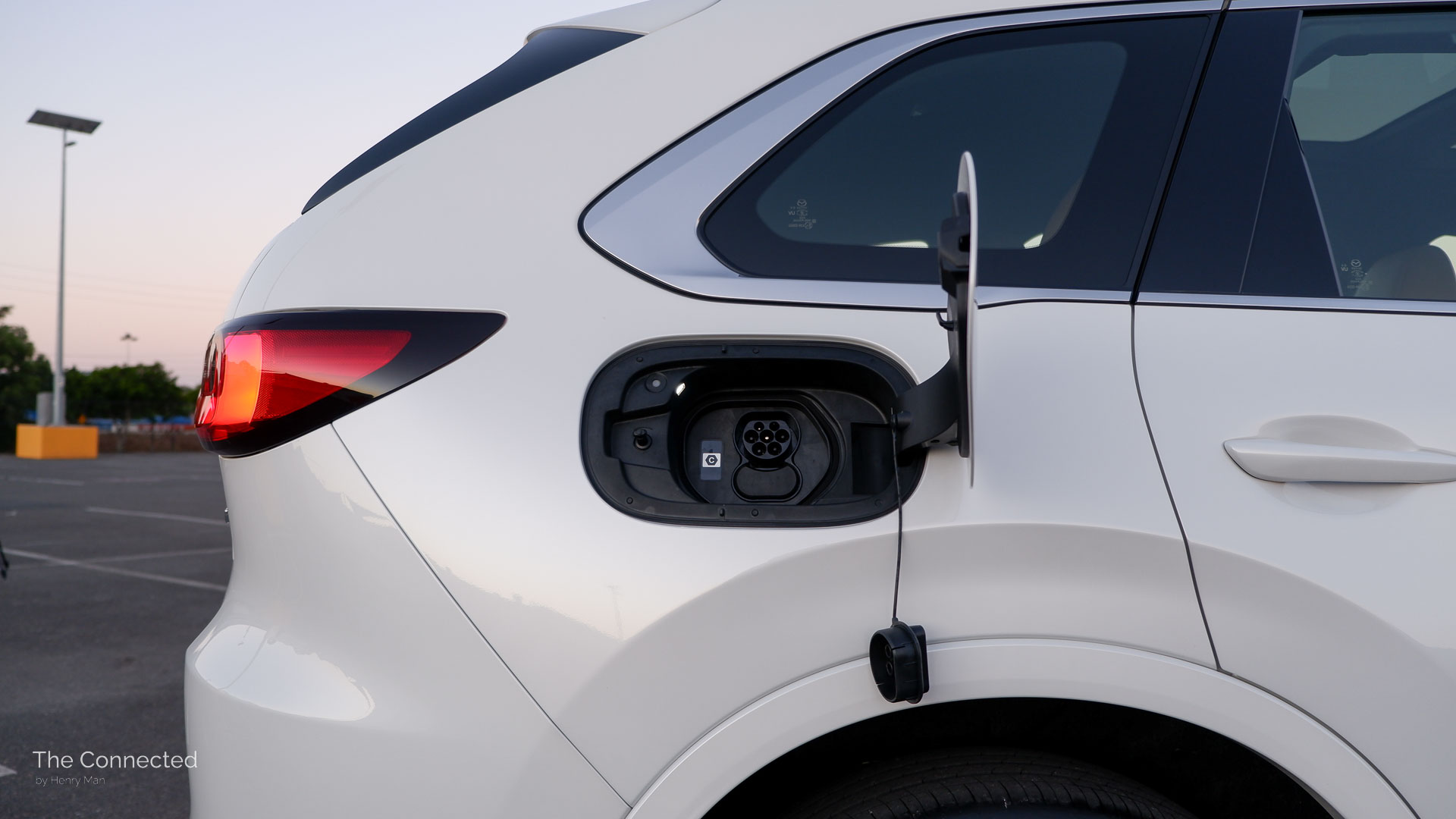
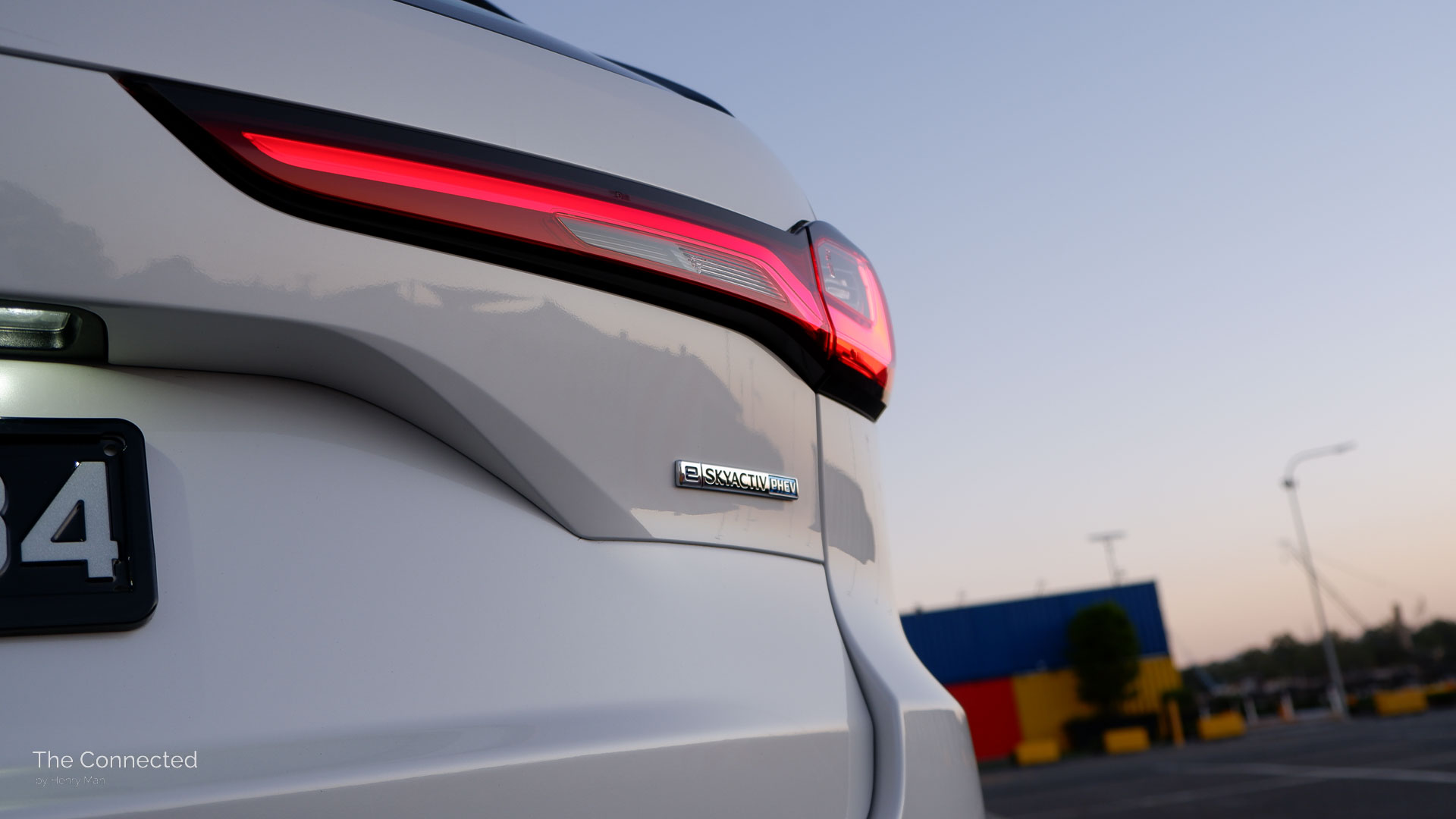
The charge port is located at the rear-right quarter side, while the fuel lid is symmetrically opposite. It’s worth noting that there are caps to cover the AC charging pins, which dangle on the bodywork when detached.
Driving.
2026 Mazda CX-80 P50e Azami SP powertrain specs:
| Engine and electric drive unit | 2.5-litre inline four-cylinder naturally-aspirated petrol engine + EV motor |
| Power / torque | 241kW @6000rpm / 500Nm @4000rpm |
| Transmission | Eight-speed auto |
| Drive type | AWD |
| Kerb weight | 2267kg |
| Payload | 579kg |
| Towing (unbraked / braked) | 750 / 2500kg (max 150kg towball download) |
The Mazda CX-80 PHEV feels great to drive, but the sporty edge has some tradeoffs in day-to-day driving.
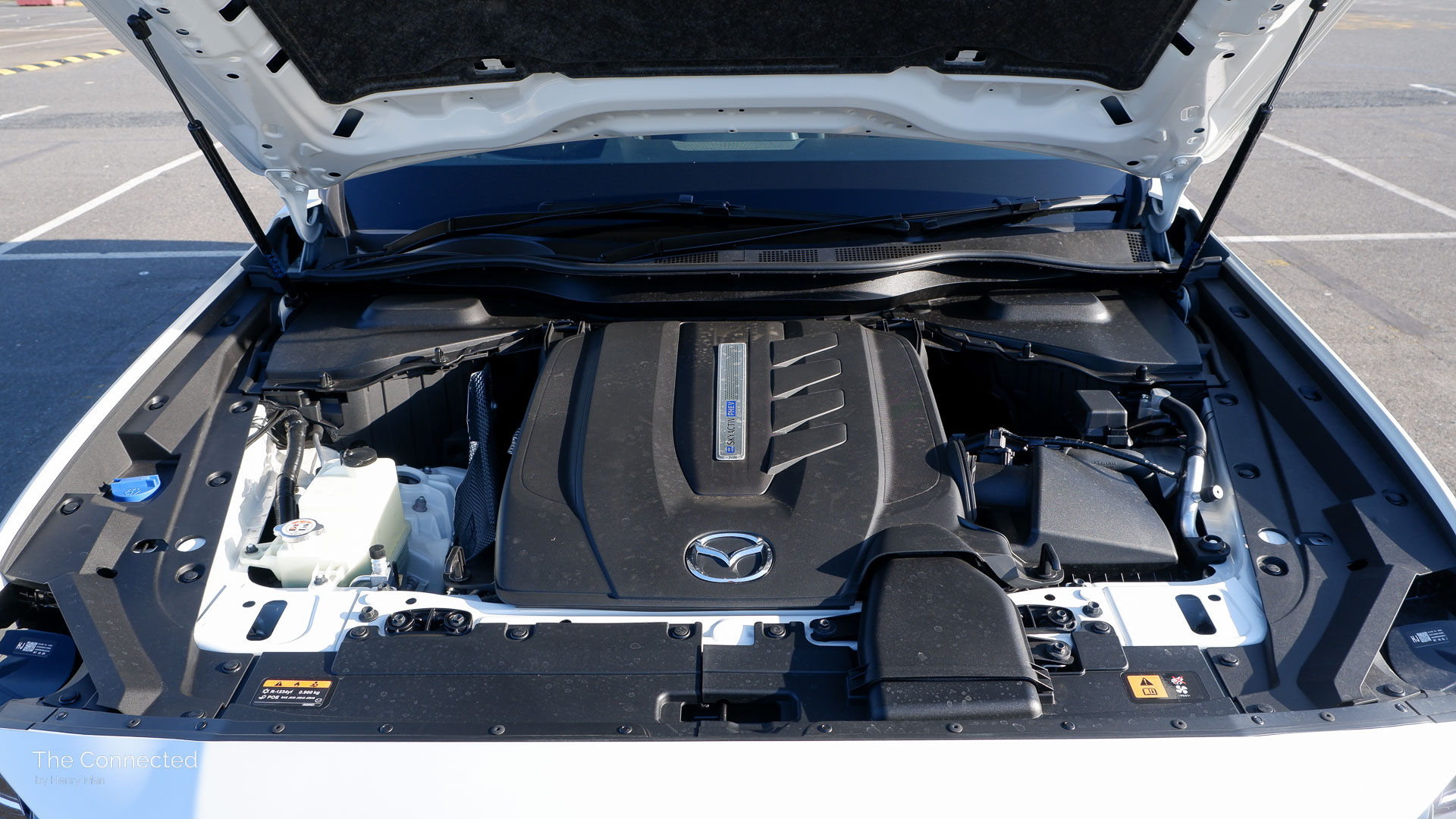
Using a 2.5-litre four-cylinder petrol engine (as on the CX-60 G25) and a single electric motor, the Mazda hybrid SUV provides up to 241kW of power and 500Nm of torque combined, with all-wheel drive.
In practice, there’s plenty of punch with a smooth transition between electric and petrol power while driving.
The engine note sounds great under hard acceleration and sport mode with a low, meaty thrum that sounds very similar to the six-cylinder G40e petrol engine.
However, in EV-only mode, there’s an audible airy whooshing propulsion sound from the electric motor – not heard of in any other hybrid car or EV – and a transmission clunking sound at times.
Gear shifts with the eight-speed automatic are also more noticeable, particularly at low speeds with a subtle jolt that may be great for drivers, but may not suit everyone.
The CX-80 is great around corners with firm handling and minimal body lean from the taught chassis that hides the fact that it’s a three-row SUV really well.
Yet, the compromise is daily driving comfort with the power steering remaining heavy at low speeds – making parking feel more laborious than it needs to – and a firm ride over bumps.
Noise insulation is adequate and not up to premium levels.
The Volkswagen Tiguan and Tayron with its adaptive dampers offer a better balance between driving engagement and comfort.
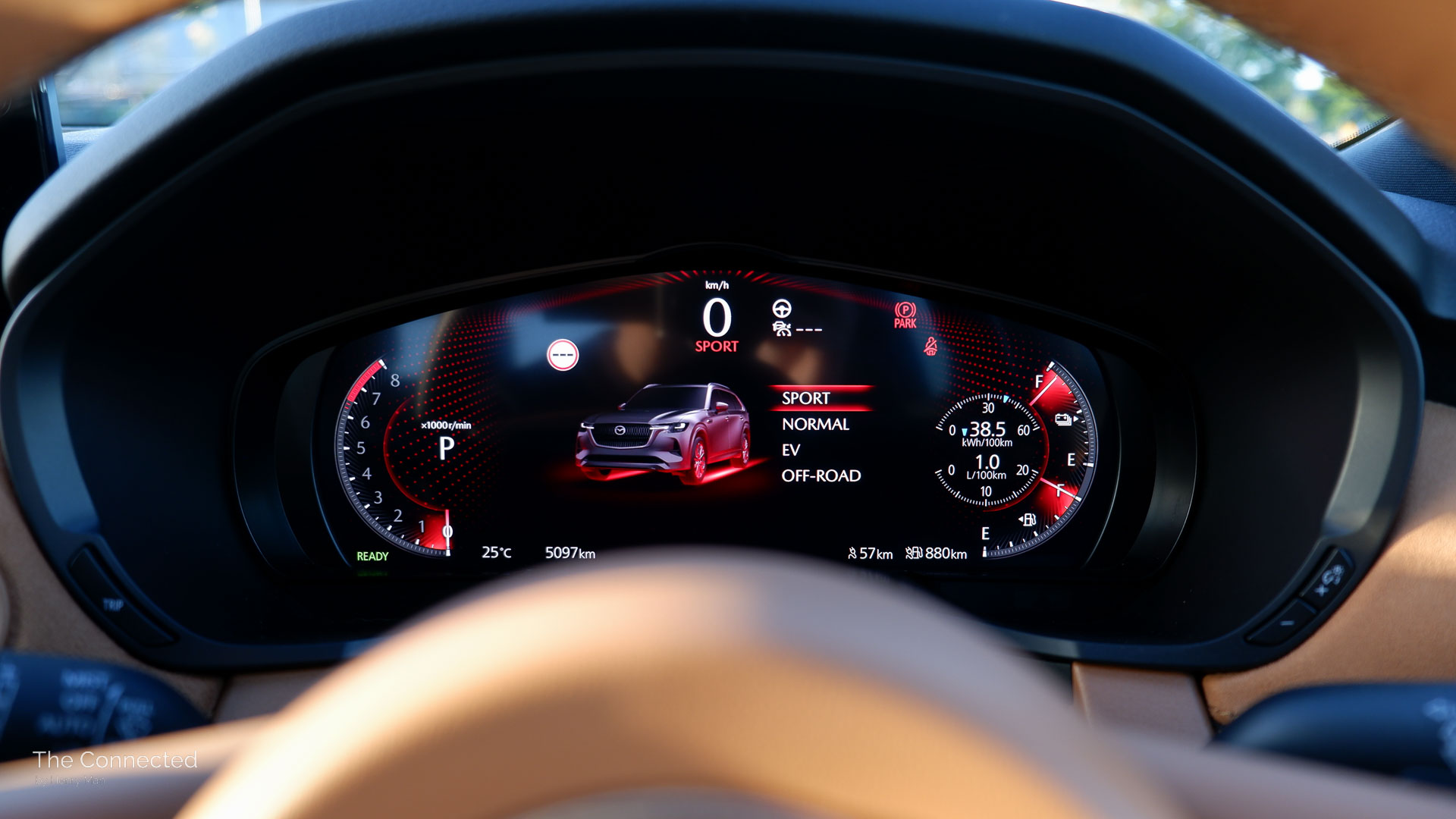
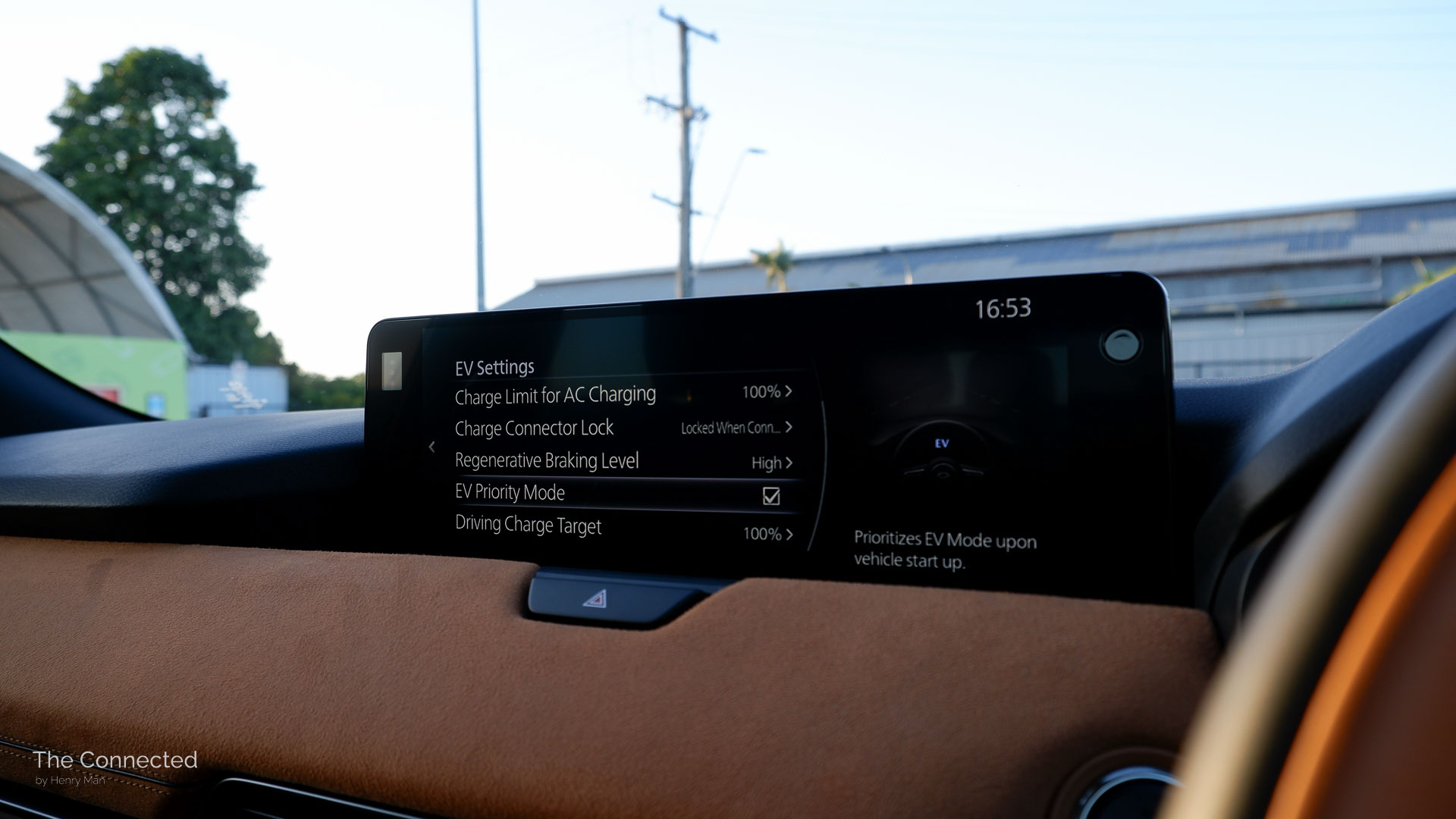
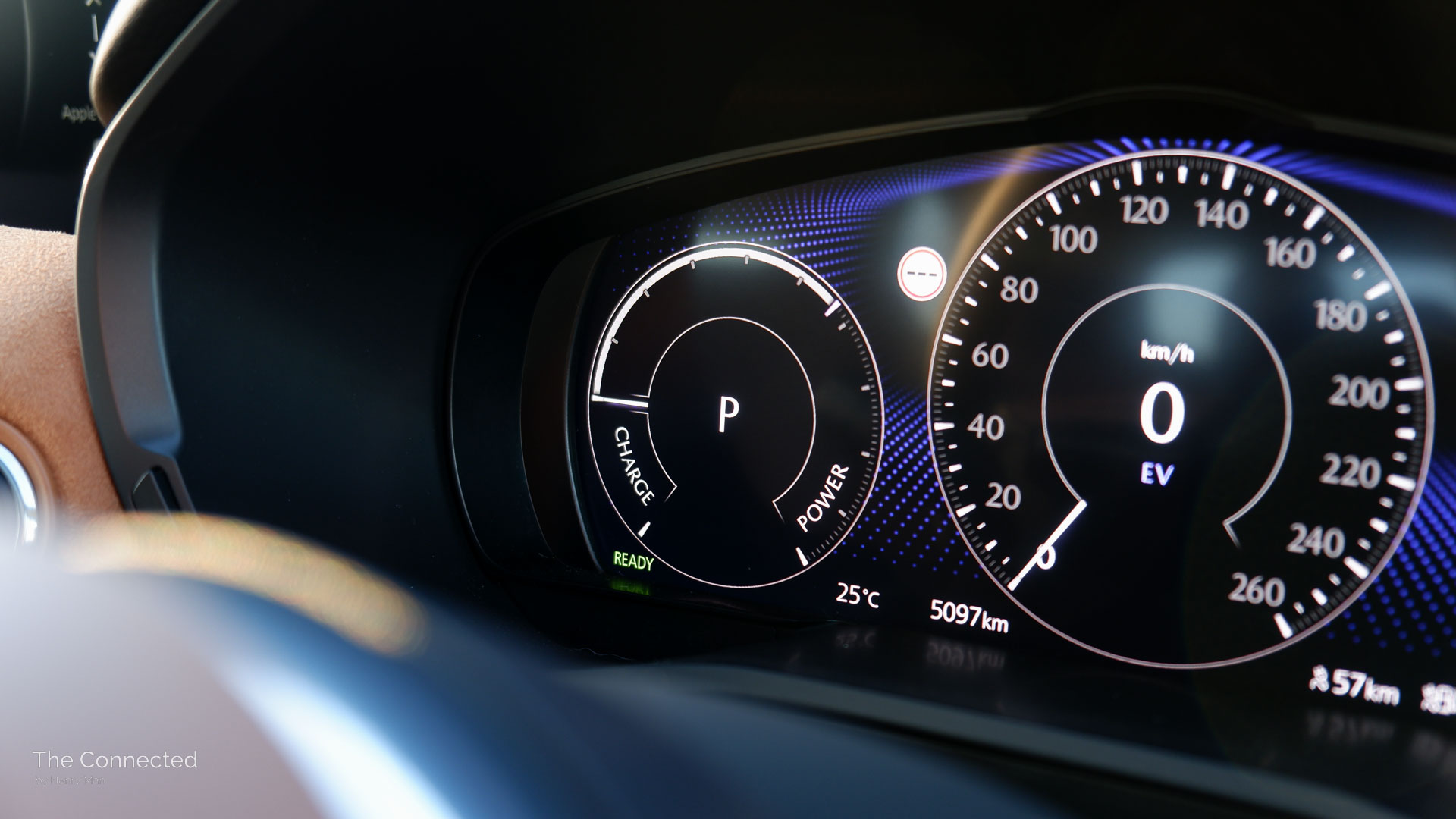
The CX-80 hybrid features three regenerative braking settings adjusted via the infotainment screen, with the highest setting providing a good progressive slow down as you start to lift off the accelerator.
While it doesn’t come to a complete stop (the regen cuts off at around 15km/h), the Mazda SUV has an impressively good blended brake pedal feel that isn’t too stiff nor spongy like many other hybrid cars.
Yet, the short gear shifter requires some learning since drivers must shift it through neutral and reverse in order to get to drive or vice versa back to park.
Besides the questionably Mazda requisite zoomed-in right wing mirror view, the CX-80 has good all-round visibility with a high seating position.
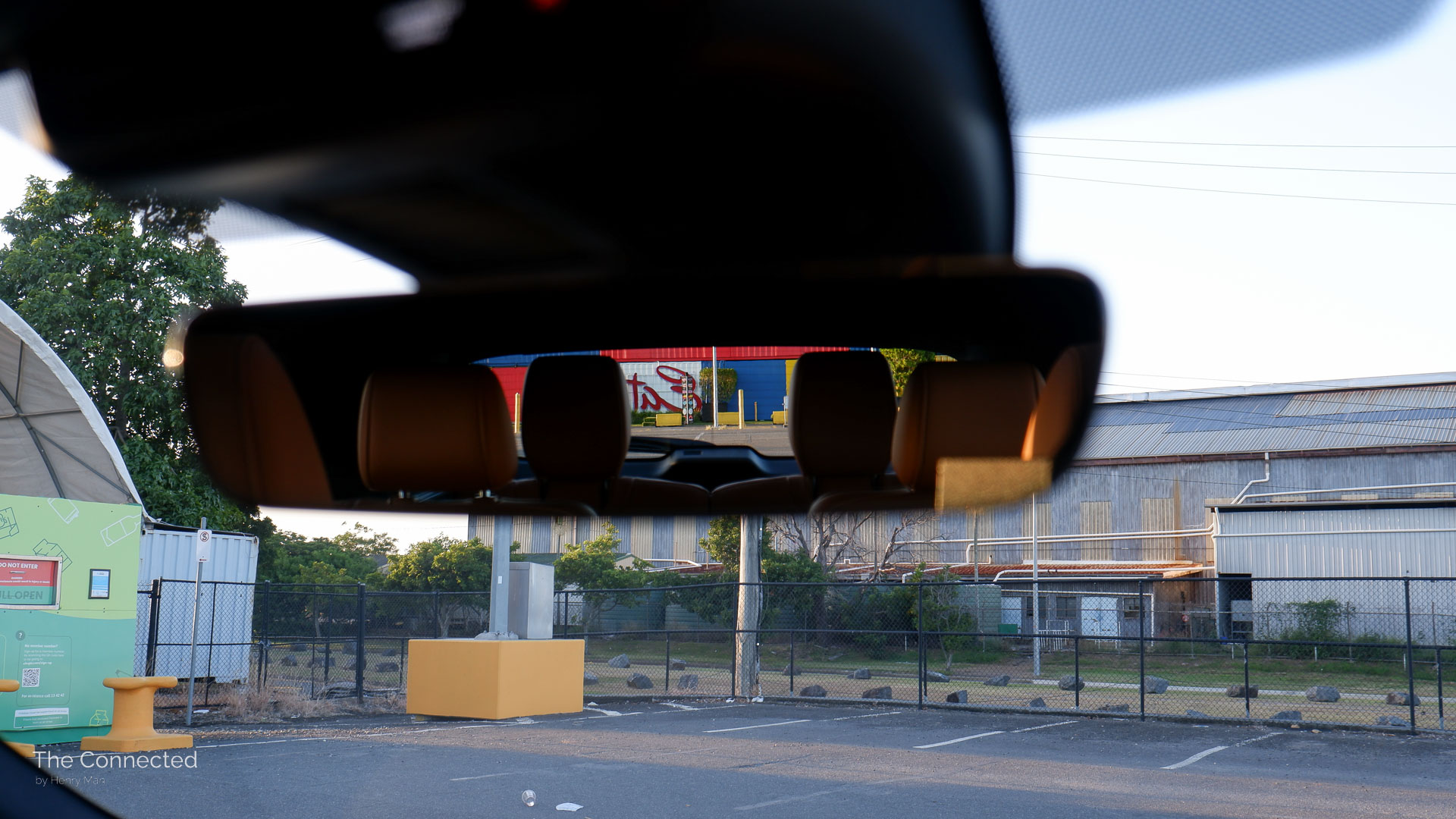
It would be great if it also had the option of a digital rear-view mirror camera accessory as per the related CX-60 and CX-90 since the prominent third-row headrests and passengers can obscure the rear view when in use.
Warranty and servicing.
2026 Mazda CX-80 P50e Azami SP capped-price servicing costs:
| 1 year/15,000km | 2 years/30,000km | 3 years/45,000km | 4 years/60,000km | 5 years/75,000km |
| $449 | $653 | $562 | $653 | $449 |
The 2026 Mazda CX-80 PHEV is backed by a five-year, unlimited kilometre vehicle warranty and an eight-year/160,000km battery warranty.
Servicing is required every one year/15,000km (whichever occurs first) with costs fixed for up to seven years/105,000km.
After the first five years/75,000km, expect to pay $2766 in total to maintain the CX-80 plug-in hybrid.
Up to five years of roadside assistance is included, while three years of Mazda Connected Services are standard.
The CX-80 PHEV does not have a spare tyre with a patch-up goo kit included instead.
Price and rivals.
2026 Mazda CX-80 model range pricing (accurate as at the time of publication):
| Pure | Touring | GT | Azami |
| From $56,100 before on-road costs | From $63,100 before on-road costs | From $70,100 before on-road costs | From $75,300 before on-road costs |
The 2026 Mazda CX-80 is priced from $56,100 before on-road costs in Australia.
Three powertrains are offered – petrol mild-hybrid (G40e), diesel mild-hybrid (D50e), and petrol plug-in hybrid (P50e).
Petrol and diesel powertrains are identically priced, while opting for Mazda’s PHEV carries a $5000 premium and can be selected on three grades only – Touring, GT and Azami.
Despite generous price discounts since its 2024 debut, particularly on the PHEV, it still remains an expensive option especially when compared to Chinese rivals, while the Volkswagen Tayron eHybrid provides more than double EV-only range.
The flagship Mazda CX-80 Azami has the option of the SP Package – a six-seat configuration with a second-row centre console and tan suede and Nappa leather design (as tested) for an extra $5000.
Most exterior colours are free, but signature paint – including Rhodium White Metallic as pictured – are $995.
The Mazda CX-80 PHEV directly rivals the following three-row hybrid family SUVs:
- Volkswagen Tayron eHybrid
- Hyundai Santa Fe Hybrid (full review)
- Kia Sorento PHEV (full review)
- BYD Sealion 8
- Chery Tiggo 9
- Mitsubishi Outlander PHEV
Other alternatives to the CX-80 PHEV include:
- Mazda CX-90 (full review)
- Hyundai Palisade Hybrid (full review)
- Tesla Model Y L
- Peugeot 5008 Hybrid
- Mercedes-Benz EQB
- Volvo XC90
Would I pick the 2026 Mazda CX-80 P50e Azami SP?
The Mazda CX-80 PHEV isn’t the most practical, efficient nor affordable three-row family SUV – yet there are positives that make it still worth considering.
The plug-in hybrid CX-80 is now more attractively priced, it’s great to drive, the interior is stunning with the optional SP Package, the technology is refreshingly non-intrusive with dependable safety assists, and is a little more versatile than the shorter wheelbase five-seat CX-60.
However, around $90K drive-away on the flagship Azami SP spec as tested, it’s still expensive when other rivals offer double the claimed EV-only range for tens of thousands less.
The CX-80 PHEV has a strangely loud EV motor propulsion sound with transmission clunking at times, the firmer ride and steering can feel tedious, Mazda’s requisite flat right wing mirror is difficult to drive with, there are some non-luxurious interior quality signs, and the third row is tight.
I’d pick the Touring P50e, the cheapest entry into a hybrid CX-80, which is a more sensible value choice at about $70K on the road.
The CX-80 is made up of tradeoffs. It’s not big enough as a full-time three-row family car, it doesn’t provide much EV-only range, and it’s still not affordable despite significant discounts.
But it’s a SUV that’s genuinely rewarding to drive with an upmarket feel and no flashy badge. It slots in the Mazda SUV line-up as a not-too-big, not-too-small sweet spot option for those who can’t decide between the CX-60 and CX-90.
Photographs by Henry Man
READ MORE: 2024 Mazda CX-90 review
READ MORE: 2026 Hyundai Palisade Hybrid review
READ MORE: 2026 Geely Starray EM-i PHEV review
Pros:
- Discounted pricing
- Great to drive
- Good brake pedal feel for a hybrid
- Eye-catching interior
- Non-overbearing tech with buttons
Cons:
- Loud EV motor, clunky transmission at times
- Firm ride and steering, zoomed-in mirror
- Third row shouldn’t be regularly used
- Still expensive
- Rivals offer much more EV-only range
About the Author.
Henry Man is an independent content producer passionate about the intersection of technology and transportation.
The former automotive journalist is focused on producing critically-detailed vehicle reviews, and unique short-form content. Learn more.


